How many degrees is 1 radian? Why SIN(30) returns -0.988, plus mils and right ascension
One radian is about 57.2958°, and 30° is 0.523598775598 rad. Excel's SIN(30) and JavaScript's Math.sin(30) return -0.988 because they take the argument in radians, not degrees. This walkthrough converts between degrees and radians with an angle unit converter, shows why a scope's mrad and the NATO mil (6400 per circle) differ by about 1.8%, and turns a right ascension of 5h 30m into 82.5°.
Contents
Type =SIN(30) into Excel and you get -0.988031624, not 0.5. JavaScript’s Math.sin(30) and Python’s math.sin(30) agree: -0.98803…. Nothing is broken. These functions take angles in radians, so they read 30 as “30 radians”, not “30 degrees”. Thirty radians is about 1718.9°, which is four full turns of 360° plus roughly another 278.9°. The sine at that position happens to be -0.988.
Degrees and radians are not the only angle units in use. Rifle scope reticles are marked in mils or MOA, and star charts write right ascension as a time, such as “5h 30m”. All of these measure angles, but each unit has a different size.
The World Angle and Measurement Units Converter converts 33 units at once: radians, degrees, arcminutes and arcseconds, gradians (gon), several military mil systems, hours of right ascension, compass points and more. Type a number into any field and every other field is rewritten. Each row lists the definition used and its source. The calculation runs inside your browser, and the numbers you enter are not sent anywhere.
Below, I first check how degrees and radians relate, then do the conversion in the tool, and finally work through mils and right ascension.
One radian is the angle whose arc equals the radius
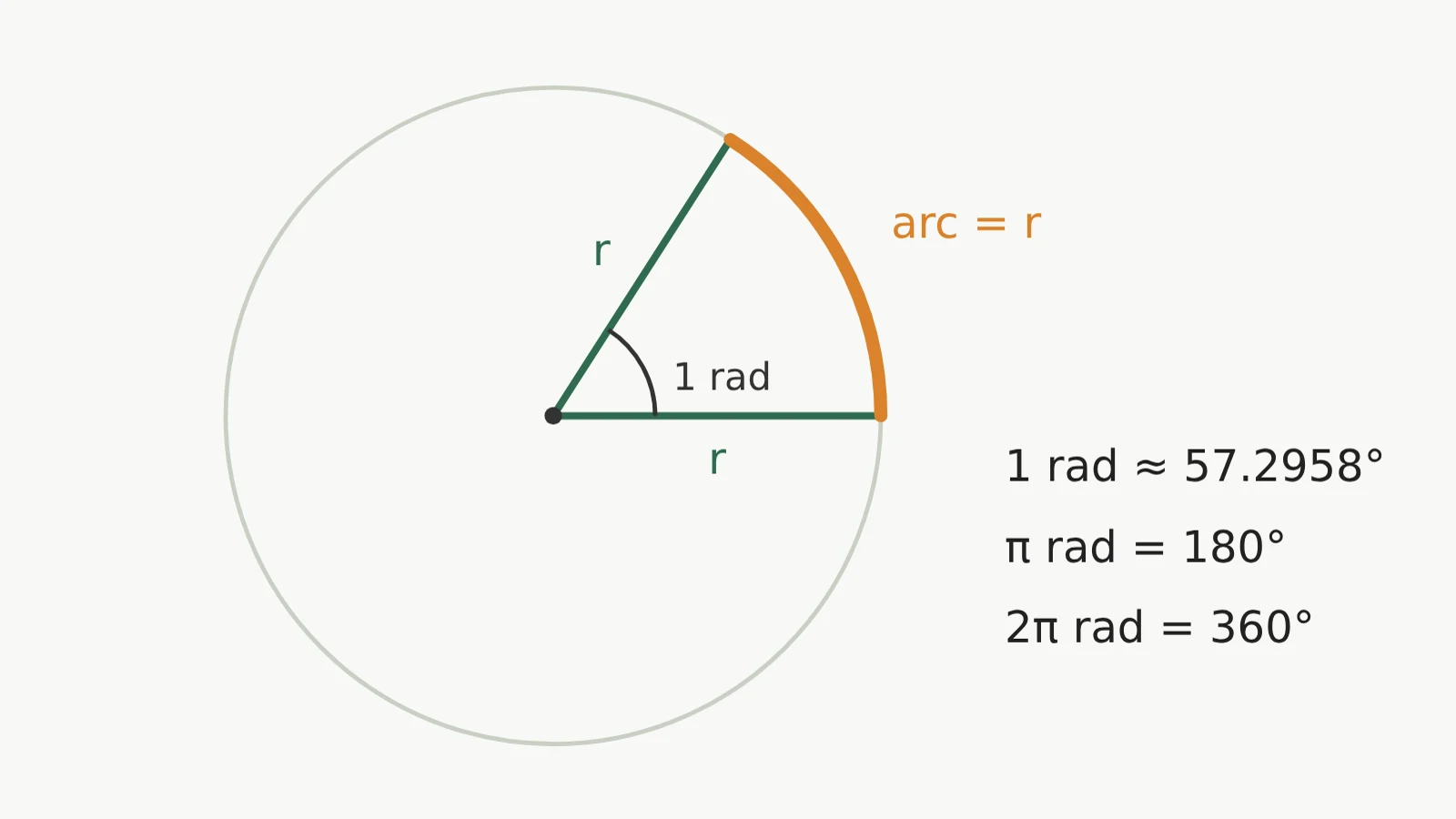
A degree is defined by convention as one 360th of a full turn. A radian, by contrast, comes from the geometry of the circle: one radian is the central angle that cuts off an arc as long as the radius (BIPM SI Brochure). As in the cover image, on a circle of radius r, the angle whose arc is also exactly r is 1 rad.
The circumference is 2πr, so a full turn holds 2π arcs of radius length. A full turn is therefore 2π rad, which equals 360°. That gives these relations:
- 180° = π rad
- 1 rad = 180° ÷ π ≈ 57.29577951°
- 1° = π ÷ 180 rad ≈ 0.01745329252 rad
To turn degrees into radians, multiply by π/180; to turn radians into degrees, multiply by 180/π. That is all the formula there is, but because π is an endless decimal, even a round angle such as 30° never ends when written in radians. That is why maths textbooks write 30° as “π/6”.
When programs and spreadsheets handle angles, radians are usually the base unit. With radians, formulas need no extra constants: arc length is “radius × angle (rad)”, and speed is “radius × angular velocity (rad/s)”. The derivatives of the trigonometric functions take simple forms such as “the derivative of sin is cos” only when angles are measured in radians.
Converting 30° to radians
Start by turning a value in degrees into radians.
- Open the World Angle and Measurement Units Converter. It starts from 1 rad, so the degree field at the top shows 57.2957795131.
- Type
30into the degree field pinned at the top of the page. - The radian field to its left changes to 0.523598775598.
- Type
milliradianinto Search units, regions and descriptions. Only the milliradian row remains, showing 523.598775598 mrad.
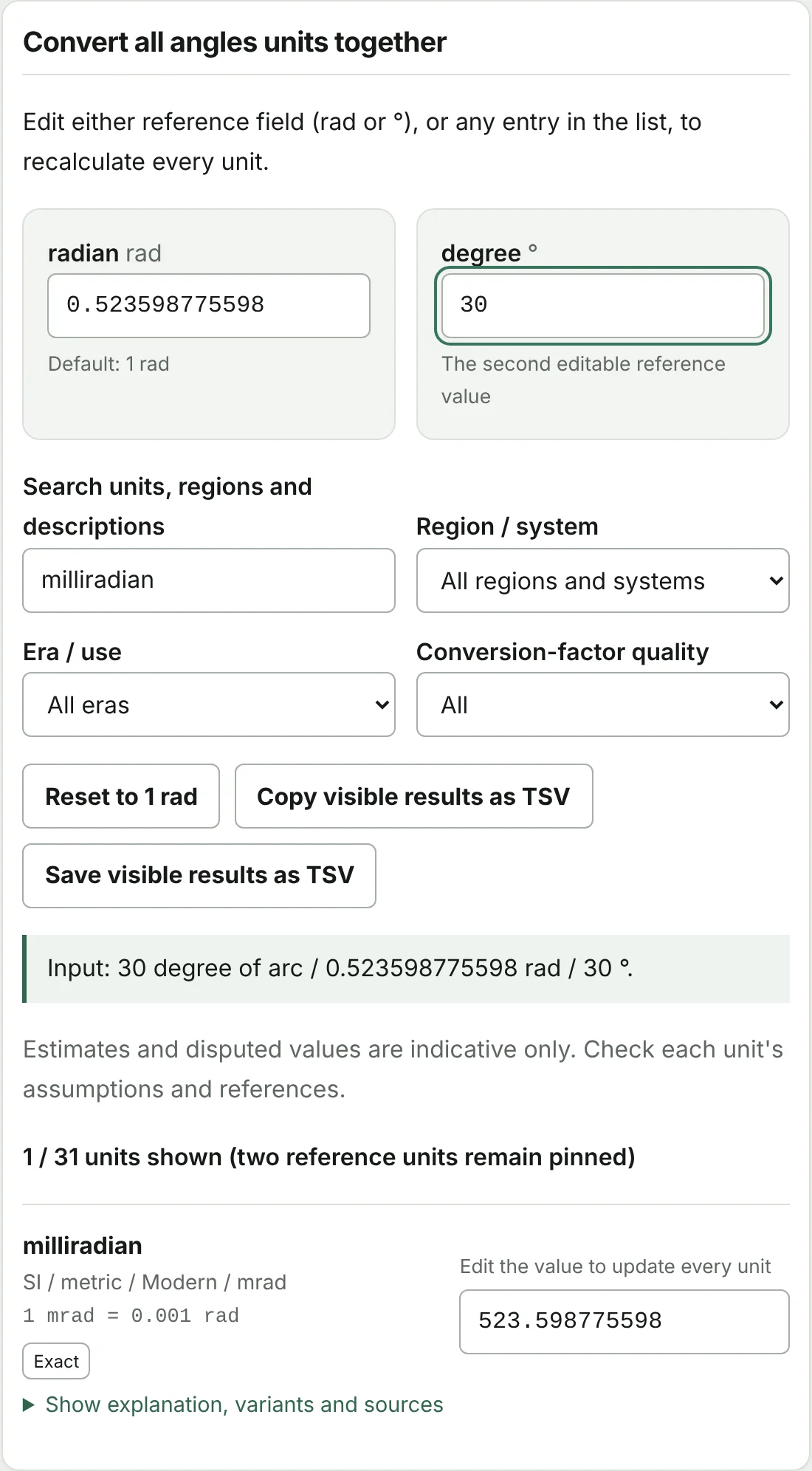
0.5235987756 is π ÷ 6 written as a decimal, matching the textbook “30° = π/6”. The tool normally rounds results to 12 significant digits, so any conversion involving π is a finite-precision approximation. Both top fields accept input: type 1 into the radian field and the degree field shows 57.2957795131.
Converting common angles with the tool’s factors gives the following.
| Degrees | Radians (in π) | Radians (decimal) |
|---|---|---|
| 1° | π/180 | 0.0174532925 |
| 30° | π/6 | 0.5235987756 |
| 45° | π/4 | 0.7853981634 |
| 60° | π/3 | 1.0471975512 |
| 90° | π/2 | 1.5707963268 |
| 180° | π | 3.1415926536 |
| 360° | 2π | 6.2831853072 |
The list also has rows for a full turn, half turn and quarter turn; 30° shows as 0.0833 of a full turn (1/12 of a circle). The gradian, or gon, used in surveying is in the same list. It divides a full turn into 400 gon, so 30° is 33.3333333333 gon.
Working in degrees in Excel or code
To have =SIN(30) from the opening treated as 30 degrees, convert the argument to radians before passing it in. Excel has RADIANS, which turns degrees into radians, and DEGREES, which does the reverse.
Excel       =SIN(RADIANS(30))          → 0.5
            =DEGREES(ASIN(0.5))        → 30
JavaScript  Math.sin(30 * Math.PI / 180)   → 0.49999999999999994
Python      math.sin(math.radians(30))     → 0.49999999999999994
JavaScript and Python do not return exactly 0.5 because π/6 is stored as a finite-precision floating-point number. Round the result for display and you get 0.5. Going the other way, Math.asin and Math.atan2 also return radians, so multiply by 180/π before showing the result as an angle in degrees.
A scope’s mil and the NATO mil differ by about 1.8%
Reticles in rifle scopes and binoculars carry a scale marked “mil”. In most cases this is the milliradian (mrad, 1/1000 rad), which spans 10 cm at 100 m. Since arc length is “radius × radians”, 100 m × 0.001 = 0.1 m. At 300 m, 1 mrad spans 30 cm.
The “mil” used by artillery and on military compasses, however, is a fixed fraction of a full turn, and the division differs by country and period. NATO and the US military use 6400 mils per circle; the Soviet Union used 6000. A full turn is 2π ≈ 6283.2 mrad, so neither matches the milliradian.
- Type
0.001into the radian field, or1into the milliradian row in the list. - Type
NATOinto the search box. The list narrows to three rows: milliradian, NATO artillery mil (6400 per circle) and Soviet artillery mil (6000 per circle). The milliradian and Soviet mil rows appear too because their descriptions mention how they differ from the NATO mil. - The NATO artillery mil field shows 1.01859163579 and the Soviet artillery mil field shows 0.954929658551.
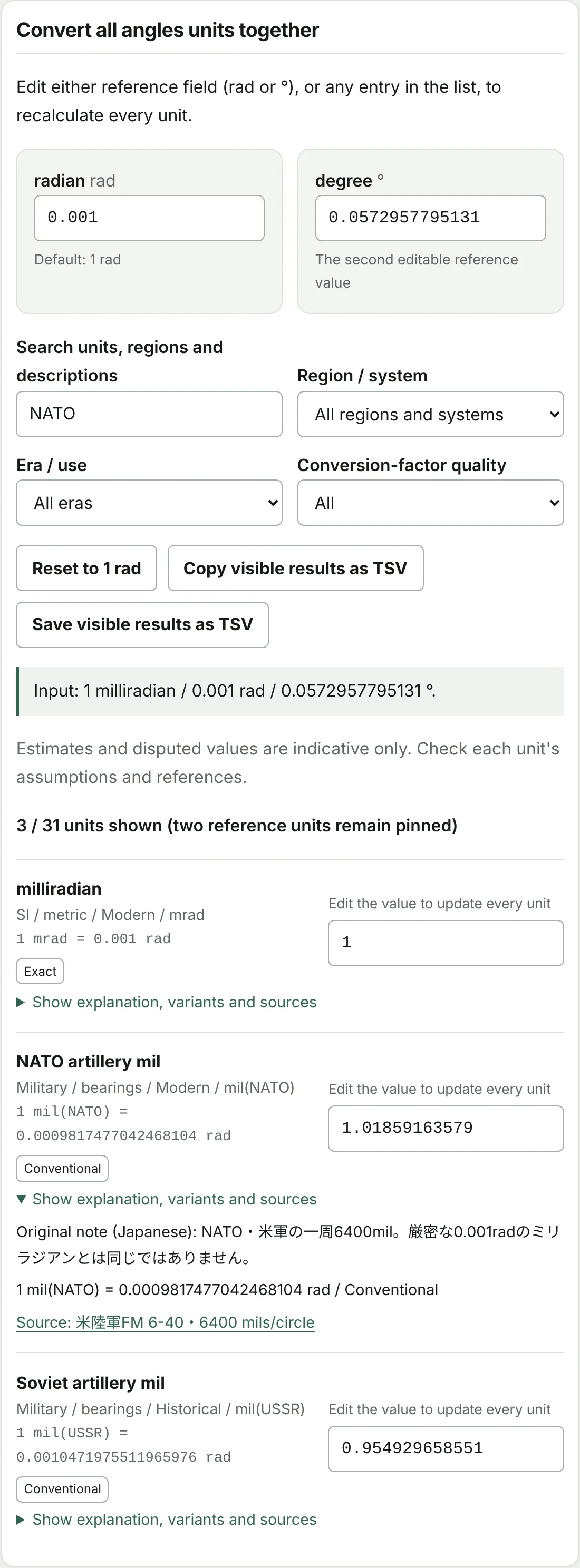
1 mrad is 1.0186 NATO mils, so the NATO mil is about 1.8% smaller. At 100 m, 1 mrad spans 10 cm while 1 NATO mil spans about 9.82 cm. The Soviet mil goes the other way and is about 4.7% larger than a milliradian. The tool also lists the 6300-per-circle mil used in Sweden during the Cold War and a 6200-per-circle system as separate rows. When a document just says “mil”, check which division it means first; otherwise your range estimate will be off by that difference.
The other common scope unit, MOA (minute of angle), is one minute of arc, or 1/60°, which is the arcminute row in the tool. 1 MOA is about 0.2909 mrad, or about 2.9 cm at 100 m, and 1 mrad is about 3.44 MOA. American shooters also use “MOA” loosely for the angle that spans 1 inch at 100 yards. That is about 0.2778 mrad, roughly 4.5% smaller than a true arcminute, and it is not included in this tool, so check which meaning a scope’s specification uses before converting.
A right ascension of 5h 30m is 82.5°
Right ascension, which gives a celestial object’s position, is written in hours, minutes and seconds, such as “5h 30m”. It is not a time of day but an angle: the celestial sphere is divided into 24 hours around, so one hour of right ascension is 360° ÷ 24 = 15°. One minute of right ascension is 0.25°, and one second is 15 arcseconds.
- Type
right ascensioninto the search box. Three rows appear: hour of right ascension, minute of right ascension and second of right ascension. - Type
5.5into the hour of right ascension field. 5h 30m is 5.5 hours, so enter the minutes as a decimal fraction of an hour (minutes ÷ 60). - The degree field changes to 82.5 and the radian field to 1.4398966329. The same angle is 330 minutes or 19,800 seconds of right ascension.
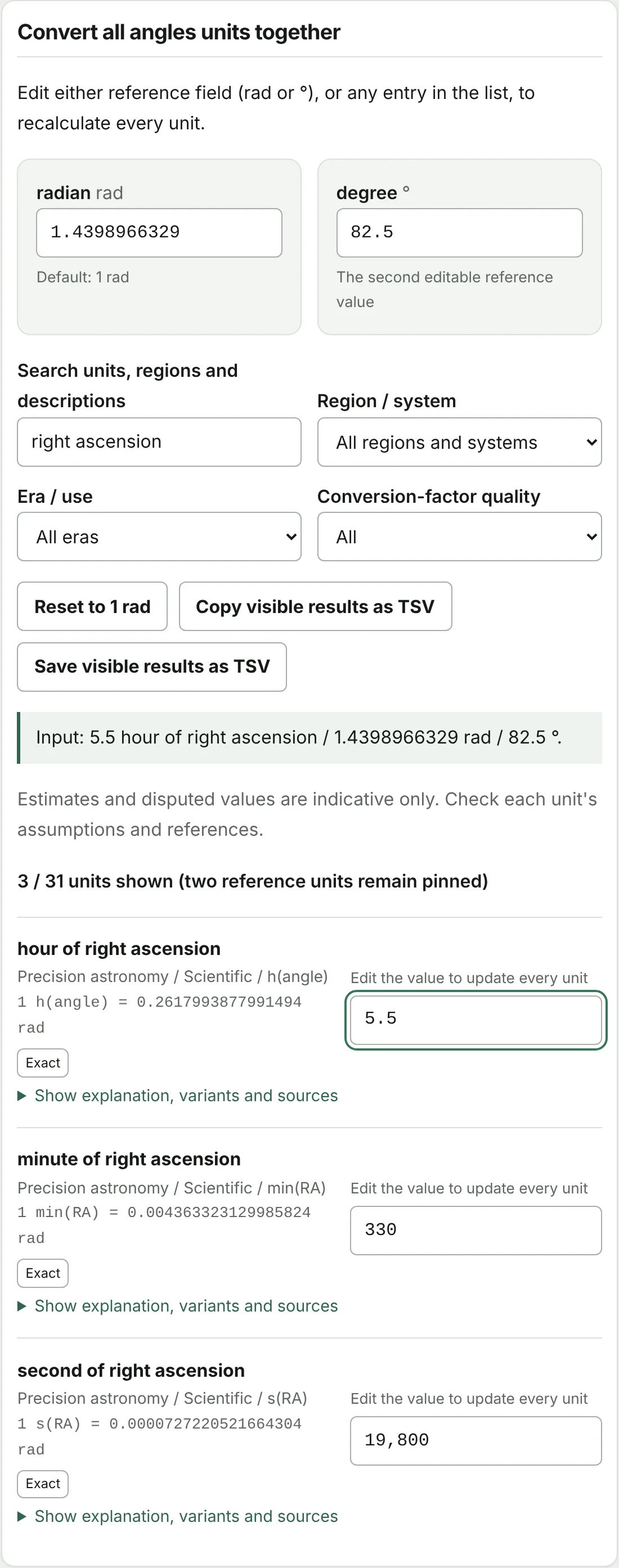
The tool does not parse mixed notation such as “5h30m”, which is why the hours were entered as a decimal here. If the value includes seconds, convert everything into one unit — hours, minutes or seconds — before entering it. For 5h 30m 30s, for example, enter 5 × 3600 + 30 × 60 + 30 = 19,830 in the second of right ascension field and you get 82.625°. Declination is already written in degrees, minutes and seconds, so it needs no such conversion.
Keeping results with their sources
To move converted values into a spreadsheet or a document, use Save visible results as TSV. The rows currently shown by the search filter, plus the radian and degree rows pinned at the top, go into a tab-separated file together with the converted value, factor, description and source URL. Copy visible results as TSV puts the same content on the clipboard. To keep a mil comparison, save while the search box still contains NATO or mil, and all the mil systems are recorded together.
The number fields accept only zero or positive values; a negative number such as -30 is shown as “Not calculable”. For angles that use a sign to distinguish clockwise from counterclockwise, convert the absolute value and put the sign back afterwards. Exponential notation such as 1e-6 works too, which lets the same screen handle the tiny milliarcsecond and microarcsecond angles used in astronomy. Inputs with more than 15 significant digits, or values that overflow, are shown as “Not calculable”.
Related tools and articles
Angles are closely tied to rotational speed. “How many hertz is 1,800 rpm? Convert shaft speed to Hz and rad/s” explains how to turn revolutions per minute into Hz and rad/s with the World Frequency and Rotational Rate Units Converter. For surveying and map distances, use the World Length and Distance Units Converter; for reading documents in US customary or imperial units, see “From yards to metres and Japanese shaku: convert 122 units of length”. Power units from foreign documents are covered in “How Many kW Is 150 PS?”, and speeds in knots and mph in “How fast is 20 knots? Convert to km/h and mph”.