How Many mL Is 1 Cup in an American Recipe? 236.6 mL, Not a 250 mL Metric Cup or Japan's 200 mL Cup
The cup in US recipes is the US customary cup, about 236.6 mL. Measured with a Japanese 200 mL cup it is about 1.18 cups, and with a 250 mL metric cup about 0.95. Using the volume converter, this guide compares the 240 mL nutrition-label cup, the 250 mL metric cup and the 180 mL rice-cooker cup, converts tbsp, tsp, fl oz and US vs imperial pints and gallons, and explains why a cup of flour cannot be converted to grams without a density.
Contents
Open an American recipe site for cookies or pancakes and the ingredients read “1 cup milk” and “2 tbsp sugar”. Most kitchens have a measuring cup and measuring spoons, so it seems you can simply measure with whatever is in the drawer. The catch is that “a cup” is not the same everywhere. A US cup is about 237 mL, the metric cup used in Australia, New Zealand, Canada and many other countries holds 250 mL, and the standard measuring cup in Japan, where this site is based, holds only 200 mL. Fill a Japanese cup once for “1 cup milk” and you are almost 20% short, which is enough to make a batter stiff or change how a cake bakes.
The World Volume and Capacity Units Converter converts 131 units at once, from litres and millilitres to US and imperial liquid measures, cooking cups and spoons, and Japanese units such as the gō and shō. Type a number into any field and every other field updates. The calculation runs in your browser, and the numbers you enter are not sent anywhere.
This article walks through the conversions you need when cooking from a US recipe with a different set of measures, checking each step in the tool. The comparisons use the Japanese 200 mL cup, 15 mL tablespoon and 180 mL rice-cooker cup, because that is where the original article was written, but the same steps work for a 250 mL metric cup or any other cup whose millilitre size you know.
There are at least five different “cups”
Before converting anything, it helps to sort out which volumes are called a cup. The same word means different amounts depending on the country and the purpose.
The cup in American recipes is the US customary cup from US customary units. It is 1/16 of a US liquid gallon, or 8 US fluid ounces. Because the gallon is defined in cubic inches and the inch is defined in metres, the millilitre value is exact: 1 cup = 236.5882365 mL (NIST, Metric Kitchen Cooking Equivalencies).
Separately, the US Food and Drug Administration (FDA) specifies how household measures are converted to metric on nutrition labels, and there 1 cup = 240 mL (FDA, Guidelines for Determining Metric Equivalents of Household Measures). “Serving size 1 cup (240mL)” on a food package uses this value.
Many countries use a 250 mL metric cup instead. Recipes from Australia, New Zealand and Canada are written with it, and when modern British recipes give cups at all, they usually mean 250 mL too. In Japan, the measuring cup used in cooking is 200 mL, with a 15 mL tablespoon (ōsaji) and a 5 mL teaspoon (kosaji) (City of Hiroshima, weight conversion table for seasonings by measuring cup and spoon, in Japanese). As the same document notes, rice is measured with a different cup: one 180 mL cup is one gō.
| Name | Volume of one cup | Where it is used |
|---|---|---|
| US customary cup | 236.5882365 mL | US recipes and cookbooks |
| FDA labelled cup | 240 mL | US nutrition labels |
| Metric cup | 250 mL | Recipes from countries that define 1 cup as 250 mL, such as Australia, New Zealand and Canada |
| Japanese measuring cup | 200 mL | Japanese recipes and cookbooks |
| Rice-cooker cup | 180 mL | Measuring rice in Japan |
The tool has no row for the Japanese 200 mL measuring cup, but 200 mL can be expressed by entering 0.2 in the litre field. A later section uses this to find how many Japanese cups a US cup equals.
Converting 1 cup to mL
First, check how many millilitres “1 cup” in a recipe is.
- Open the World Volume and Capacity Units Converter. It starts with values based on 1 L.
- Type
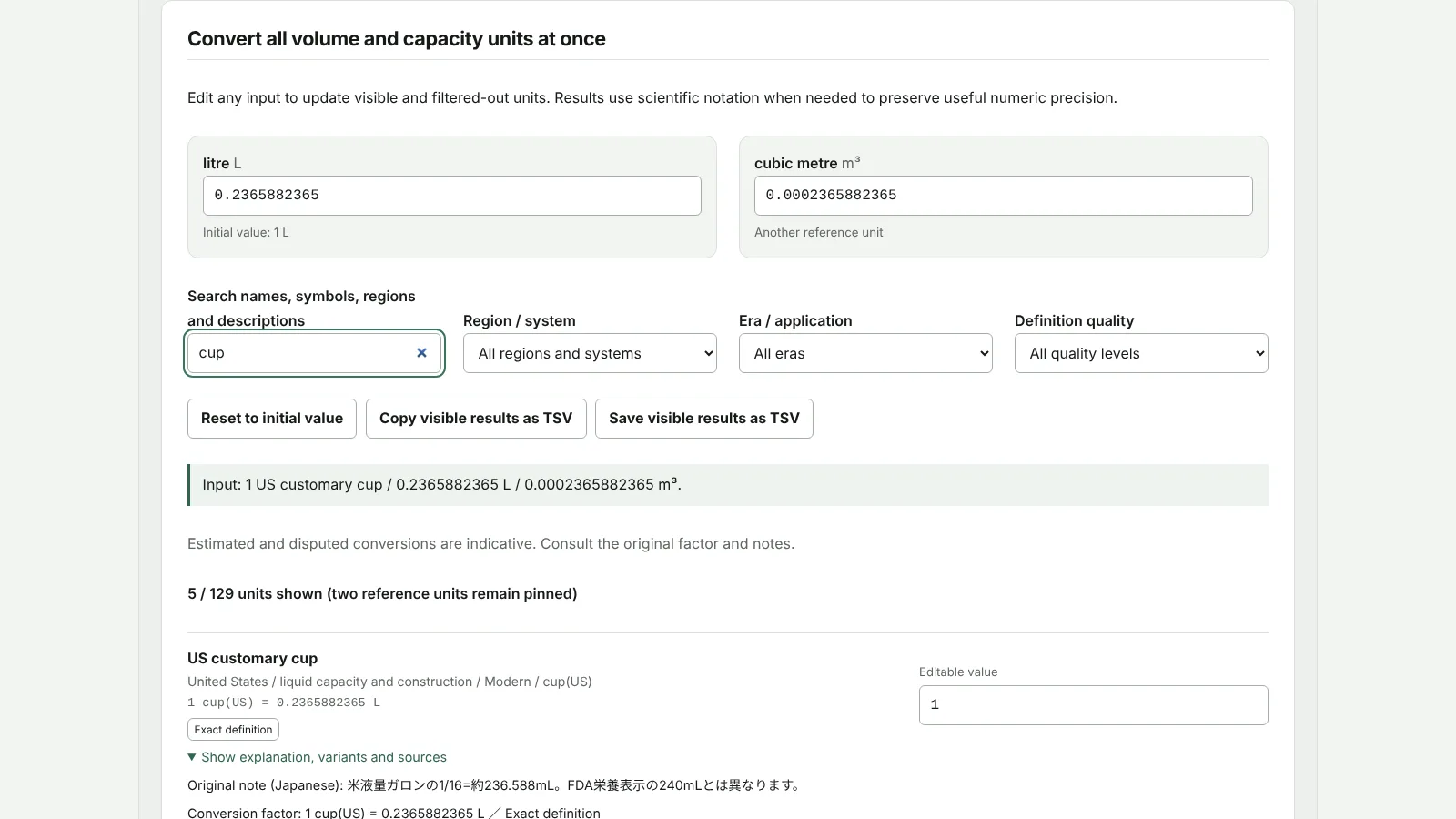
cupinto Search names, symbols, regions and descriptions. The list narrows to five rows: US customary cup, Japanese rice cup, FDA labelled cup, metric cup 250mL and half metric cup. - Enter
1in the US customary cup field. - The litre field pinned at the top of the page changes to 0.2365882365.
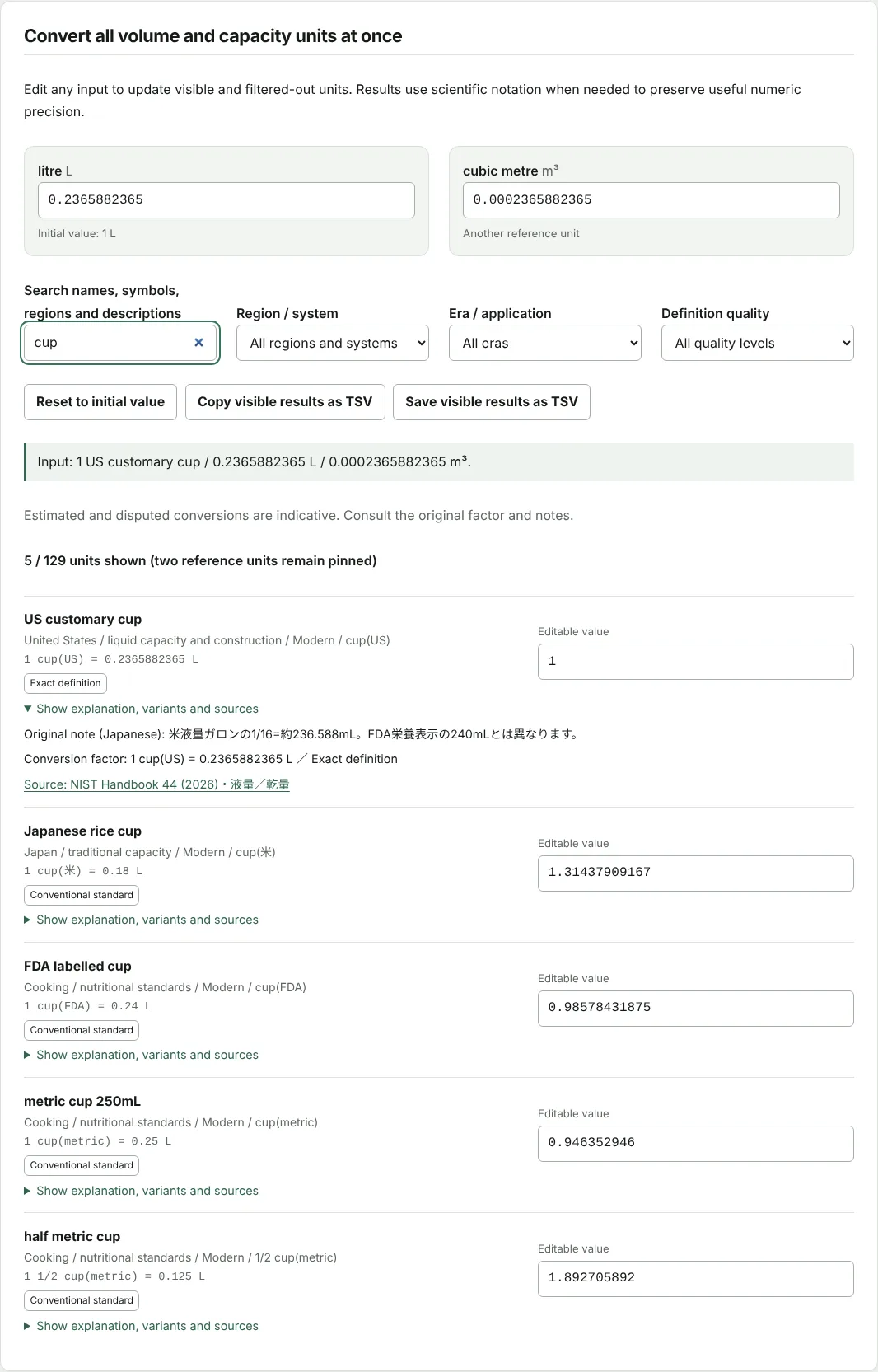
0.2365882365 L is 236.5882365 mL, or about 236.6 mL. To see the value in millilitres directly, change the search to millilitre. The converted value is kept even though the visible rows change, and the millilitre row shows 236.5882365.
The other rows on the same screen show how many of each other cup one US cup equals. It is 0.986 of an FDA cup and 0.946 of a 250 mL metric cup, both slightly less than one. If your recipes and measuring cup are metric, one US cup is a metric cup minus about 13 mL, a little less than one tablespoon. Opening Show explanation, variants and sources under the US customary cup row shows that the cup is 1/16 of a US liquid gallon and differs from the FDA’s 240 mL, along with the source link. In the English version the note itself appears in the original Japanese, but you can still confirm the factor used and the source.
Recipes often use fractions such as “1/2 cup” or “1/3 cup”. The number fields do not accept fractions, so enter them as decimals, for example 0.5. Using the tool’s factor, the common amounts are:
| Recipe amount | mL |
|---|---|
| 1 cup | 236.6 |
| 3/4 cup | 177.4 |
| 2/3 cup | 157.7 |
| 1/2 cup | 118.3 |
| 1/3 cup | 78.9 |
| 1/4 cup | 59.1 |
How many 200 mL Japanese cups is one US cup?
Knowing that a US cup is 236.6 mL is not enough if your measuring cup only goes up to 200 mL. You still have to decide how many cups plus how many millilitres to measure. Here we go the other way and look at how many US cups one 200 mL Japanese cup is.
- Leave
cupin the search box. - Enter
0.2in the litre field at the top. - US customary cup becomes 0.845350567546. Japanese rice cup shows 1.11111111111, FDA labelled cup 0.833333333333 and metric cup 250mL 0.8.
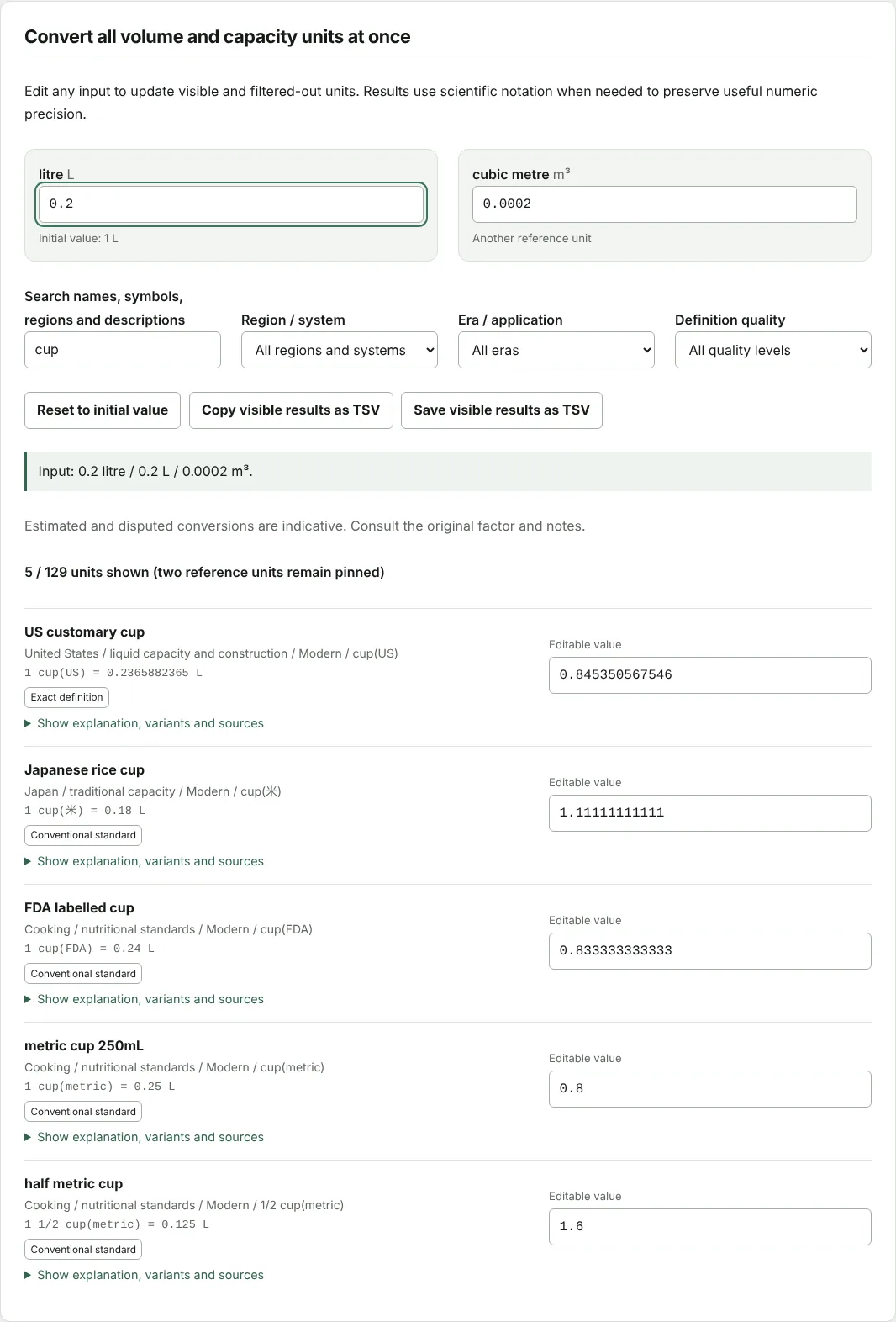
A Japanese cup holds only about 85% of a US cup. Taking the reciprocal, one US cup is about 1.18 Japanese cups. To measure it, fill the Japanese cup once (200 mL) and add about 37 mL more. That is roughly two and a half 15 mL tablespoons.
The difference is 37 mL per cup, but it grows with the quantity. If you measure “3 cups flour” as three Japanese cups, you get 600 mL instead of the intended 709.8 mL, nearly 110 mL short. For ingredients used in large amounts, such as flour or milk, converting to millilitres first is the safer approach.
The reverse applies when you introduce a Japanese recipe in English or only have an American measuring cup. Read “1 cup” in a Japanese recipe as 0.845 US cup. American measuring cups usually have fraction marks such as 1/4, 1/3 and 1/2, so you end up measuring a little more than 3/4 cup. With a 250 mL metric cup, a Japanese cup is exactly 0.8 cup.
Tablespoons and teaspoons nearly match; fluid ounces differ by country
Compared with cups, the differences between tablespoons and teaspoons are small. A US tablespoon (tbsp) is half a US fluid ounce. Enter 1 in the US customary tablespoon field and the litre field shows 0.0147867647812, or about 14.79 mL. A teaspoon (tsp) is one third of a tablespoon, about 4.93 mL. Compared with the 15 mL and 5 mL spoons used in Japan, the UK, New Zealand and Canada, the difference is about 1.4%, which does not matter when measuring with spoons. Type spoon into the search box and enter 2 in US customary tablespoon: US customary teaspoon shows 6 and metric tablespoon shows 1.9715686375, confirming that 2 tbsp is almost exactly two 15 mL tablespoons.
The unit that needs care is the fl oz (fluid ounce) that appears for drinks and liquid ingredients. The fluid ounce differs between the US and the UK. A US fl oz is 1/128 of a US liquid gallon, about 29.57 mL, while an imperial fl oz is 1/20 of an imperial pint, about 28.41 mL.
- Type
ounceinto the search box. Three rows appear: US fluid ounce, imperial fluid ounce and FDA labelled fluid ounce. - Enter
16in the US fluid ounce field. - The litre field becomes 0.473176473, imperial fluid ounce shows 16.6534836926 and FDA labelled fluid ounce 15.7725491.
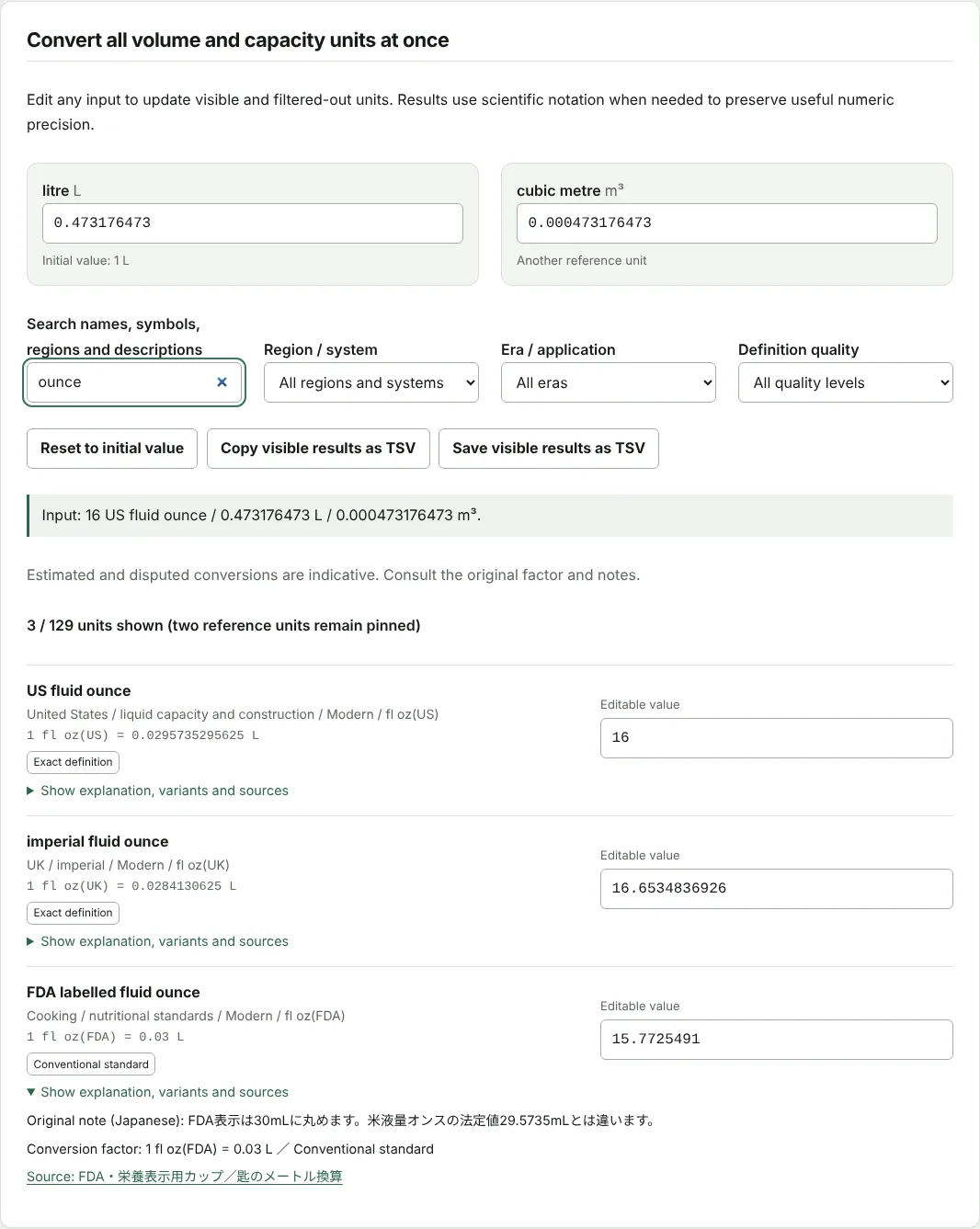
16 US fluid ounces is about 473 mL, the same as 2 cups or 1 US pint. Because FDA nutrition labels round 1 fl oz to 30 mL, the mL figure on a label can differ slightly from the legal conversion. The description of the FDA labelled fluid ounce row states that it is the value rounded to 30 mL for labelling.
Pints and gallons also differ between the US and the UK. Type pint into the search box and enter 1 for imperial pint: the litre field shows 0.56826125, which is 1.2009499255 US liquid pints. A pint in a British pub is about 568 mL, roughly 20% more than a US pint of about 473 mL. Gallons follow the same pattern: a US liquid gallon is 3.785411784 L and an imperial gallon about 4.546 L. When a British recipe mentions pints or fl oz, make sure you are not converting with US values.
A cup is a volume, not a weight
The other common mix-up when adapting foreign recipes is between units of volume and units of weight.
The oz in “8 oz butter” is usually not a fluid ounce but an avoirdupois ounce of weight: 1 oz = 28.349523125 g. Weight ounces can be converted to grams with the World Mass and Weight Converter — Historical and Regional Standards. Recipes often write fl oz for liquids and oz for solids, but some drop the “fl”, so decide by whether the ingredient is a liquid or a solid.
This tool also cannot tell you how many grams a cup of flour or sugar weighs. As the tool’s description says, converting volume to weight requires the density of the substance, and powders weigh different amounts in the same cup depending on how tightly they are packed. If you want to weigh in grams, use an ingredient weight chart or a recipe that also gives grams. For the Japanese measuring cup and spoons, the City of Hiroshima document cited above lists approximate weights for each seasoning.
The Japanese gō and the rice-cooker cup
The traditional volume unit Japanese people meet most often is the gō, used to measure rice. Type rice into the search box to see the Japanese rice cup (180 mL) row. Typing the kanji 合 shows the Japanese go as well as rows whose description includes 合, such as the Japanese shaku and shō, the Chinese market ge and the Korean hop.
The gō is a unit of the traditional Japanese shakkanhō system, and the tool uses the modern definition of 180.3906837 mL per gō. The rice cup supplied with a rice cooker is 180 mL, so strictly speaking it differs from one gō by about 0.4 mL. The rice cup row’s description mentions this, but for measuring rice the two can be treated as the same. Rice cookers from Japanese makers sold outside Japan usually come with the same 180 mL cup, which is why “1 cup” in a rice cooker manual is about 3/4 of a US cup.
If a recipe says “2 cups rice”, that is about 473 mL in US customary cups, or about 2.6 rice-cooker cups. When measuring rice for an American recipe, do not assume it means two rice-cooker cups. Besides the gō, you can also use the tool to check other traditional volumes such as the shō, to and koku, and how the Chinese and Korean versions of these units differ.
Related tools and articles
Recipes from abroad often give oven temperatures in Fahrenheit as well. To read a temperature such as 350 °F, see “What Is 68 °F in Celsius? Convert Temperature Scales and Save Historical Values as TSV”, which walks through the Temperature Scale Converter — Modern and Historical Units. If pan or baking-sheet sizes are given in inches, “From yards to metres and Japanese shaku: convert 122 units of length” helps, and to convert the psi on imported car or bicycle tires to kPa, see “Converting Tire Pressure from psi to kPa and bar”.