How Many kW Is 150 PS? PS and hp Are Different Units, and 300 hp Is About 304 PS
1 PS is 735.49875 W and 1 hp (mechanical horsepower) is about 745.70 W, so two units both called horsepower differ by about 1.4%. 150 PS is 110.32 kW, and the 300 hp quoted in US specs is 223.71 kW, or about 304 PS. Using a power unit converter, we check the difference between PS, hp, electrical horsepower and boiler horsepower against their sources, see why a 12,000 BTU/h air conditioner is 3.52 kW (one refrigeration ton), and learn how to keep kW and kWh apart.
Contents
Car catalogs for the Japanese market usually state peak engine output in both kW and PS, as in “110 kW (150 PS)”. European spec sheets do much the same with PS or CV. US manufacturers’ websites and English-language road tests, on the other hand, fill the same line with “300 hp”. In Japanese both PS and hp are translated as bariki (馬力, literally “horsepower”), and in English both are casually called horsepower, so it is tempting to compare the numbers directly. They are, however, two separate units of different sizes. If you treat a 300 hp car as “300 horsepower” and line it up against a Japanese car rated at 300 PS, you underestimate it by about 4 horsepower.
The World Power and Output Units Converter converts 29 units at once, including W and kW, PS, mechanical, electrical and boiler horsepower, BTU per hour and the refrigeration ton. Enter a number in any one field and every other field is rewritten. Each row carries the definition it uses and its source, so you can check on the same screen why a value comes out the way it does. The calculation runs in your browser, and the numbers you enter are not sent anywhere.
Below, we work through how to bring the horsepower figures found in catalogs and English-language documents to a common footing in kW, following along in the tool. The screenshots show this English version.
There are at least four units called “one horsepower”
Before converting anything, it helps to sort out how many units go by the name horsepower. All of them are units of power, expressing how much work is done in a given time, but they rest on different definitions.
The PS in Japanese catalogs is metric horsepower, defined as the power needed to lift a weight of 75 kgf by 1 m in one second. Multiplying by standard gravity, 9.80665 m/s², fixes it exactly: 1 PS = 75 × 9.80665 = 735.49875 W. The abbreviation comes from the German Pferdestärke, and in French- and Spanish-speaking countries it is often written CV.
The hp used in the US and UK is imperial (mechanical) horsepower: the power needed to lift 550 pounds by 1 foot in one second, or 550 ft·lbf/s. Because the foot and the pound are themselves defined in metric terms, the conversion to watts is fixed too: 1 hp = 745.6998715822702 W, or about 745.70 W (NIST Guide to SI Appendix B.8).
On top of these, electric motors and other electrical equipment have long used electrical horsepower, which sets one horsepower at 746 W. Boiler horsepower, which describes boiler capacity, is an order of magnitude larger; the tool adopts the conventional value of about 9.8095 kW per boiler horsepower. Old standards differ depending on steam conditions and the like, so the tool also marks it as “Conventional” rather than exact.
| Name | Symbol | W per horsepower | Typical use |
|---|---|---|---|
| Metric horsepower | PS | 735.49875 | Car specifications in Japan and Europe |
| Imperial (mechanical) horsepower | hp | about 745.70 | Cars and engines in the US and UK |
| Electrical horsepower | hp(elec) | 746 | Conversions for electric motors and other electrical equipment |
| Boiler horsepower | boiler hp | about 9,809.5 | Boiler capacity (older notation) |
The ratio of hp to PS is 745.70 ÷ 735.50, about 1.0139. One hp is about 1.4% larger than one PS. Electrical and mechanical horsepower differ by only about 0.3 W per horsepower, which you can ignore when comparing car outputs, but the tool keeps them as separate rows.
Converting 150 PS to kW and hp
First, let’s convert a PS value typical of Japanese-market catalogs into kW and hp.
- Open the World Power and Output Units Converter. It starts with values based on 1 W.
- Type
horsepowerinto Search units, regions and descriptions. The list narrows to five rows: mechanical horsepower, electrical horsepower, metric horsepower, kilogram-force metre per second, and boiler horsepower. - Enter
150in the metric horsepower field. This is the PS row. - The kilowatt field pinned at the top changes to 110.3248125. The mechanical horsepower field becomes 147.948010593.
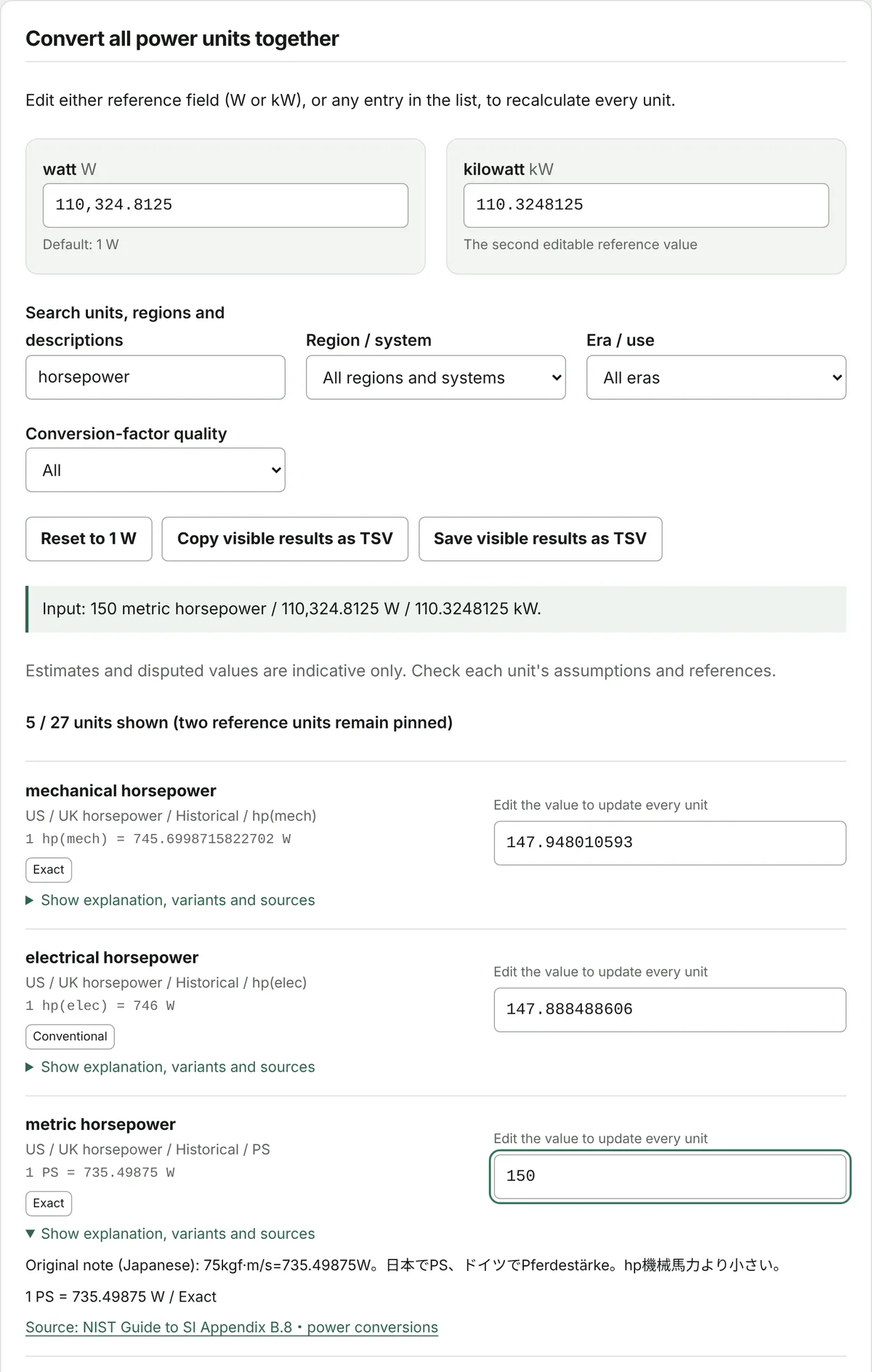
150 PS is about 110.3 kW, which matches the pairing written in catalogs as “110 kW (150 PS)”. The same output expressed in imperial horsepower is about 147.9 hp, roughly 2 less than the PS figure. Because one hp is the larger unit, the same output comes out as a smaller number.
Open Show explanation, variants and sources on the PS row and you see the definition 75 kgf·m/s = 735.49875 W along with a link to the NIST document it refers to. The kilogram-force metre per second field on the same screen reads 11,250 because 150 PS × 75 = 11,250 kgf·m/s, which lets you confirm numerically that PS is defined as 75 times that unit. In the English version the explanation text appears in the original Japanese, labeled “Original note (Japanese)”, but the factor and the source are the same.
What is a US-spec 300 hp in PS?
Now the other way round: we take the hp figure from an English-language document and convert it to PS and kW so it can be compared with Japanese-market cars.
- Leave
horsepowerin the search box. - Enter
300in the mechanical horsepower field. - The kilowatt field becomes 223.709961475, and the metric horsepower (PS) field shows 304.160899627.
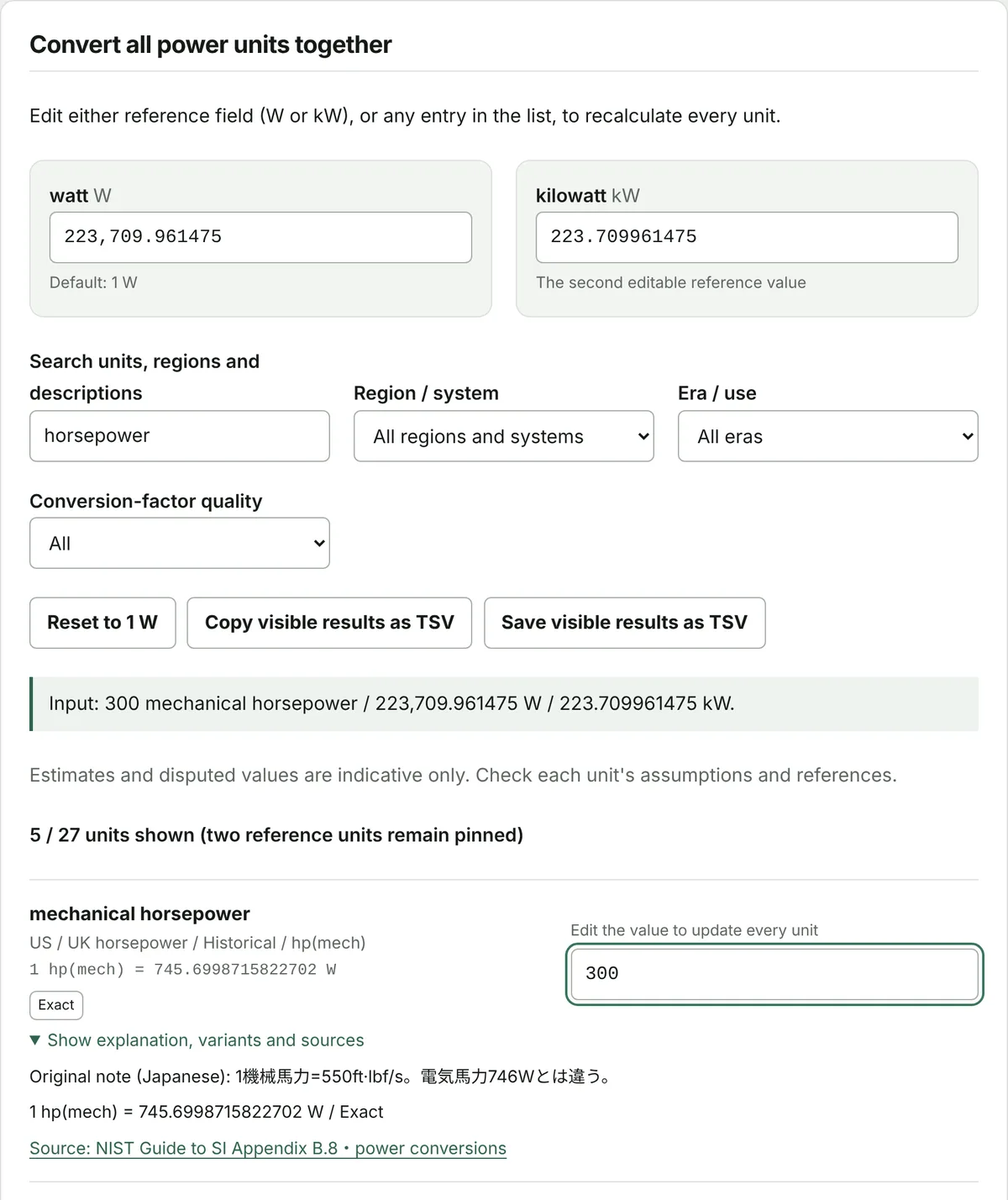
300 hp is about 223.7 kW, or about 304.2 PS. The same “300 horsepower” written in hp is about 4 PS more than a Japanese catalog’s 300 PS. Since the gap is set by a ratio, it widens as output rises: 600 hp is about 608 PS.
English-language documents also frequently say bhp (brake horsepower). That name indicates the output was measured at the engine’s shaft; as a unit, it is treated as the same size as imperial horsepower. The tool registers bhp as an alias of mechanical horsepower, so typing bhp in the search box brings up that row. The output figure itself, however, can vary with the test conditions and standard used. Converting the unit does not make figures measured in different ways comparable, and that is worth keeping in mind.
Working out common catalog values with the tool’s factors gives the following.
| kW | PS | hp (imperial) |
|---|---|---|
| 50 | 68.0 | 67.1 |
| 75 | 102.0 | 100.6 |
| 100 | 136.0 | 134.1 |
| 150 | 203.9 | 201.2 |
| 200 | 271.9 | 268.2 |
| 300 | 407.9 | 402.3 |
As a rule of thumb for mental arithmetic, multiply kW by about 1.36 to get PS, or by about 1.34 to get hp. To go between PS and hp, multiply hp by about 1.014 to get PS, and divide PS by about 1.014 to get hp.
A 12,000 BTU/h air conditioner is 3.52 kW, or one refrigeration ton
Besides horsepower, the other figure that often fails to line up between English-language and Japanese documents is heating and cooling capacity. Japanese air conditioners state their cooling capacity in kW, as in “2.8 kW”, while US product pages typically say “12,000 BTU”, meaning BTU per hour (BTU/h). The BTU (British thermal unit) is a unit of heat, and BTU/h is a unit of power expressing how much heat can be moved per hour.
- Type
BTUinto the search box. Three rows appear: IT British thermal unit per hour, thermochemical BTU per hour, and refrigeration ton US. The refrigeration ton matches because its explanation mentions BTU. - Enter
12000in the IT British thermal unit per hour field. - The kilowatt field becomes 3.51685284207, and the refrigeration ton US field shows 1.
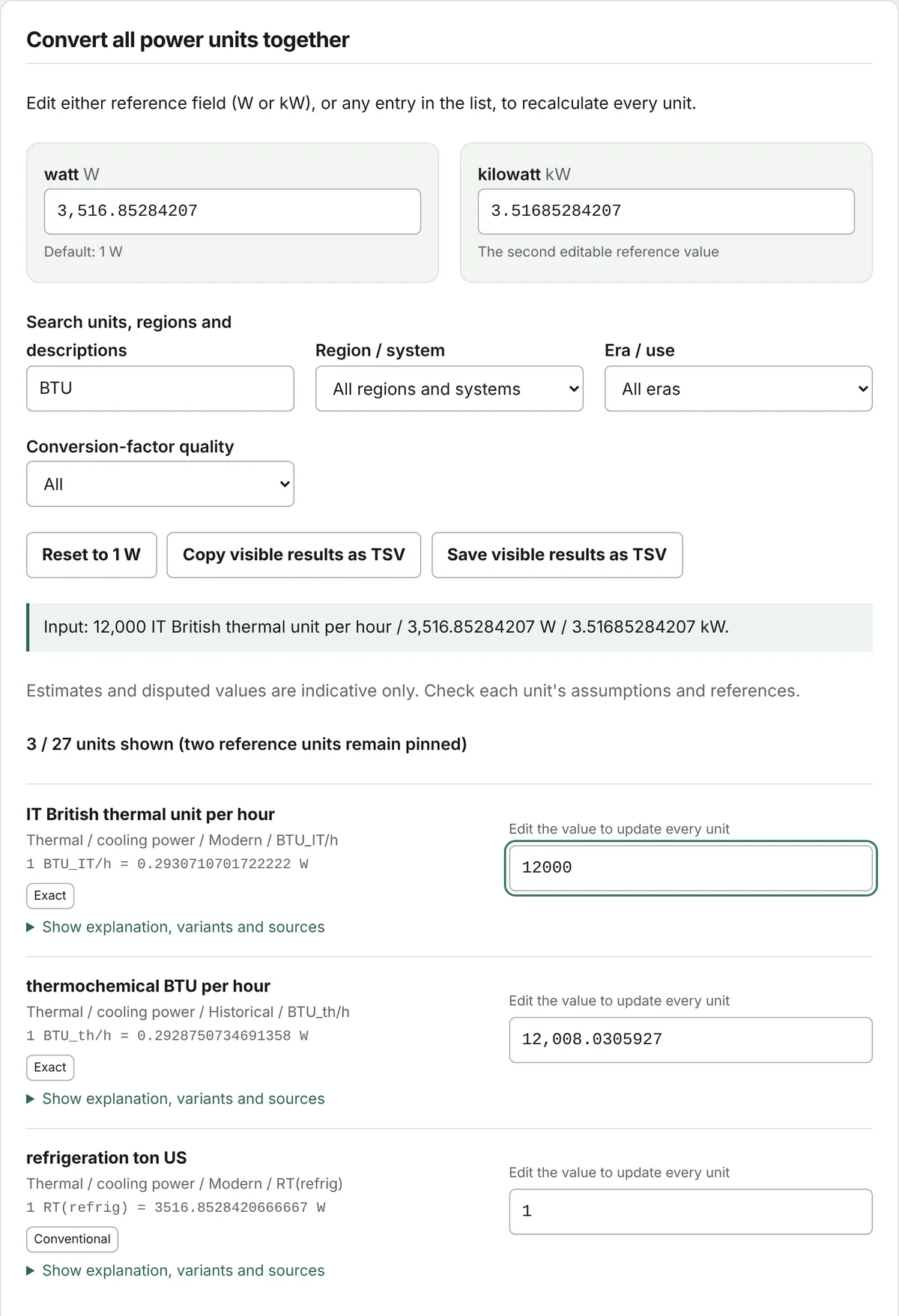
12,000 BTU/h is about 3.52 kW, and the US refrigeration ton is defined as exactly this value. The refrigeration ton is a unit of cooling capacity and has nothing to do with the ton as a weight. The name is said to come from the heat absorbed when one ton of ice melts over a day. A common Japanese air conditioner size, 2.8 kW of cooling capacity, works out to about 9,554 BTU/h, or roughly 0.8 refrigeration tons.
The screen also has a thermochemical BTU per hour row, which shows the same output as 12,008. There are several definitions of the BTU, and the International Table (IT) BTU commonly used in today’s equipment ratings and the thermochemical BTU differ slightly in size. Opening a row’s explanation confirms that the IT BTU is based on 1055.05585262 J. Note also that the refrigeration ton traditionally used in Japan (3,320 kcal/h, about 3.86 kW) differs from the US refrigeration ton and is not included in this tool. If you come across “refrigeration tons” in older Japanese documents on refrigeration equipment, first check whether converting with the US value is appropriate.
kW and kWh are different quantities: 2.4 kWh a day averages 100 W
When dealing with power units, the pair most easily confused is kW and kWh. kW is power, how hard something is working at a given moment, while kWh is energy: that rate multiplied by the number of hours it ran. Running a 100 W device for 10 hours uses 1 kWh. Electricity bills count kWh, while the output of engines and appliances is given in kW.
The tool has a kilowatt hour per day (kWh/d) row that converts a daily amount of energy into average power.
- Type
per dayinto the search box. - Enter
2.4in the kilowatt hour per day field. - The watt field becomes 100, and the kilowatt field 0.1.
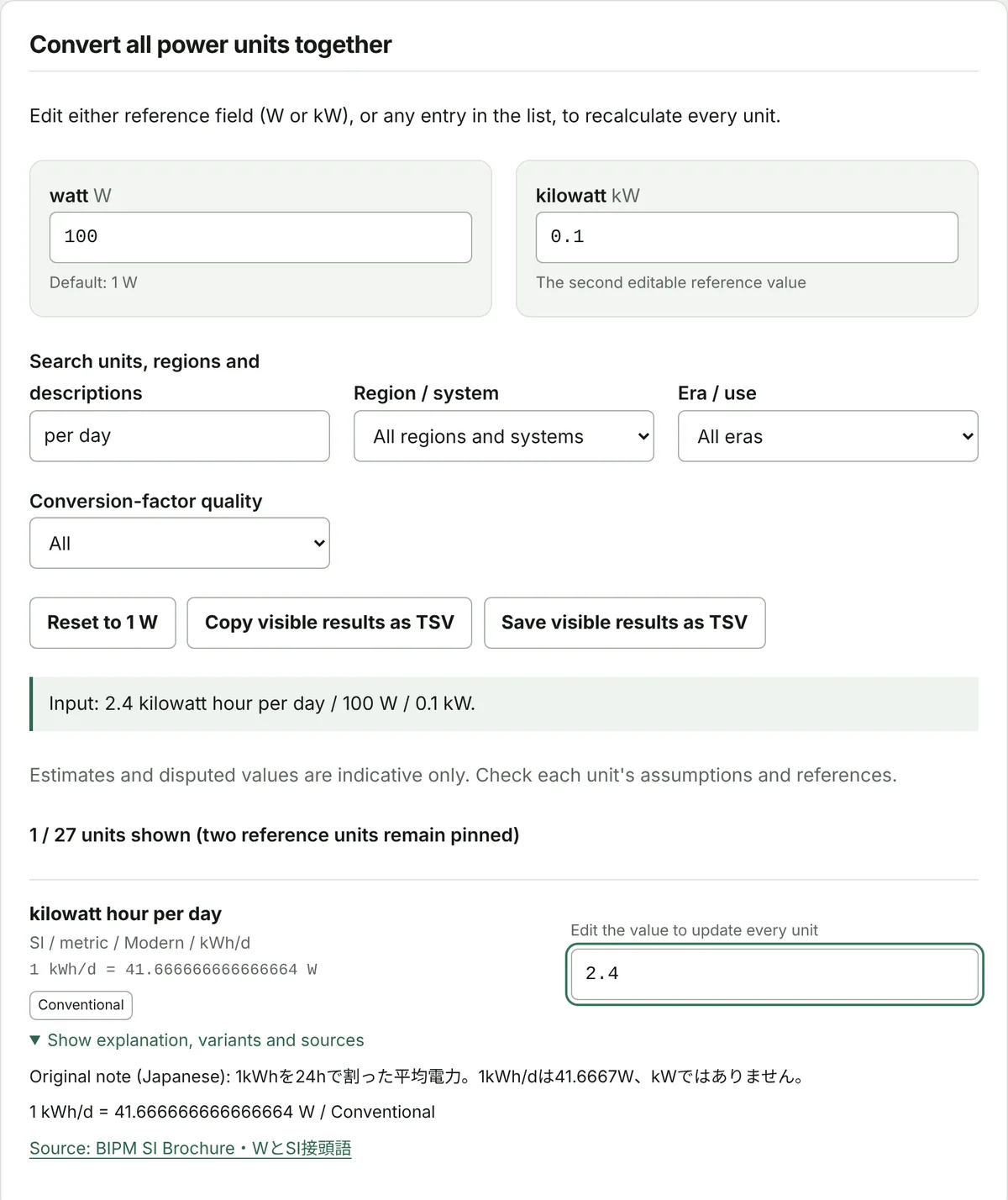
A device that uses 2.4 kWh a day is equivalent to one running continuously at an average of 100 W, spread over 24 hours. Put the other way, what this tells you is an average, not the maximum power drawn at any moment. As this row’s explanation says, “it is not kW”: kWh/d is handled as kWh divided by time.
If you want to carry the relationship between power and energy through to your electricity bill, the Electricity Cost Calculator works out the cost from power consumption and hours of use. How to use it is explained in “How Much Does a 1,200 W Heater Cost to Run 3 Hours a Day?”. To convert units of energy and heat themselves, such as kWh, kcal and BTU, use the World Energy and Heat Units Converter.
Keeping the results with their sources
When you want to collect your catalog comparisons in a spreadsheet, use Save visible results as TSV. The rows currently shown by your search, plus the W and kW rows pinned at the top, go into a tab-separated file along with the converted values, factors, explanations and source URLs. To record both PS and hp, save while the search box still says horsepower, and all five horsepower-related rows are kept together. Copy visible results as TSV puts the same content on the clipboard so you can paste it straight into a spreadsheet.
Number fields also accept scientific notation such as 1e6. That is why the same screen can handle power plant output in MW or GW, and even astronomical values such as the luminosity of the Sun. Input with more than 15 significant digits, or a value that overflows, is shown as “Not calculable”, and the other fields become “Not calculable” too. Enter a new value and every field is calculated again.
Related tools and articles
Reading documents for an imported car means converting more than just horsepower. To turn speeds in mph into km/h, the World Speed and Velocity Converter covered in “How fast is 20 knots?” will help, and for tire pressures in psi, see “Converting Tire Pressure from psi to kPa and bar”. For quantities in American recipes and oven temperatures, “How many mL is 1 US cup?” (in Japanese) and “What Is 68 °F in Celsius?” explain how to read them.