Converting Tire Pressure from psi to kPa and bar: 32 psi Is About 221 kPa, and Japan's "2.2 kilo" Is Not 220 kPa
How to convert a tire pressure given in psi, in an imported car's manual or on a bicycle tire, into the kPa or bar used on pressure placards. The pressure converter shows that 32 psi is 220.6 kPa and 230 kPa is 33.36 psi. The article also covers where 1 psi = 6.894757 kPa comes from, a mental-math shortcut, why the Japanese "2.2 kilo" (2.2 kgf/cm²) is 215.7 kPa, the difference between at and atm, and how to read gauge versus absolute pressure (psig and psia).
The manual of an imported car says “32 psi”. The sidewall of a bicycle tire prints “50–85 PSI” next to a figure in bar. Meanwhile, in Japan the air pump at the gas station and the tire pressure placard by the driver’s door use kPa, and a friend may tell you to “just put in 2.2 kilo”. All of these describe the same thing, the pressure of the air inside the tire, but because the units differ it becomes unclear which number to set on the pump in front of you.
World Pressure Units Converter converts 29 pressure units at once, including psi, kPa, bar, kgf/cm², atm and mmHg. Type a number into any one field and every other field is rewritten. The calculation runs in your browser, and the numbers you enter are not sent anywhere.
This article focuses on the four units that come up most often for tire pressure, psi, kPa, bar and kgf/cm², and walks through converting them with the tool and the points where conversions are easy to get wrong. The screenshots are of this tool.
How psi, kPa, bar and kgf/cm² relate to each other
First, it helps to see how the four units are connected. The tool will give you a number either way, but knowing the relationships lets you judge for yourself whether the result is plausible.
Pressure is force per unit area, and the International System of Units (SI) measures it in pascals (Pa). 1 Pa is a force of one newton on one square metre. At the scale of tire pressure that gives too many digits, so pressures are normally written in kPa (kilopascals), 1,000 times larger.
psi stands for pound-force per square inch: a force of one pound-force acting on one square inch. It is a US customary unit, and since the pound (0.45359237 kg), the inch (0.0254 m) and standard gravity (9.80665 m/s²) are all defined values, its conversion factor to Pa follows by calculation. The tool uses the same value as the conversion tables of the US National Institute of Standards and Technology (NIST), 1 psi = 6,894.757… Pa, or 1 psi ≈ 6.894757 kPa (NIST Handbook 44 Appendix C).
The bar is defined as the round figure 1 bar = 100 kPa. Dividing a kPa value by 100 gives bar, so you can move between these two in your head.
kgf/cm² (kilogram-force per square centimetre) is the pressure of the weight of a 1 kg mass resting on one square centimetre, and 1 kgf/cm² = 98.0665 kPa. Japan used to state tire pressures in this unit. People in Japan still say “2.2 kilo” (2.2 kgf/cm²) when they mean a tire pressure, a habit left over from that time. The unit is quite close to 100 kPa but not the same, and a later section checks the difference with concrete numbers.
| Unit | In kPa |
|---|---|
| 1 psi | 6.894757 kPa |
| 1 bar | 100 kPa |
| 1 kgf/cm² | 98.0665 kPa |
| 1 atm (standard atmosphere) | 101.325 kPa |
Converting 32 psi to kPa and bar
Let’s convert the 32 psi in an imported car’s manual to the kPa used on a local air pump.
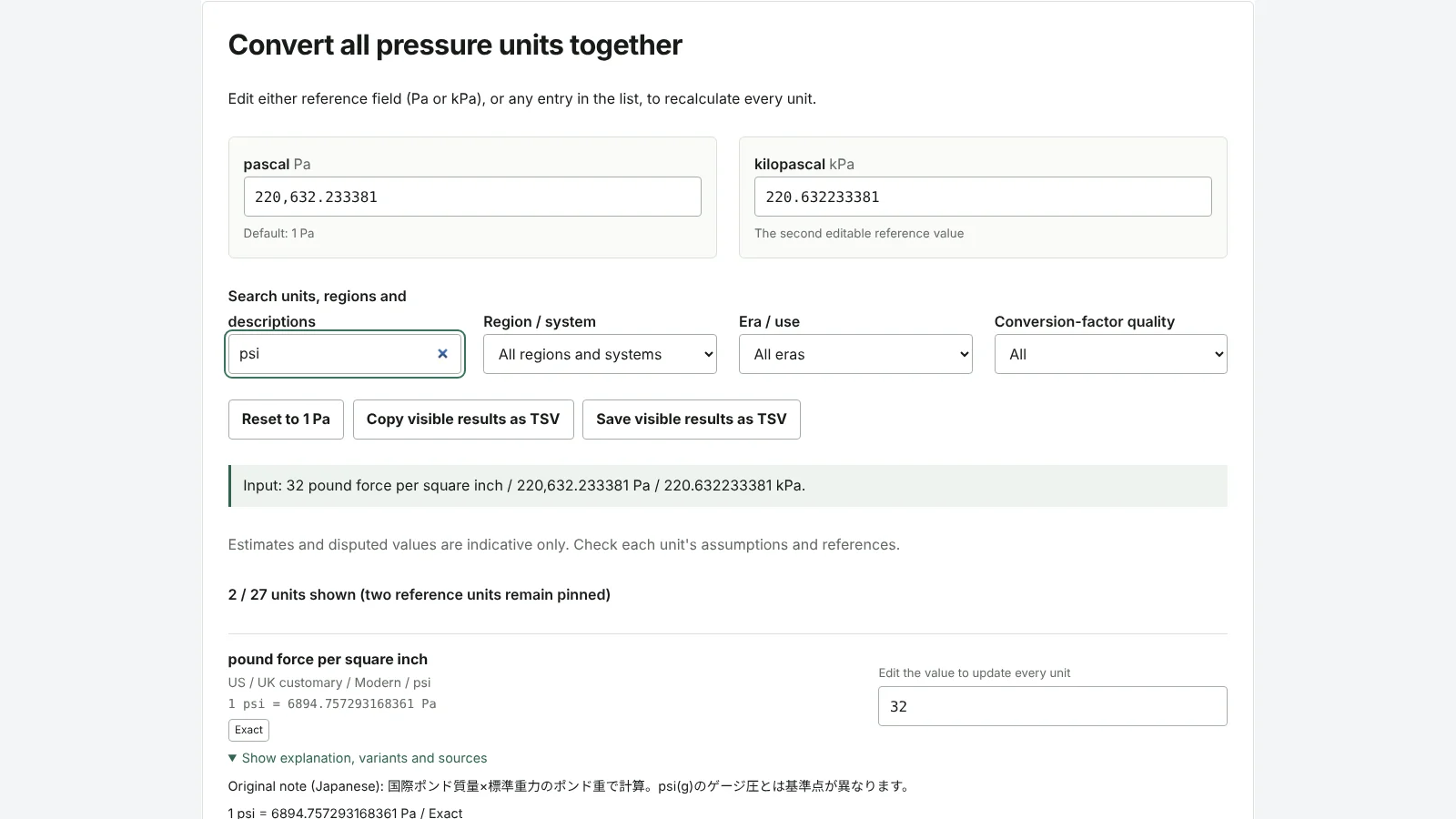
- Open World Pressure Units Converter. At first, the values are based on 1 Pa.
- Type
psiinto “Search units, regions and descriptions”. The list narrows to two rows, pound force per square inch (psi) and kilopound force per sq inch (ksi). - Enter
32in the value field of the psi row. - The kPa field pinned at the top of the screen changes to 220.632233381.
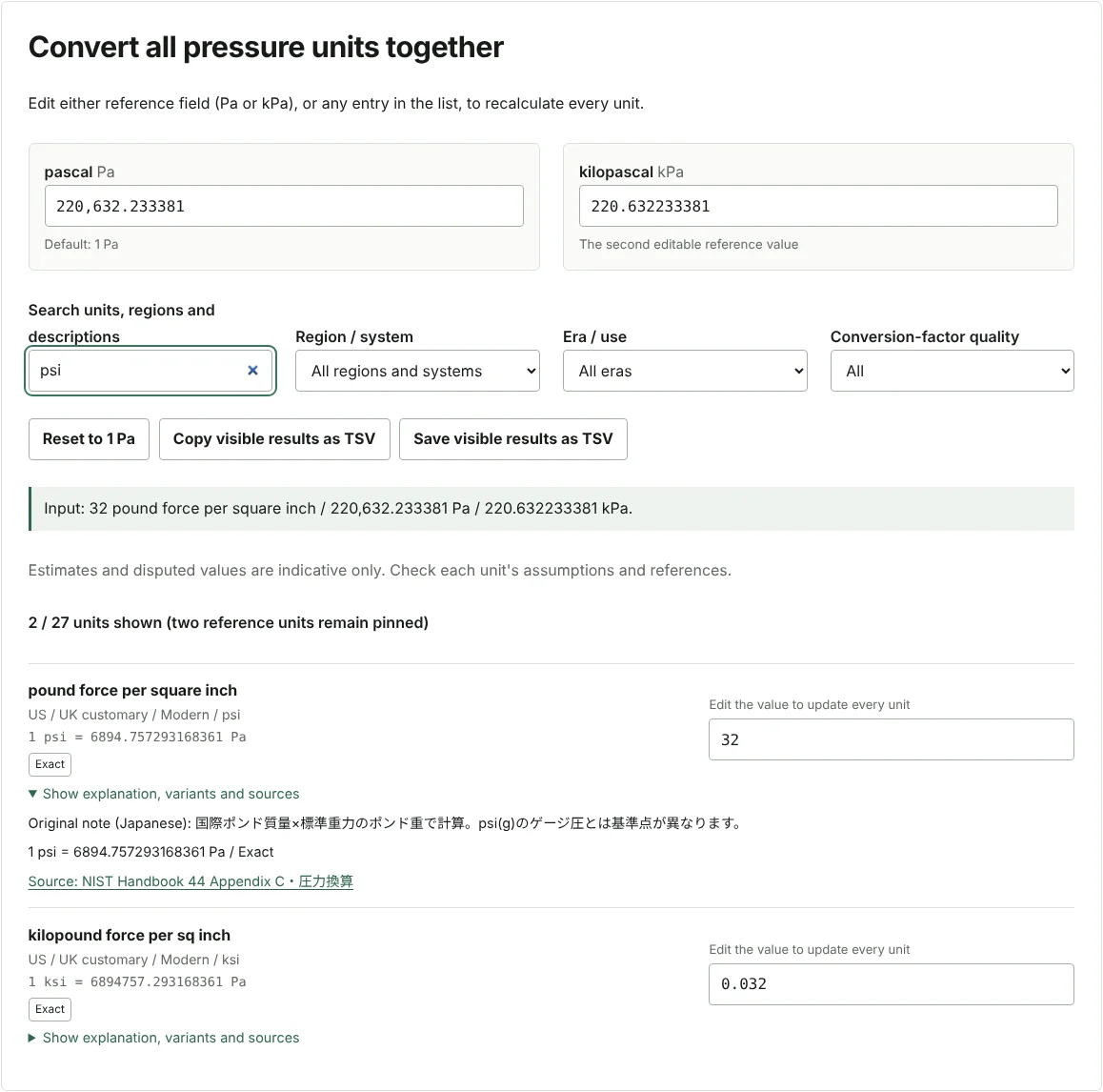
32 psi is about 220.6 kPa. To see it in bar, change the search to bar. Even when the visible rows change, the values converted from 32 psi stay as they are, and the bar field shows 2.20632233381. That is the kPa value divided by 100, which agrees with the relationship above.
Opening “Show explanation, variants and sources” on the psi row shows how many Pa one psi is calculated as, together with a link to the source. The explanatory note itself is shown as the original Japanese text (“Original note (Japanese)”), but the conversion factor and source are displayed in English.
Other values you often see convert as follows with the same steps.
| psi | kPa | bar |
|---|---|---|
| 32 | 220.6 | 2.21 |
| 33 | 227.5 | 2.28 |
| 35 | 241.3 | 2.41 |
| 36 | 248.2 | 2.48 |
| 40 | 275.8 | 2.76 |
The tool normally shows converted values to 12 significant digits. Air pump scales are nowhere near that fine, so when you actually inflate, round to the graduations of your gauge.
Doing it in your head
As a rough guide when you have no phone at hand, multiplying kPa by 0.145 gives psi, and multiplying psi by 7 gives a slightly high kPa value. 230 kPa × 0.145 = 33.35, which almost matches the tool’s 33.36 psi. On the other hand, 32 psi × 7 = 224 is about 3 kPa more than the correct 220.6 kPa. Multiplying by 7 is easy to remember, but the error grows with the psi value, so it is worth checking the exact value with the tool before you inflate.
The roughly 2% gap between “2.2 kilo” and kPa
Converting in the other direction, from a pressure specified in kPa to psi or kgf/cm², shows how it relates to values spoken of in “kilo”. As an example, take a specified pressure of 230 kPa.
- Enter
230in the kPa field at the top of the screen. - Type
kgf/cminto the search box. Two rows appear, kilogram-force per cm² (kgf/cm²) and technical atmosphere (at). The second one matches because its note contains “kgf/cm²”. - Both fields show 2.34534728985.
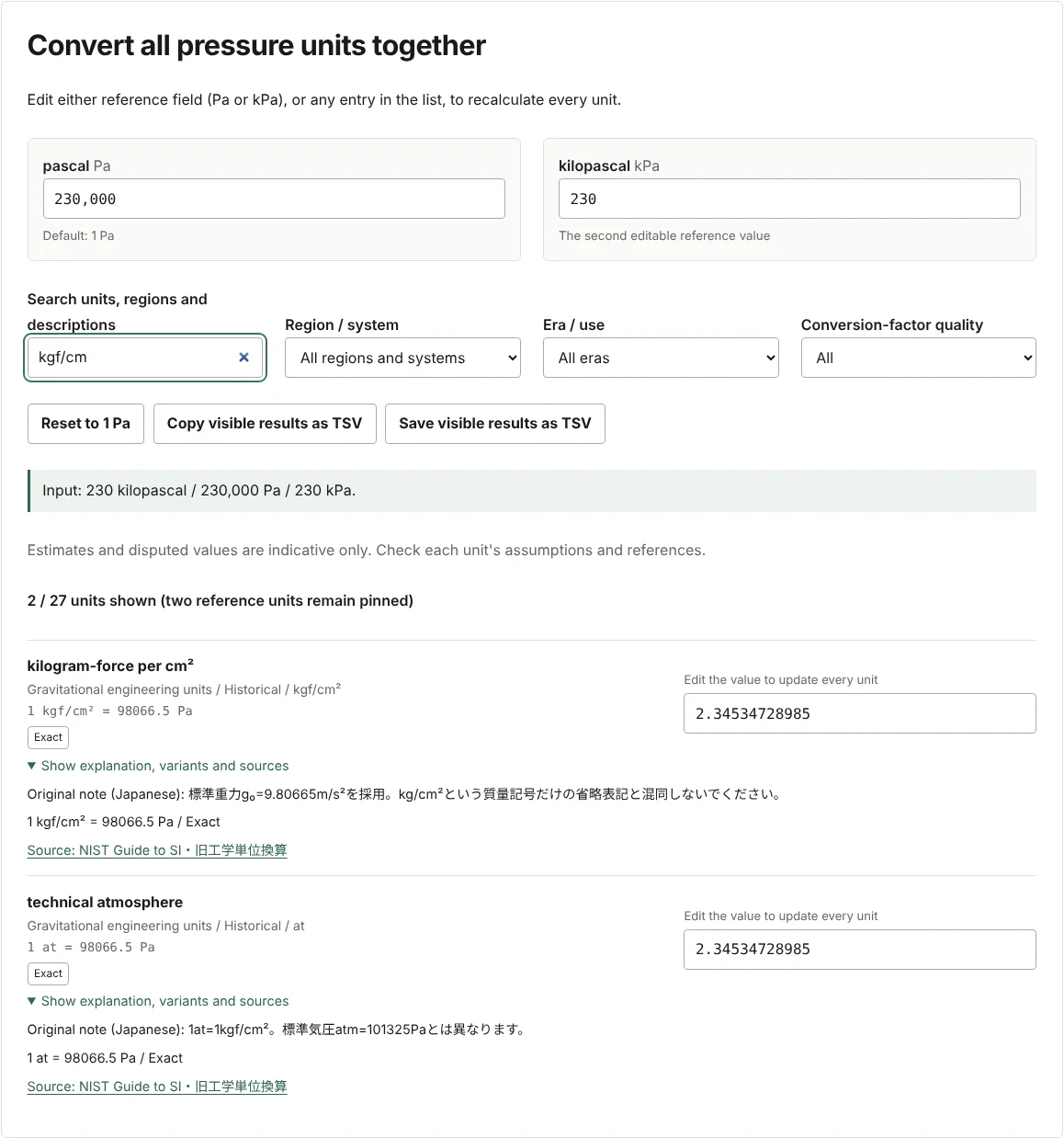
230 kPa is about 2.35 kgf/cm², so reading it as “2.3 kilo” underestimates it by about 0.05. Conversely, entering 2.2 in the kgf/cm² field gives 215.7463 kPa, about 4 kPa lower than the 220 kPa you get by reading “2.2 kilo” as 220 kPa. Because 1 kgf/cm² is 98.0665 kPa, simply multiplying a kgf/cm² value by 100 to get kPa always gives a value about 2% too high.
4 kPa is about 0.6 psi, a difference that some pump gauges cannot even resolve. Still, if the specified pressure is written in kPa, it is more reliable to set it in kPa directly without going through kgf/cm². Use this conversion when an old pump only has a kgf/cm² scale, or when you need to turn a pressure someone told you in “kilo” into kPa.
As the tool’s note also says, kgf/cm² is sometimes written “kg/cm²”. That is a shorthand that uses only the mass symbol, and it means the same kgf/cm². The technical atmosphere is likewise defined as 1 at = 1 kgf/cm², so if a document says at, you can read it as the same value in kgf/cm².
Not confusing at with atm, or gauge with absolute pressure
Documents about air pressure also use units and notations based on atmospheric pressure. Misreading them can leave the result off by one atmosphere even when the conversion itself is correct.
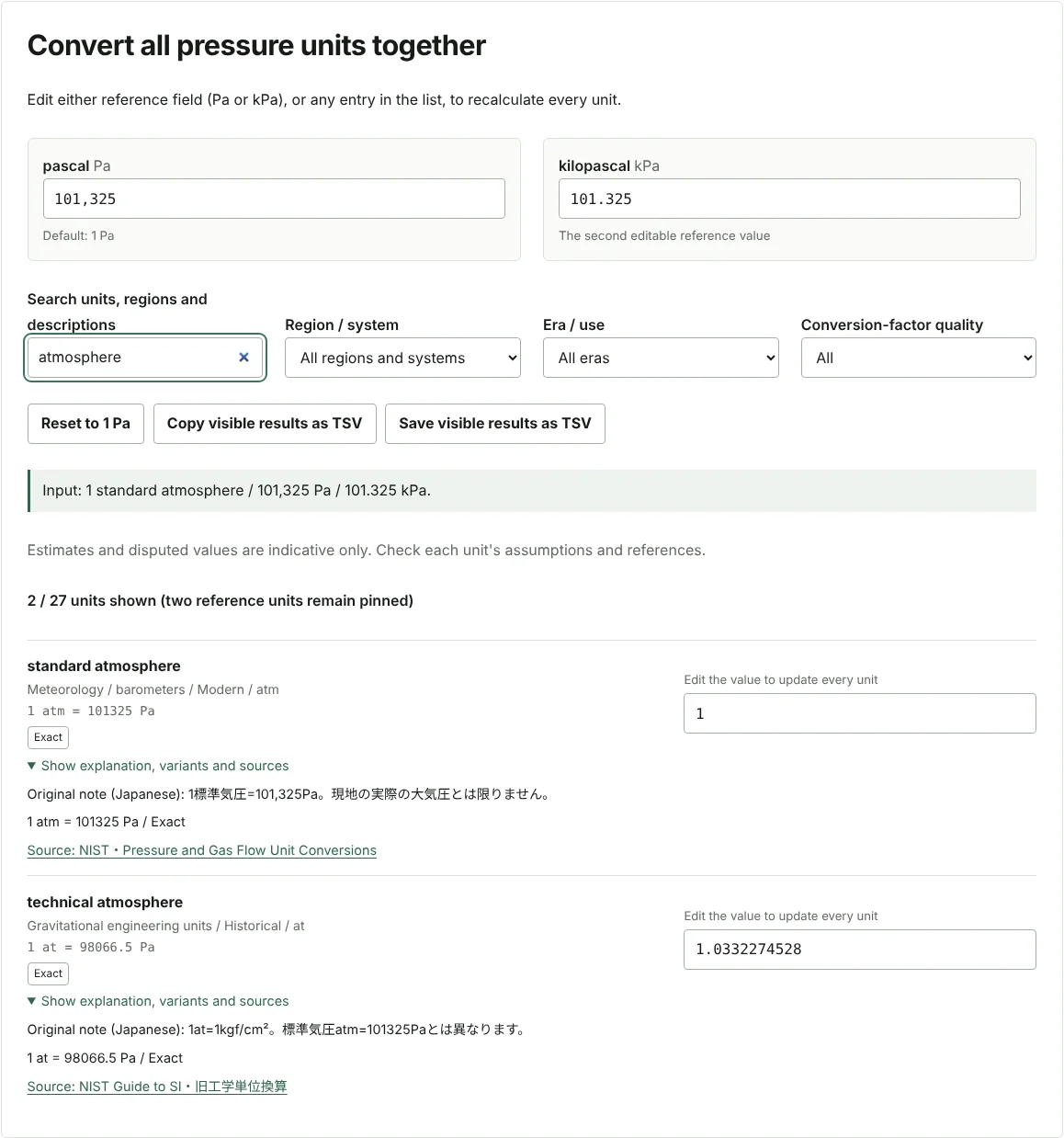
First, the technical atmosphere (at) and the standard atmosphere (atm) are different units. Type atmosphere into the search box and enter 1 in the standard atmosphere (atm) field, and the technical atmosphere field shows 1.0332274528. 1 atm is 101.325 kPa and 1 at is 98.0665 kPa; the names are similar, but they differ by about 3%.
The other point is the difference between gauge pressure and absolute pressure. A tire pressure gauge shows gauge pressure, how many kPa the pressure is above the surrounding atmosphere, so it reads 0 on a tire with no air in it. Absolute pressure, by contrast, takes a vacuum as 0. The absolute pressure of the air inside a tire is the gauge reading plus atmospheric pressure (101.325 kPa, or about 14.7 psi, for the standard atmosphere).
English-language documents sometimes distinguish gauge pressure as psig and absolute pressure as psia. That is what the note on the tool’s psi row means when it says the reference point differs from psi(g) gauge pressure, and you need to check the notation in your document to know which one a number is. That said, specified tire pressures are normally gauge pressures, and converting 32 psi to kPa is a conversion between gauge pressures, so multiplying by the factor is all you need.
The case to watch is converting across gauge and absolute pressure. For example, if you want to check a value written in psia with a tire gauge, you have to convert it to kPa and then subtract atmospheric pressure. This addition or subtraction is a separate calculation from unit conversion, so the tool does not do it automatically. Converting 1 atm to psi gives 14.6959487755, so subtract this value to go from psia to psig. Keep in mind that actual atmospheric pressure varies with the weather and altitude, and the standard atmosphere is only a representative value.
Bicycle tires and other pressures
The same approach works beyond car tires.
Bicycle tires often have their recommended pressure range printed on the sidewall in both psi and bar, and some floor pumps have gauges with both psi and bar scales. Entering 100 psi, for example, gives 6.89475729317 in the bar field and 689.475729317 in the kPa field. bar and kPa differ by a factor of 100, so once you know one, the other follows immediately.
The same list also includes hPa, used for atmospheric pressure (1 atm = 1,013.25 hPa), and mmHg, the unit of blood pressure monitors. Entering 120 in the mmHg field gives about 16.0 kPa. As the tool’s notes point out, mercury and water column units vary slightly with the temperature of the mercury or water and the value of gravity used, so if you need a strict comparison, check the assumptions in each row’s explanation and source.
To keep a record of the displayed results, press “Save visible results as TSV”. The rows matching the search and the pinned Pa and kPa rows are saved to a file together with the converted values, notes and source URLs. To keep psi, kPa, bar and kgf/cm² together, either clear the search box and save the whole list, or search for each unit and save them one by one.
Related tools and articles
The “kgf” in kgf/cm² is a unit of force, and its relationship to N (newtons) and lbf can be checked in World Force and Load Units Converter. Manuals from other countries also bring up fuel economy in mpg and temperatures in Fahrenheit besides pressure. World Fuel Economy and Consumption Units Converter converts fuel economy to km/L or L/100 km. Reading Fahrenheit temperatures is covered in “What Is 68 °F in Celsius?”, and lengths in inches and feet in “From yards to metres and Japanese shaku”.