Converting L/min to m³/h: 100 L/min Is 6 m³/h, and 10 US GPM Is About 37.9 L/min
1 L/min is 0.06 m³/h, so a 100 L/min pump delivers 6 m³/h. 10 US GPM is about 37.85 L/min, but 10 GPM in imperial gallons is about 45.46 L/min, roughly 20% more. Using a volumetric flow converter, this guide converts pump ratings between L/min and m³/h, shower head GPM, range hood CFM (400 CFM is about 680 m³/h) and water filter GPD (75 GPD is about 284 L a day) with sources, and explains why SCFM and mass flow cannot be converted directly.
Contents
Read enough pump or fan spec sheets and you notice that the same “flow rate” turns up in several different units. Submersible pump catalogs in Japan usually state discharge in L/min, yet equipment drawings and piping documents use m³/h. With imported products, plumbing items routinely use GPM (gallons per minute) and ventilation or HVAC equipment uses CFM (cubic feet per minute). All of these describe the same quantity, the volume that passes in a given time, but because both the time unit and the volume unit differ, you cannot compare the numbers just by putting them side by side.
The World Volumetric Flow Units Converter converts 32 units at once, from L/s, L/min and m³/h to US and imperial gallons per minute, CFM, the cfs used for river flows, and barrels of crude oil per day. Type a number into any one field and every other field is rewritten. Each row shows its conversion factor and source, so you can check on the same screen why a value comes out the way it does. The calculation runs in your browser, and the numbers you enter are not sent anywhere.
This article walks through the combinations that most often appear in spec sheets, using the tool to confirm how to read one unit as another. The screenshots are from the English version of the tool.
L/min and m³/h are linked by a factor of 60 and a factor of 1,000
Start with the relationship that comes up most often in metric documents: L/min versus m³/h. One cubic metre is 1,000 L and one hour is 60 minutes, so 1 L/min flowing for an hour amounts to 60 L, or 0.06 m³. In other words, 1 L/min = 0.06 m³/h, and conversely 1 m³/h ≈ 16.67 L/min. Multiply an L/min figure by 0.06 and you have m³/h.
To check this in the tool, use the litre per minute field pinned at the top of the page.
- Open the World Volumetric Flow Units Converter. It starts with values based on 1 L/s, and the litre per minute field at the top shows 60.
- Type
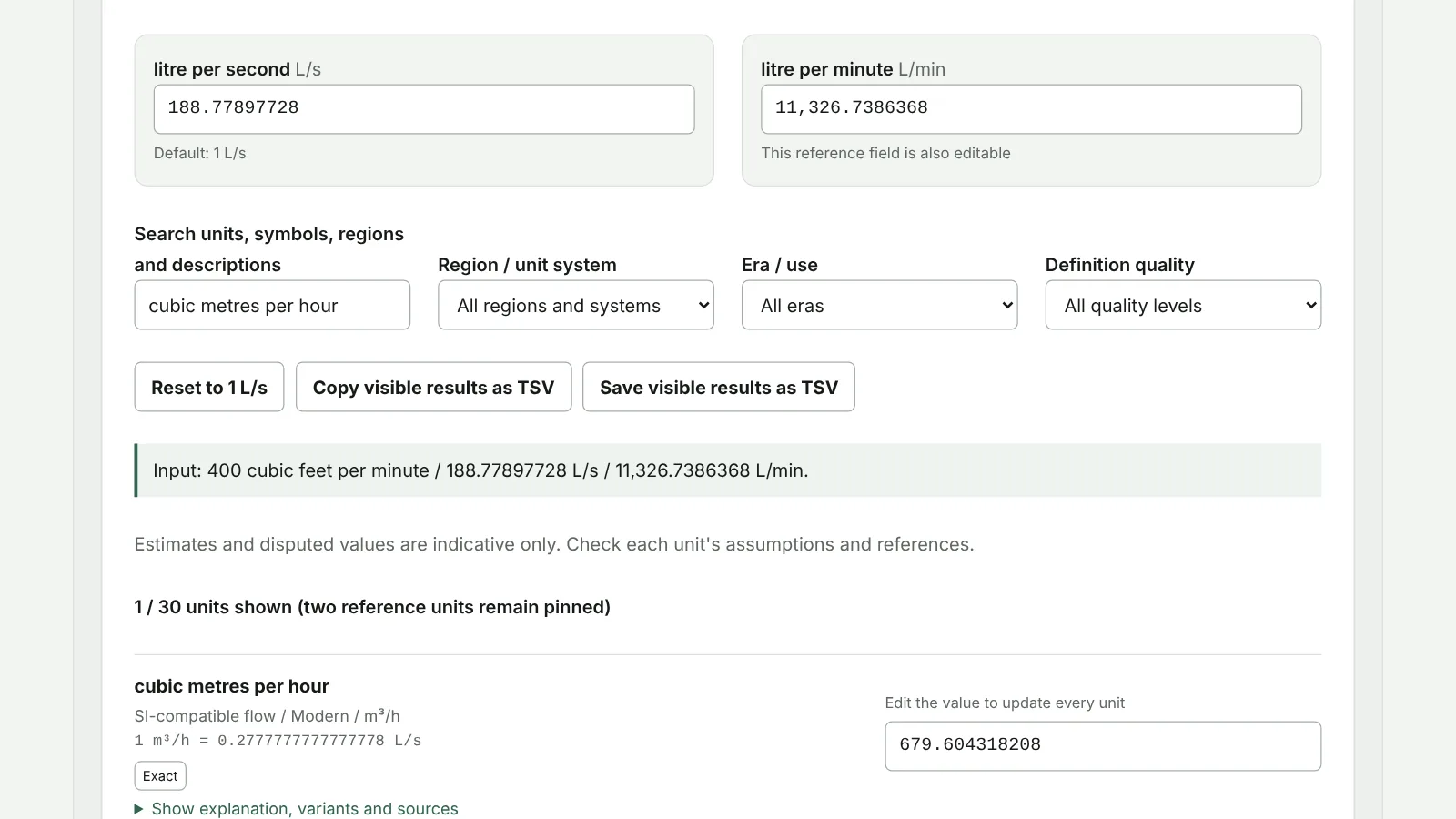
cubic metres perinto Search units, symbols, regions and descriptions. The list narrows to four rows: cubic metres per second, per minute, per hour and per day (24 h). - Enter
100in the litre per minute field at the top. - The cubic metres per hour field changes to 6, and cubic metres per minute changes to 0.1.
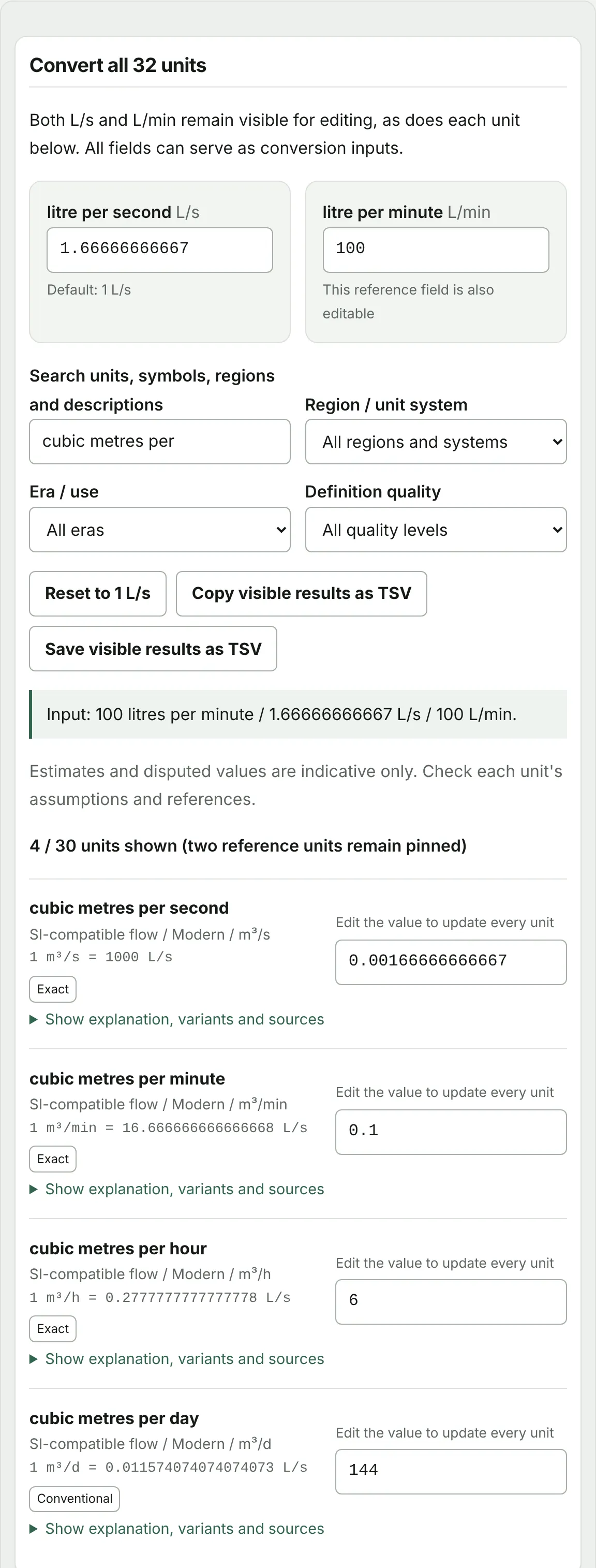
A pump rated at 100 L/min therefore delivers 6 m³/h, or 144 m³ if it runs for 24 hours straight. The cubic metres per day row is marked Conventional because it treats a day as exactly 24 hours (86,400 seconds). The other three rows follow directly from definitions, so they are marked Exact.
Here are some values that often appear in spec sheets. US and imperial GPM are covered in the next section.
| L/min | m³/h | GPM (US) | GPM (imperial) |
|---|---|---|---|
| 5 | 0.3 | 1.32 | 1.10 |
| 10 | 0.6 | 2.64 | 2.20 |
| 20 | 1.2 | 5.28 | 4.40 |
| 50 | 3 | 13.21 | 11.00 |
| 100 | 6 | 26.42 | 22.00 |
Keep in mind that the discharge listed on a pump spec sheet is normally the value at a specified head (the height the water is lifted). Converting the unit does not mean you will get the same flow on a site where the pipe length or lift is different. What a conversion tells you is how numbers stated under the same conditions compare.
GPM differs by about 20% depending on whether it uses US or imperial gallons
Imported shower heads, garden watering products and American pumps state flow in GPM (gallons per minute). The catch is that there are two gallons, a US one and a British one. The US liquid gallon is defined as 3.785411784 L and the imperial gallon as 4.54609 L, so the imperial gallon is about 20% larger. A figure labelled simply “GPM” converts to a different number depending on which gallon is meant.
- Type
gallons per minuteinto the search box. Two rows appear: US gallons per minute and imperial gallons per minute. - Enter
10in the US gallons per minute field. - The litre per minute field at the top becomes 37.85411784, and imperial gallons per minute shows 8.32674184629.
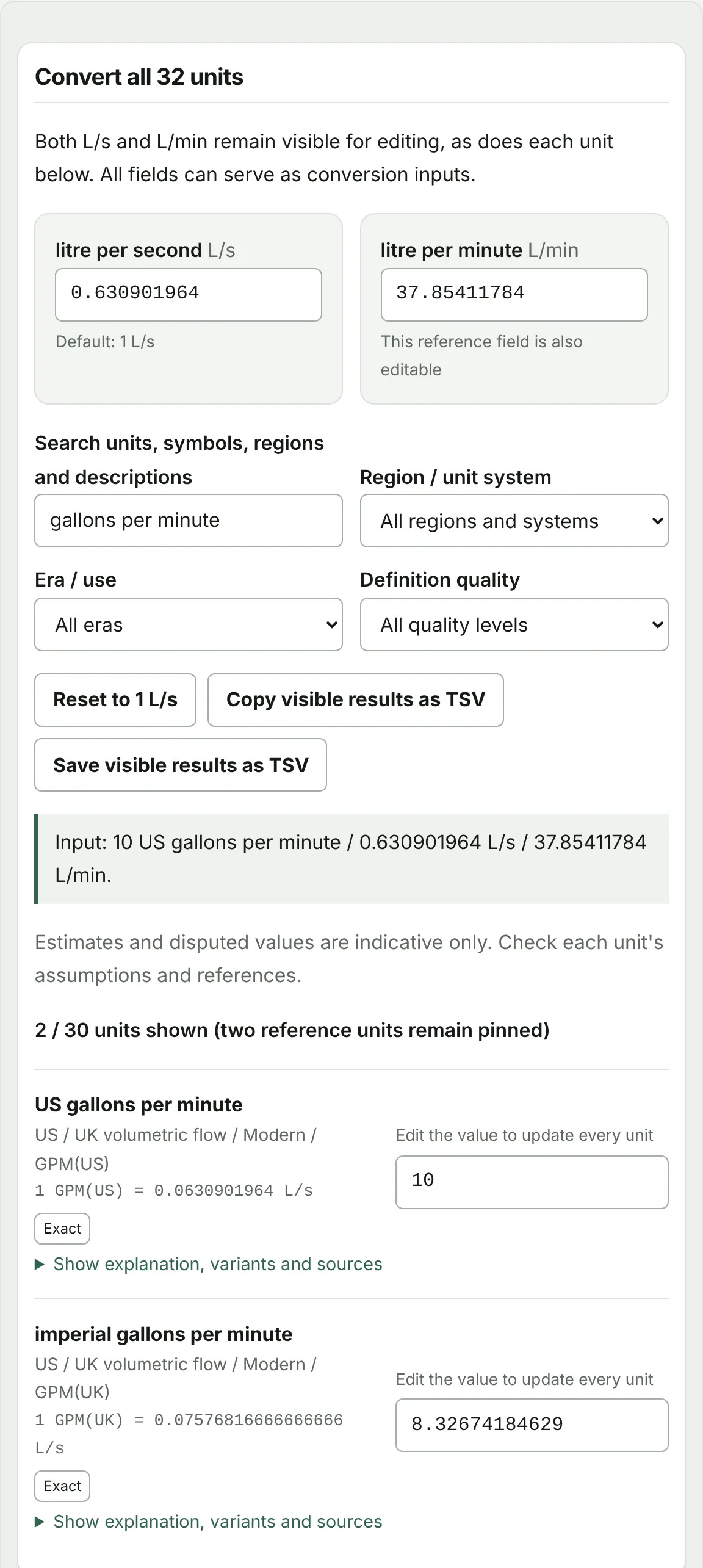
So 10 US GPM is about 37.9 L/min. If the same “10 GPM” were in imperial gallons, it would be about 45.5 L/min. For an American product, US gallons are the natural assumption, and for older British documents, imperial gallons. Older Canadian and Australian documents may also use imperial gallons. Opening a row’s explanation shows which gallon definition the tool uses and its source.
Shower heads in the United States are a familiar example. According to the U.S. Environmental Protection Agency’s WaterSense page on showerheads, the federal maximum is 2.5 GPM (at 80 psi), and the WaterSense water-saving label requires 2.0 GPM or less. In the tool, 2.5 GPM converts to about 9.46 L/min and 2.0 GPM to about 7.57 L/min. When you compare an American shower head with one rated in L/min, these figures are a useful reference.
A 400 CFM range hood moves about 680 m³/h
Airflow for ventilation fans, range hoods and air purifiers is another place where units split by market. Products sold in Japan and Europe generally state airflow in m³/h, while American product pages use CFM (cubic feet per minute). One cubic foot is 28.316846592 L, so 1 CFM ≈ 1.699 m³/h; multiplying by roughly 1.7 gets you to m³/h.
- Type
cubicinto the search box. Along with the four cubic-metre rows, you will see cubic feet per minute, per second and per hour, plus cubic inches per minute. - Enter
400in the cubic feet per minute field. - cubic metres per hour becomes 679.604318208, and cubic metres per minute becomes 11.3267386368.
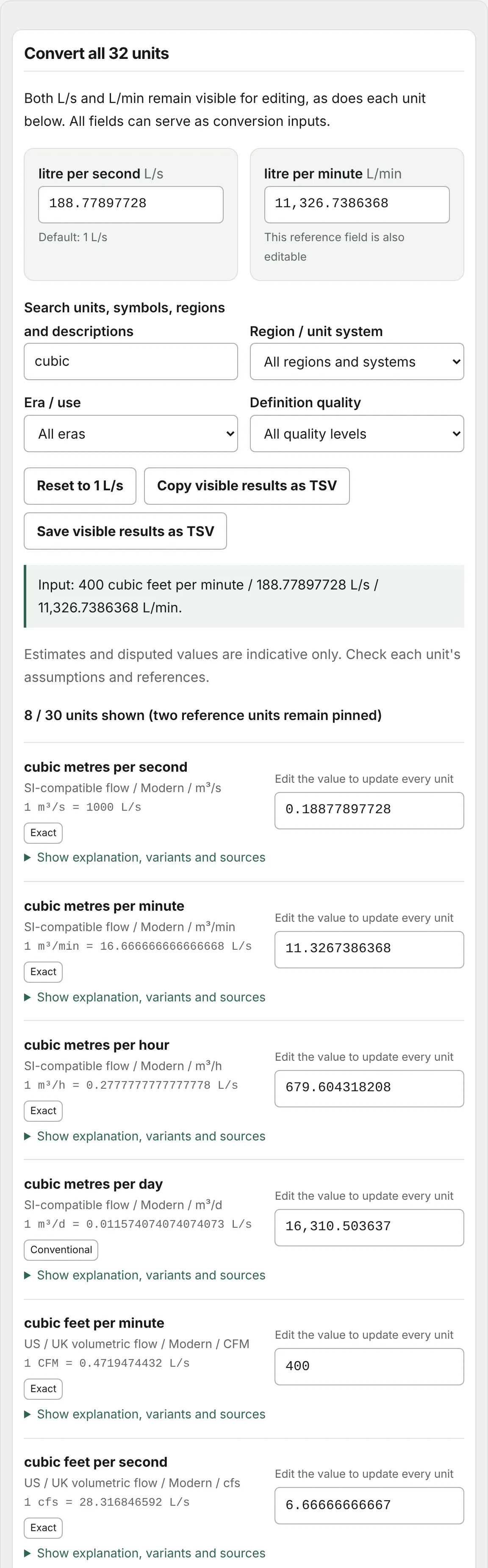
400 CFM is about 680 m³/h. Going the other way, 1 m³/h is about 0.589 CFM. Here are some common values.
| CFM | m³/h |
|---|---|
| 100 | 169.9 |
| 200 | 339.8 |
| 300 | 509.7 |
| 400 | 679.6 |
| 600 | 1,019.4 |
That said, catalog airflow depends on how it was measured. Whether a duct is attached, and how much static pressure (duct resistance) the fan is working against, changes the airflow even for the same model. Some American documents list “maximum airflow” separately from airflow with a duct connected. Once the units match, check which conditions each value was measured under as well.
A 75 GPD water filter makes about 284 L a day, or roughly 0.2 L a minute
Flow rates stated per day also need to be translated. Home reverse osmosis (RO) water filters often rate their membranes as “50 GPD” or “75 GPD”, meaning the amount of water they can produce in a day, in US gallons. GPD stands for gallons per day.
- Type
per dayinto the search box. The list narrows to rows such as litres per day, cubic metres per day, US gallons per day, million gallons per day and barrels of crude oil per day. - Enter
75in the US gallons per day field. - litres per day changes to 283.9058838, and the litre per minute field at the top changes to 0.19715686375.
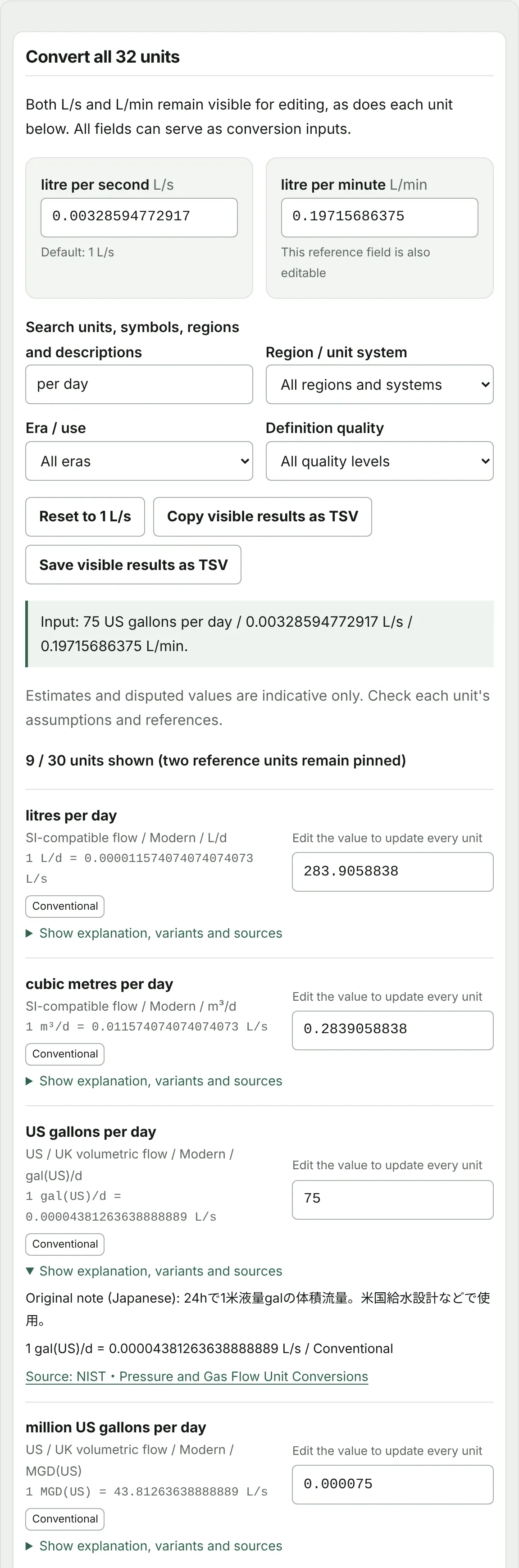
75 GPD is about 284 L a day, and 50 GPD about 189 L. Averaged per minute, that is only around 0.2 L, nowhere near the gush you get from a tap. This is why RO filters usually come with a tank: they make water slowly and store it. Membrane capacity is also measured under set test conditions such as water temperature and pressure, so the actual output varies with the environment where the filter is used.
Opening Show explanation, variants and sources on the US gallons per day row shows that it is a volumetric flow based on a 24-hour day, along with a link to the NIST document it references. In the English version, the explanation appears as the Japanese original labelled “Original note (Japanese)”, but the factor and source are the same as in the Japanese version. The same search results also include MGD (million gallons per day), which is used to describe the size of water and wastewater facilities, again with separate rows for US and imperial gallons.
SCFM and kg/h cannot be converted with this tool alone
Some flow units are not determined by volume and time alone. As the tool’s own notes say, the following two kinds are not included.
The first is SCFM, NL/min and sccm, used for gas flow in air compressors and similar equipment. These express the amount of gas corrected to “standard conditions”, and the temperature and pressure that count as standard differ between manufacturers and standards. Because the volume of a gas changes a great deal with temperature and pressure, turning a standard-condition quantity into an actual volumetric flow requires both that definition and the actual operating conditions. CFM and SCFM have similar names, but they cannot be treated as the same value.
The second is mass flow, such as kg/h or t/h. To get mass flow from volumetric flow, you have to multiply by the density of whatever is flowing. Water is roughly 1 kg/L, so 100 L/min is about 100 kg/min, but oils and chemical solutions have different densities. To bring density units into line, the World Density and Specific Gravity Units Converter converts between kg/m³, g/cm³, lb/ft³ and more.
Saving results together with their sources
When you want to collect the results in a spreadsheet, use Save visible results as TSV. It writes the rows currently shown by your search, plus the L/s and L/min rows pinned at the top, to a tab-separated file with the converted values, factors, notes and source URLs. Copy visible results as TSV puts the same content on the clipboard so you can paste it into a spreadsheet.
The number fields also accept exponential notation such as 1e6, so values that are many orders of magnitude apart, like river flows (m³/s or cfs) or microfluidic nL/min, can be handled on the same screen. Inputs with more than 15 significant digits, or values that overflow, are shown as Not calculable; enter a new value and every field is calculated again.
Related tools and articles
When you are translating flow units, other units tend to appear alongside them. To convert pump or compressor pressure from psi to kPa or bar, use the World Pressure Units Converter, which is covered in “Converting Tire Pressure from psi to kPa and bar”. To convert gallons or cubic feet themselves to litres, there is the World Volume and Capacity Units Converter, explained in “How Many mL Is 1 Cup in an American Recipe?”. For converting motor or pump output from hp to kW, see “How Many kW Is 150 PS?”.