How Much Does a 1,200 W Heater Cost to Run 3 Hours a Day? Working Out Appliance Running Costs from Watts and Checking the Price per kWh on Your Bill
A 1,200 W space heater used 3 hours a day for 30 days uses 108 kWh: 3,348 yen a month at 31 yen/kWh, or 37.2 yen an hour. Ten minutes with a hair dryer costs 6.2 yen. Put four appliances side by side and 86% of the winter bill comes from one heater, and a new refrigerator that saves 7,440 yen a year still takes about 16 years to pay back 120,000 yen. All checked in the Electricity Cost Calculator, along with the formula and how to get your own price per kWh from your bill.
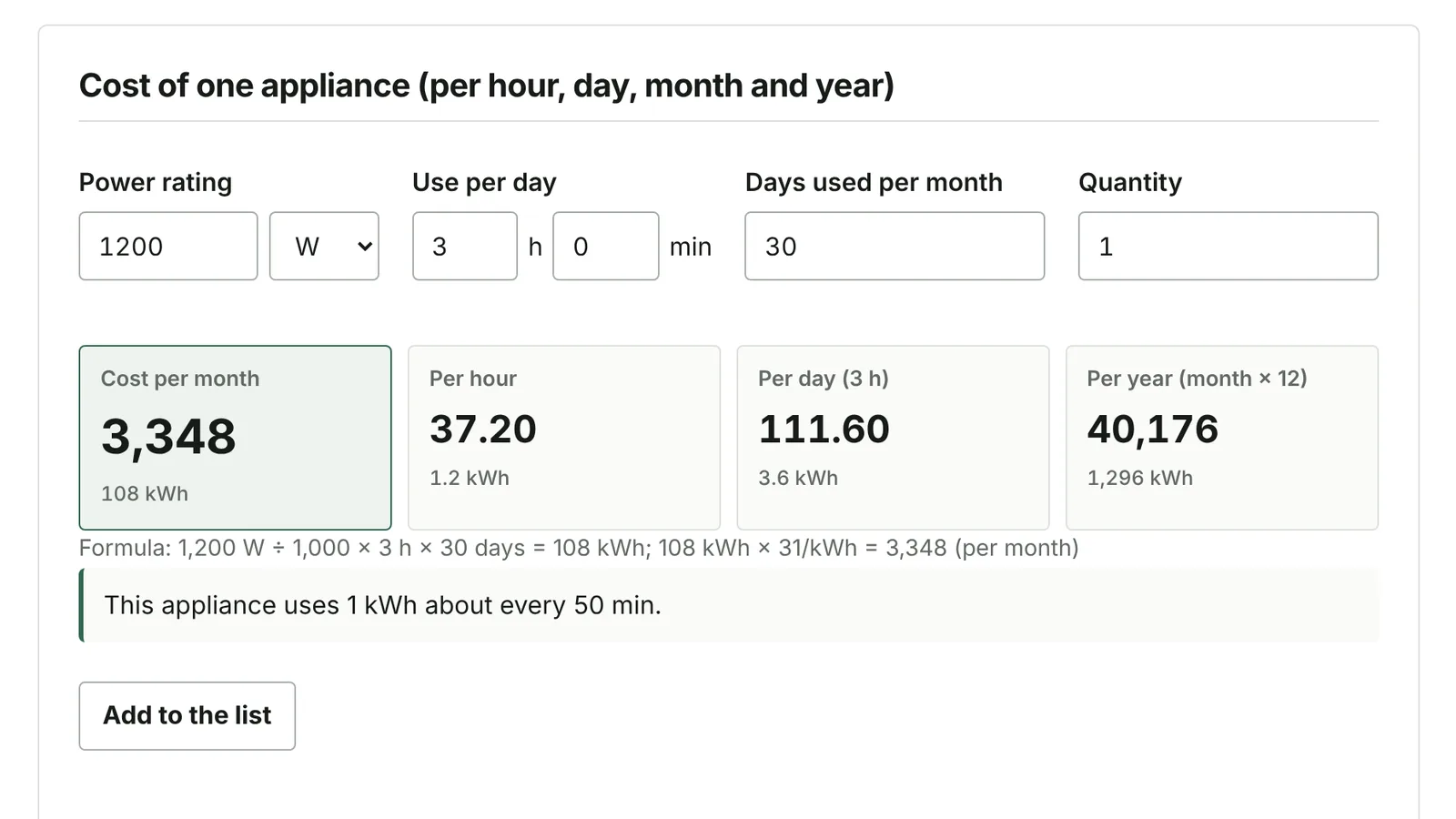
When the weather turns cold and the space heater comes out of the cupboard, the next question is what it will do to the electricity bill. The label on the heater says something like “1200W”, but staring at a wattage does not tell you what a month of use will cost.
The cost of electricity is the energy you use (kWh) multiplied by the price per kWh. The arithmetic is just multiplication, yet it is easy to trip over the conversion from W to kWh, the hours and days of use, and which price to use. The Electricity Cost Calculator takes an appliance’s power rating and how long you use it, and shows the energy and the cost per hour, day, month and year, along with the formula. In this article I enter real numbers to answer four questions: what a winter heater and a hair dryer cost, which appliances account for most of a household’s bill, whether replacing an appliance pays for itself, and what your own price per kWh actually is.
The examples come from Japan, so the amounts are in yen, calculated at 31 yen/kWh, the reference price used for appliance running-cost labels in Japan (explained below). The English version of the tool has no default price and shows amounts without a currency symbol. To reproduce the numbers here, type 31 in the price field; to get figures for your own home, type your own price per kWh in your own currency. The arithmetic is identical in any currency. The screenshots were taken in the English version with 31 entered.
The formula: W ÷ 1,000 × hours × price
A kilowatt-hour (kWh) is the energy used by 1 kW (1,000 W) of power over one hour. Appliances usually state their power in watts, so you divide by 1,000 to get kilowatts and then multiply by the hours of use.
- Energy (kWh) = power (W) ÷ 1,000 × hours of use
- Cost = energy (kWh) × price per kWh
All examples below use 31 yen/kWh. The “estimated monthly running cost” printed in Japanese appliance ads and manuals is calculated with this figure, a reference price set by the Japan Fair Trade Council of Home Electric Appliances (revised in July 2022, tax included). It is handy for comparing appliances with each other or checking a figure in a catalog. Later in the article I show how to replace it with the price you actually pay.
Outside Japan the bill is usually made up of a fixed standing charge, an energy rate per kWh (sometimes in tiers that rise with usage, or varying with the time of day) and taxes. For the cost of a single appliance, the per-kWh energy rate on your tariff is the number to enter.
A 1,200 W heater for 3 hours a day: 3,348 yen a month
The “Cost of one appliance” section starts with a power rating of 1200 W, 3 hours a day, 30 days a month and a quantity of 1. With 31 entered as the price, you get the result in the cover image at the top of this article.
| Period | Energy | Cost (31 yen/kWh) |
|---|---|---|
| Per hour | 1.2 kWh | 37.2 yen |
| Per day (3 hours) | 3.6 kWh | 111.6 yen |
| Per month (30 days) | 108 kWh | 3,348 yen |
| Per year (month × 12) | 1,296 kWh | 40,176 yen |
The formula line reads “1,200 W ÷ 1,000 × 3 h × 30 days = 108 kWh; 108 kWh × 31/kWh = 3,348 (per month)”. Below it, the English version adds a note that “This appliance uses 1 kWh about every 50 min” (1 ÷ 1.2 hours). The Japanese version instead says how long it takes to run up 100 yen: at 37.2 yen an hour, 100 ÷ 37.2 ≈ 2.69 hours, or about 2 hours 41 minutes. Either way, it gives you a feel for the cost in terms of how long the heater has been left on, which is often easier to relate to than a monthly figure.
The yearly figure is simply the monthly figure × 12. For a heater that only comes out in winter, do not read that as your annual cost; multiply by the number of months you actually use it. December to February is 3,348 × 3 = 10,044 yen. For an appliance you use every day and want a 365-day year, set the days per month to 30.4 (365 ÷ 12).
The power rating is on the sticker on the bottom or back of the appliance, or in the specifications in the manual. If the model has settings such as “High 1200W / Low 600W”, enter the one you normally use. The field accepts thousands separators such as 1,200, full-width digits, and values with a unit such as 1.2kW.
Ten minutes with a hair dryer: 6.2 yen
For appliances you use for less than an hour, use the minutes field. For a hair dryer used 10 minutes a day, enter 1200 as the power, 0 hours and 10 minutes.
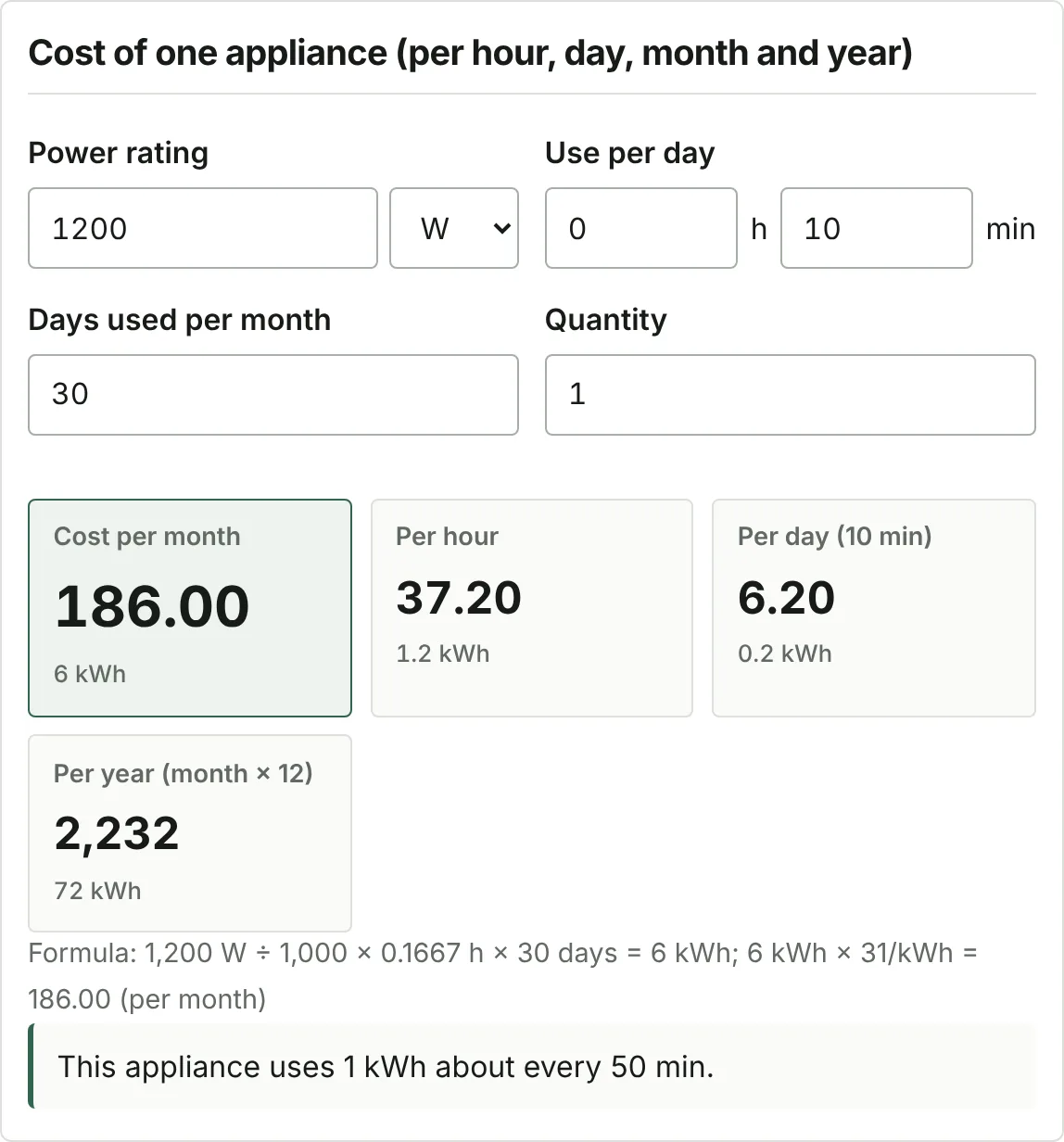
That comes to 6.2 yen a day and 186 yen a month. The hourly cost of 37.2 yen is the same as the heater’s; the total is small only because the dryer runs for such a short time. A high wattage alone does not make an appliance expensive to run. You always have to look at it together with how long it is used.
If you run four identical light bulbs, enter 4 as the quantity. Several units used for the same time are covered by a single multiplication.
Quick table by power rating
Below the inputs, the section lists the cost for power ratings from 5 W to 2,000 W. It uses the hours, days, quantity and price you entered above, and the row for the power rating you entered is shown in bold.
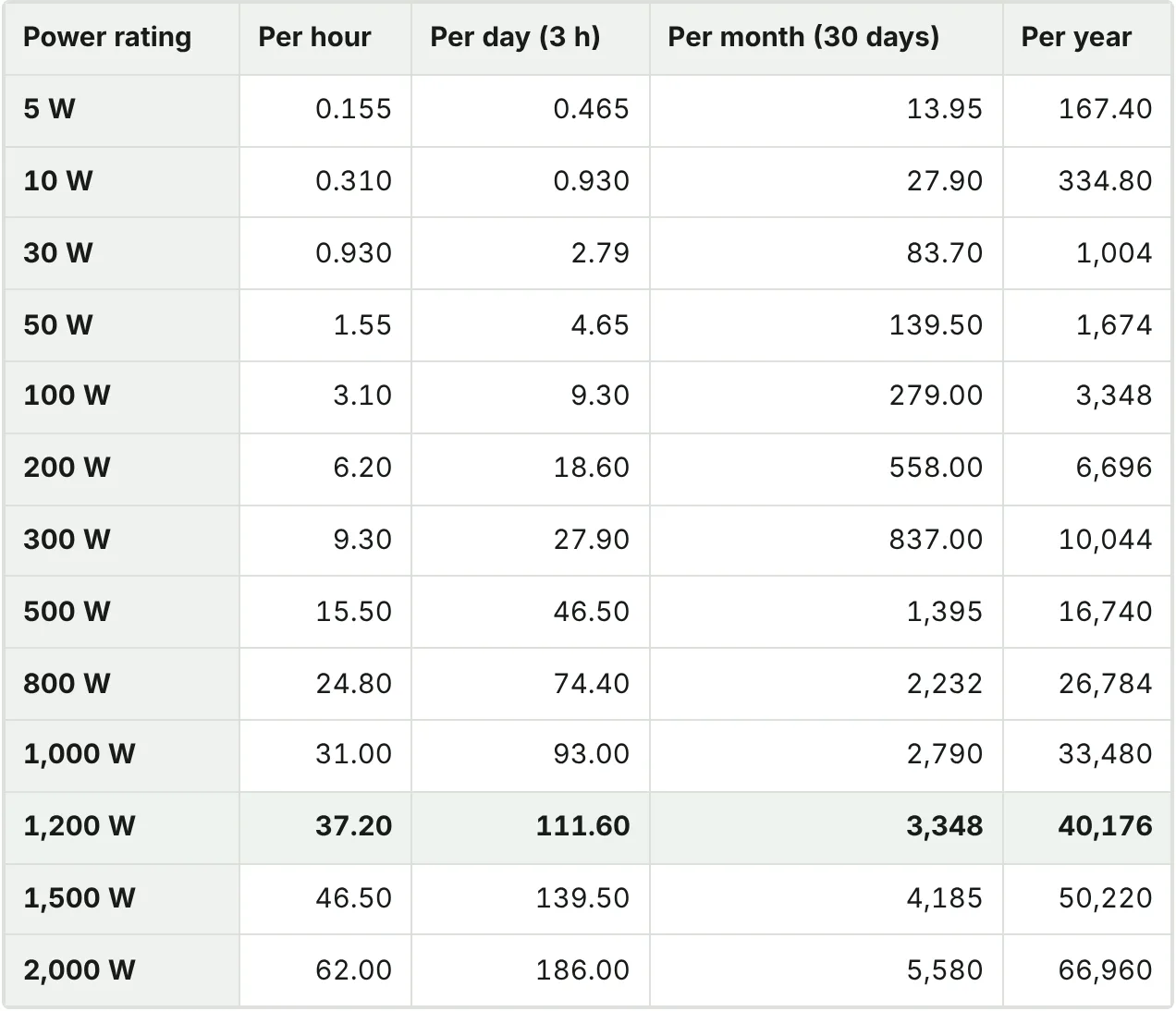
At 31 yen/kWh, 3 hours a day and 30 days, 100 W costs 279 yen a month, 800 W costs 2,232 yen and 2,000 W costs 5,580 yen. Because cost is proportional to power, remembering the figure per 100 W lets you estimate any other wattage in your head.
Appliances that do not draw their rated power all the time
Everything so far assumes the appliance draws its rated power the whole time it is on. That holds closely for appliances that simply turn electricity into heat, such as space heaters, hair dryers and electric kettles.
Appliances that hold a temperature behave differently. Air conditioners, refrigerators, a kotatsu (a low Japanese table with a built-in electric heater underneath), heated floor mats and oil-filled radiators turn their output down or switch off as they approach the set temperature. Multiplying their rated power by the hours gives a figure higher than reality, so treat it as the upper limit for running at full power. For refrigerators and air conditioners, whose spec sheets list an annual energy consumption in kWh per year, entering that figure in the replacement comparison described below is much closer to real use.
Four appliances side by side: the winter bill is mostly the heater
To see which appliances account for how much of a household’s bill, use the “Several appliances” section. It starts with four example rows: a space heater at 800 W (5 hours a day), four LED bulbs at 8 W each (6 hours a day), a laptop at 45 W (8 hours a day, 22 days a month) and a hair dryer at 1,200 W (10 minutes a day).
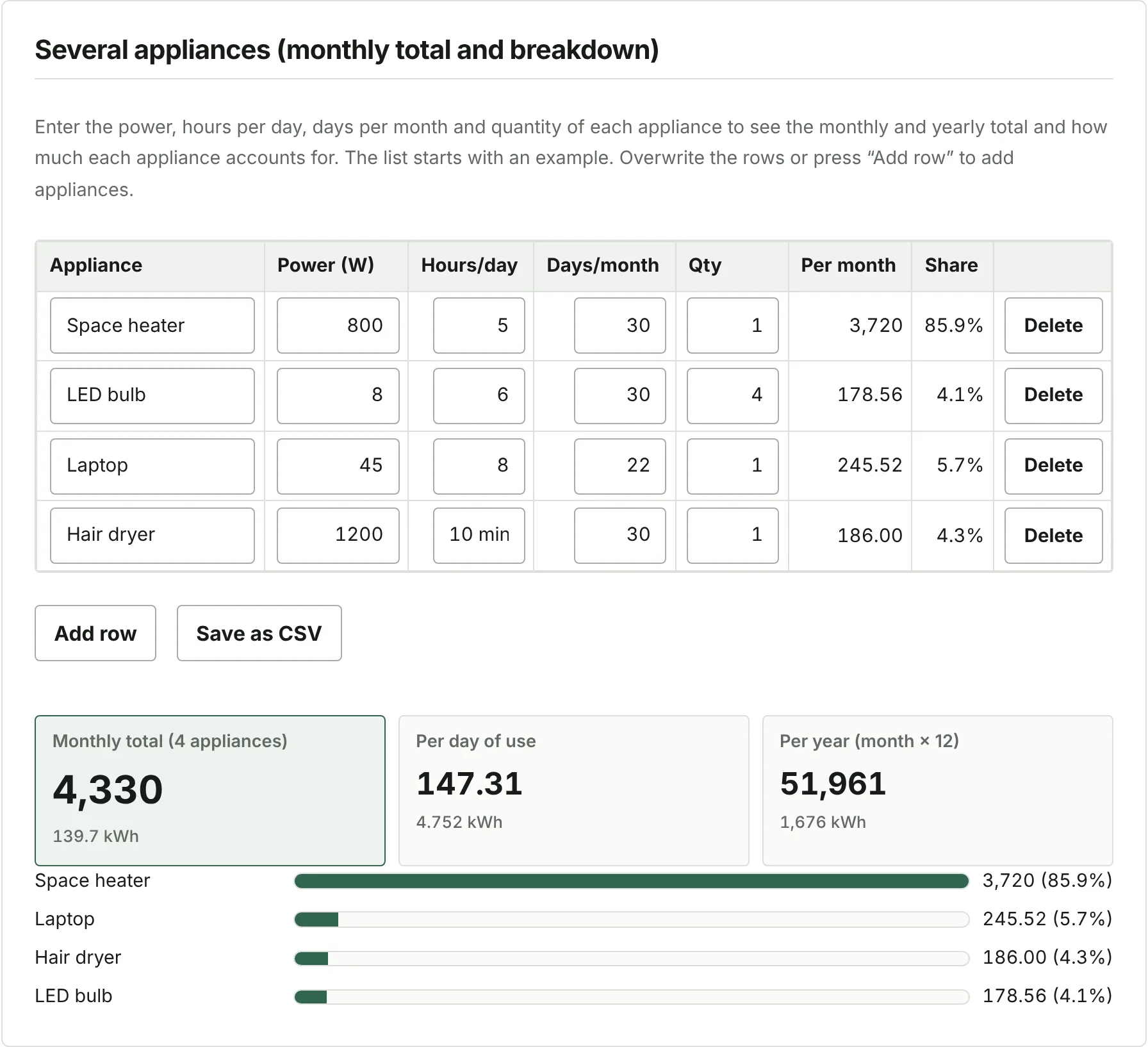
The monthly total is 4,330 yen (139.7 kWh), and the space heater accounts for 3,720 yen of it, or 85.9%. All four LED bulbs together come to 178.6 yen, the laptop to 245.5 yen and the hair dryer to 186 yen.
Saving electricity tends to bring to mind switching off lights, but in this example turning off half the bulbs would save only about 90 yen a month. Cutting the heater from 5 hours a day to 4 saves 744 yen a month. Laying the appliances out side by side makes it obvious where an effort will actually pay off.
Change any number in a row and the costs, shares and the bar chart below update immediately. To add an appliance, press “Add row”. An appliance calculated in “Cost of one appliance” above can be added to this list with “Add to the list”. The Hours/day column accepts 3, 1.5, 10 min or 1:30.
“Save as CSV” saves the energy, cost and share of each appliance plus the total as a CSV file (UTF-8 with BOM, so it opens correctly in Excel). It is useful for keeping a record of household spending or comparing one season with another.
How much a new appliance saves, and how long it takes to pay back
To find out how much a more efficient model would cut your bill, use “How much would a new appliance save? (old vs new)”. There are two ways to compare.
A 60 W bulb against an 8 W LED bulb (power and hours of use)
For appliances whose power stays roughly constant while they run, set “Compare by” to “Power (W) and hours of use”. As an example, I compared a 60 W incandescent bulb with an 8 W LED bulb, both used 6 hours a day, 30 days a month.
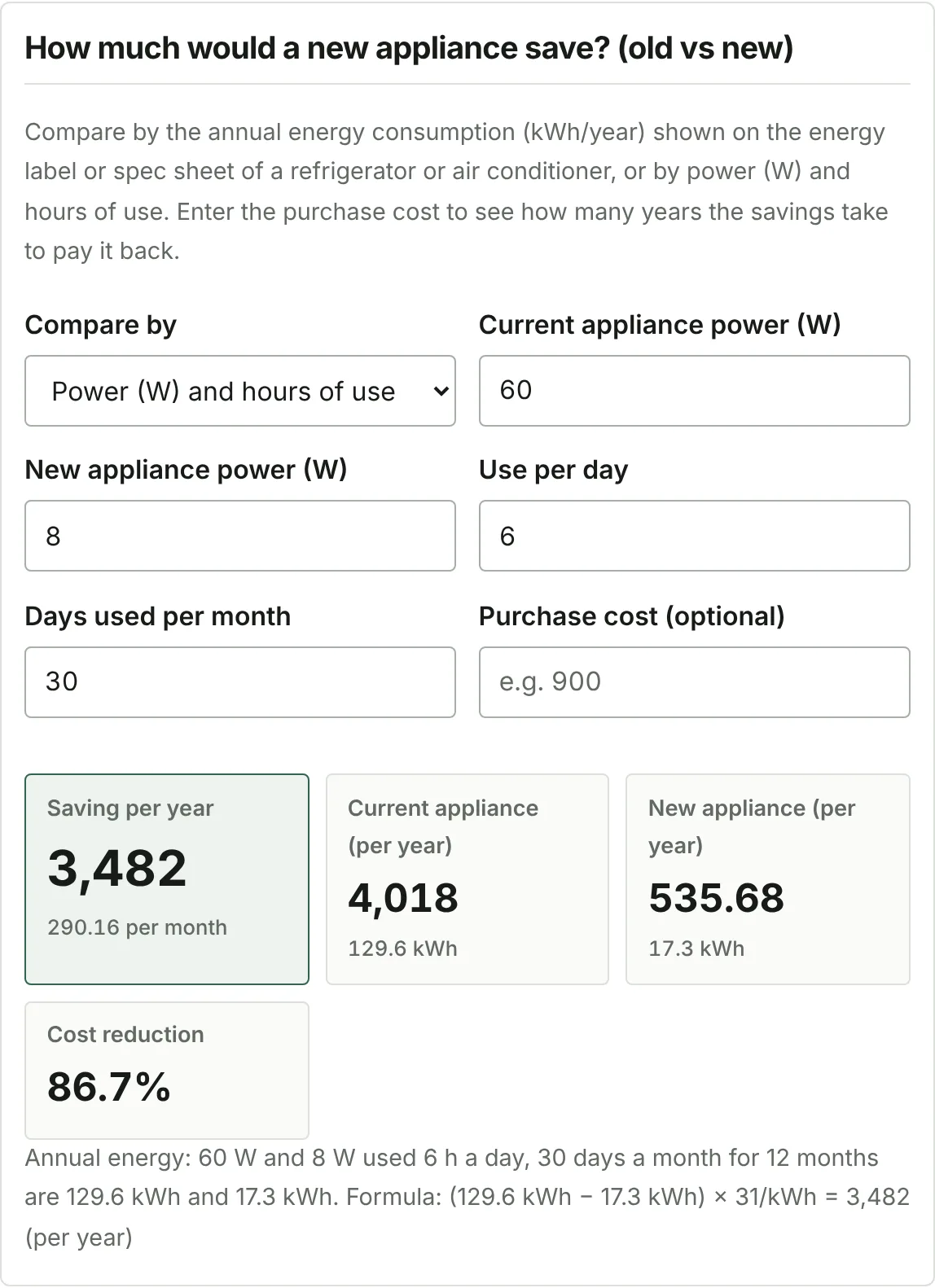
The annual energy is 129.6 kWh against 17.3 kWh, a saving of 3,482 yen a year, or 290.2 yen a month: an 86.7% reduction. The ratio of the power ratings (8 ÷ 60) carries straight through to the cost, so the percentage stays the same however many hours you use the bulbs; only the amount grows in proportion to the hours.
Comparing refrigerators by the annual energy on the label
Refrigerators and air conditioners keep changing how hard they run, so power × hours does not give a realistic cost. Use the annual energy consumption (kWh per year) from the energy label or spec sheet instead. Set “Compare by” to “Annual energy (kWh/year)” and the fields start at 520 kWh/year for the current appliance and 280 kWh/year for the new one. I added 120,000 as the purchase cost.
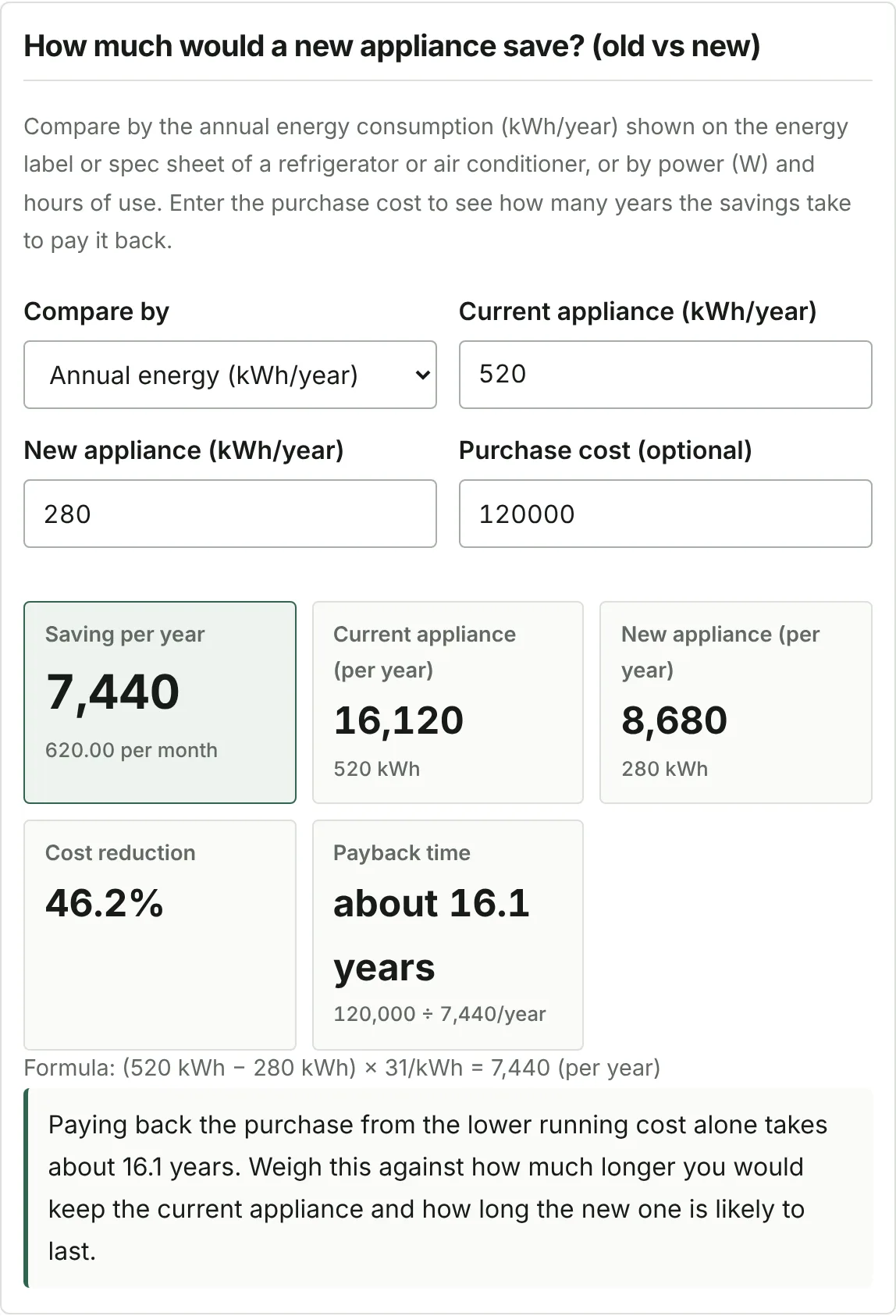
The yearly running cost falls from 16,120 yen to 8,680 yen, a saving of 7,440 yen or 46.2%. Divide the 120,000-yen purchase price by that saving, though, and it takes about 16.1 years to get the money back. When the payback time exceeds 10 years, the tool adds a note asking you to weigh it against how much longer you would keep the current appliance and how long the new one is likely to last.
Replacing an appliance that still works purely to save on electricity does not necessarily pay for itself. On the other hand, if the old one has broken down and you have to buy something anyway, entering the price difference between two candidate models as the purchase cost tells you how many years it takes for the more efficient, more expensive model to earn back the extra.
The annual energy figure for an air conditioner is calculated for a set climate, season and hours of use. If you live somewhere else or use it differently, your real consumption will differ, so treat the figure as a yardstick for comparing models measured under the same conditions.
Working out your own price per kWh from your bill
31 yen/kWh is only a reference price. What you actually pay depends on your supplier, your tariff, how much you use, and in Japan the monthly fuel cost adjustment, a per-kWh charge that moves with the price of the fuel used to generate electricity. To calculate with your own numbers, enter the amount and usage from your bill in “Work out your price per kWh from your bill”. In Japan the figures are on the monthly electricity usage notice that the meter reader leaves in your mailbox, or on the online statement. As an example, I entered a bill of 9,800 yen for 280 kWh.
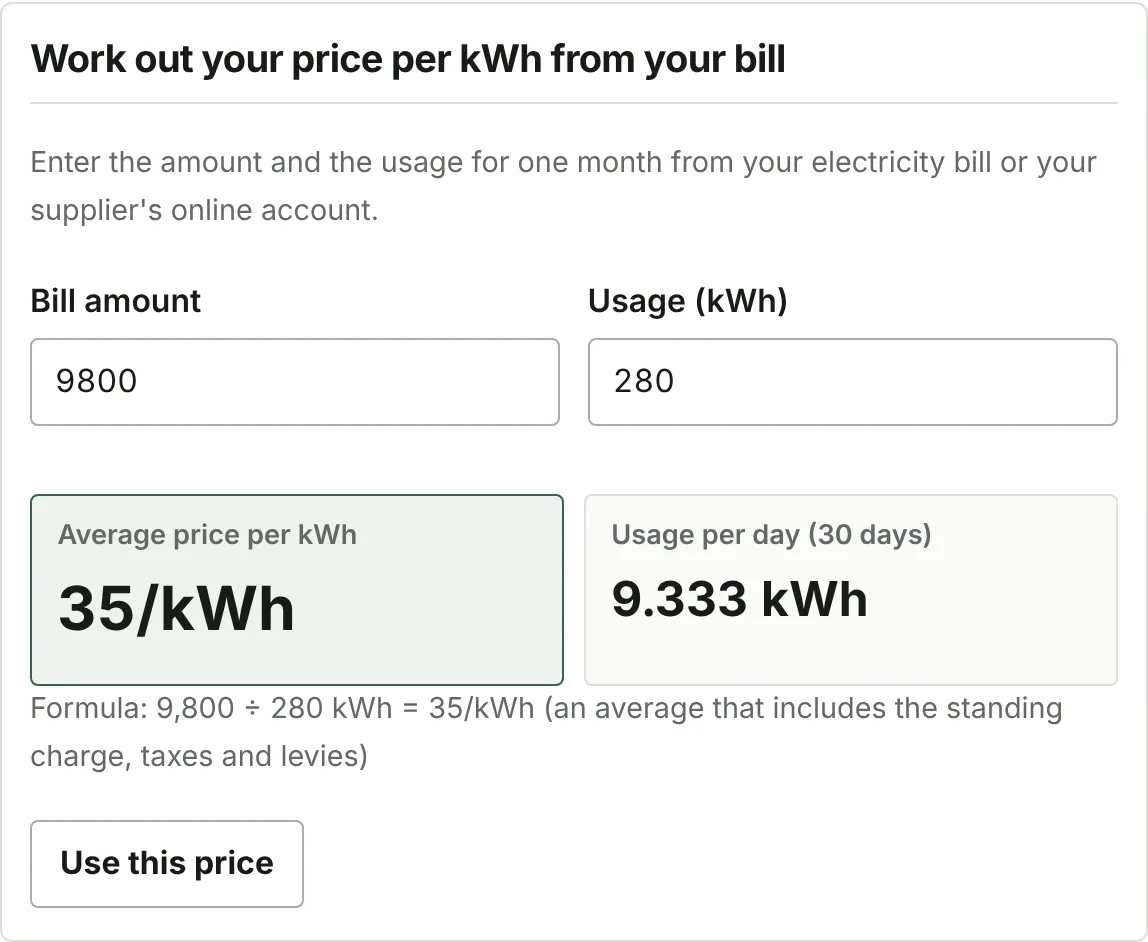
The average price is 9,800 ÷ 280 = 35 yen/kWh, 4 yen above the reference price. (The Japanese version of the tool also shows that difference from 31 yen.) Press “Use this price” and the price at the top of the page changes to 35, and every other section is recalculated with it. The 1,200 W heater used 3 hours a day for 30 days goes from 3,348 yen to 3,780 yen.
This average includes the standing charge, the fuel cost adjustment and the renewable energy surcharge, a per-kWh levy added to every Japanese bill to fund renewable generation. That makes it a good figure for splitting the whole bill between appliances, but it is not quite the same as how much the bill rises when you start using one more appliance, because the standing charge stays the same however much you use. To estimate the extra cost precisely, take the energy rate for the usage band you fall into from your tariff, add the per-kWh fuel cost adjustment and renewable energy surcharge, and enter that as the price. Outside Japan, the equivalent is the per-kWh rate on your tariff including tax.
The fuel cost adjustment changes from month to month, so working out the average price from a winter bill and a summer bill shows you how much your price per kWh varies.
Keeping and sharing a calculation
Your inputs are saved in the page URL after #, so a bookmark reopens the same list of appliances. “Copy all results” copies the price, the result of each section and the formulas as text. “Reset to example” puts every input back to the initial example.
Under the tool, “Share or embed this result” lets you send a URL that includes your inputs to X (formerly Twitter) or LINE, the messaging app widely used in Japan, and save the result of the last section you used as an image. All calculations run in your browser, and the numbers you enter are not sent anywhere.
Electricity suppliers round each charge on the bill in their own way, for example by dropping fractions of a yen. The tool calculates with the values exactly as entered and rounds only for display, so its result can differ from your bill by a few yen.
Related tools and articles
To find by what percentage your electricity cost has risen from the same month last year, use the Percentage Calculator. Why a year-over-year change is easy to confuse between “percent” and “percentage points” is explained in “Is 20% Off Plus Another 10% Off Really 30% Off?”.
Test environment
- Electricity Cost Calculator (English version, with 31 entered as the price), Chromium via Playwright
- The 1,200 W / 3-hour example, the list of several appliances and the annual energy of 520/280 kWh/year are each section’s initial values. The 10-minute hair dryer, 60 W/8 W at 6 hours and 30 days, the 120,000 purchase cost, and the 9,800 bill for 280 kWh were checked by entering the numbers given in the text