Tune a guitar with your phone or computer microphone: standard, half-step down, Drop D, and how to read cents
How to tune all six strings with a browser-based guitar tuner when you don't have a tuner at hand. Using test tones fed into the tool — the 5th string 18 cents flat, 2 cents sharp, a different string from the one selected, and a 6th string still in standard tuning checked against the half-step-down and Drop D presets — this guide explains how to read cents, the ±5-cent “In tune” range, why nothing appears when the wrong string is selected, what +100 and +200 cents mean when you first switch to half-step down or Drop D, and how much difference setting A4 to 442 Hz makes.
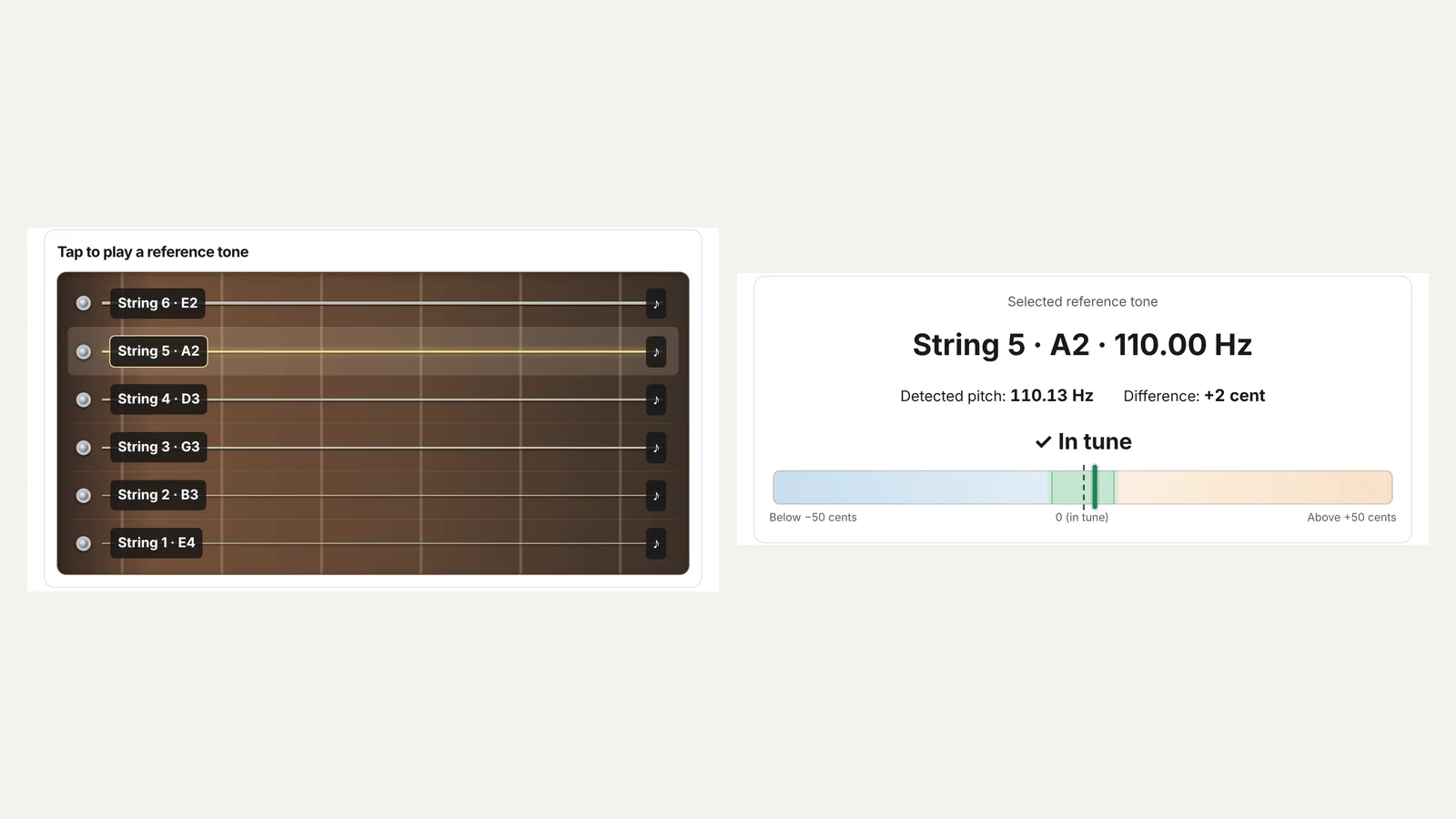
You pull out a guitar you haven’t touched in a while, you’ve just put on new strings, or a friend hands you their guitar to play. If there’s no clip-on tuner around, the first problem is tuning. You could hunt for a phone app, but many are full of ads or ask for permissions, so they aren’t always ready to use right away.
The Guitar Tuner is a tuner that works as soon as you open it in a browser. It can play the reference tone for the selected string, and it can show how far the guitar sound picked up by your microphone is above or below that reference. Besides standard tuning, you can switch to half-step down, whole-step down, Drop D, Drop C, DADGAD, open G, and standard tuning for a seven-string guitar. The microphone audio is analyzed inside the browser and is not sent anywhere.
This article walks through selecting a string and tuning it on the tool’s screen, and explains what the “cent” readout means, using the results of actual tones fed into the tool.
How I tested it
To check the tuner’s behavior in numbers, I used synthesized tones that imitate a plucked string rather than the sound of my own guitar. Using the Karplus-Strong method, which models a vibrating string, I made WAV files at specified frequencies, re-plucked every 3 seconds, and fed them to the tool as Chromium’s fake microphone input (--use-file-for-fake-audio-capture). I measured each tone’s pitch with autocorrelation and confirmed it was within 0.01 cent of the target frequency.
I prepared five tones: 18 cents below the 5th string A2 (110.00 Hz), 2 cents above it, exactly 110.00 Hz, exactly the 6th string E2 (82.41 Hz), and 40 cents below that. All screenshots are from the English version of the tool.
String pitches and “cents”
In standard tuning, the six strings are tuned to E, A, D, G, B, E, starting from the low 6th string. In the tool, the number after the note name is the octave: the 6th string is E2 and the 1st string is E4, the same note E two octaves apart.
| String | Note | Frequency (A4 = 440 Hz) |
|---|---|---|
| 6th | E2 | 82.41 Hz |
| 5th | A2 | 110.00 Hz |
| 4th | D3 | 146.83 Hz |
| 3rd | G3 | 196.00 Hz |
| 2nd | B3 | 246.94 Hz |
| 1st | E4 | 329.63 Hz |
These frequencies take the reference A4 (the A above middle C on a piano) as 440 Hz and multiply by the twelfth root of 2 (about 1.0595) for each semitone up. The tool uses the same calculation.
The unit the tuner uses for the difference is the cent. A cent is one hundredth of a semitone: +100 cents is a semitone sharp, and -50 cents is a quarter tone flat. A difference in Hz means different things on different strings. On the 6th string, 1 Hz off is about 21 cents, but on the 1st string 1 Hz is only about 5 cents. Cents let you compare how far off you are on the same scale for every string.
Select the string, then play it
When you open the tool, check that “Tuning preset” is set to “Standard (E A D G B E)”. Then choose the string you want to tune, either from the “String” list or by tapping the string on the fretboard drawing below it.
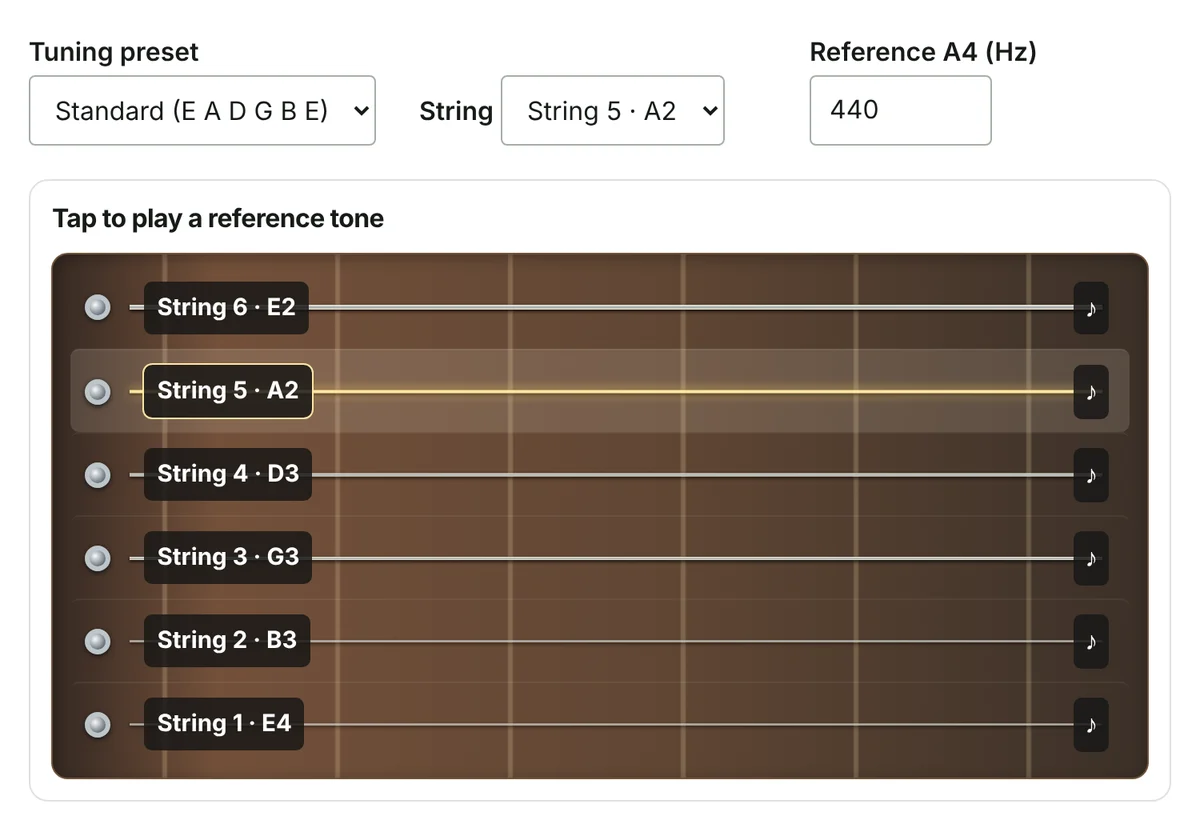
Tapping a string on the fretboard drawing selects it and starts its reference tone. If you want to tune by ear, this is all you need. Play the open string on the guitar and turn the tuning peg until the beating against the reference tone (the “wah-wah” wobble in the sound) slows down and disappears. “Play reference tone” starts and stops the tone, and tapping another string while it plays switches only the pitch.
To tune with the microphone, press “Check with microphone” and allow microphone access when the browser asks. Detection works with the reference tone still playing, but the microphone will pick up the speaker, so listen through earphones or headphones, or stop the reference tone. If you want to select a string without playing its reference tone, pick it from the “String” list instead of the fretboard drawing.
The microphone works only on an HTTPS page and only after you grant the browser permission. If it doesn’t respond even after you’ve allowed it, a different microphone may be selected or another app may be using it. You can narrow this down with the steps in “Test your mic and camera before a video call”.
Reading the result
Here is the screen after playing a tone 18 cents flat (108.86 Hz) with the 5th string A2 selected.
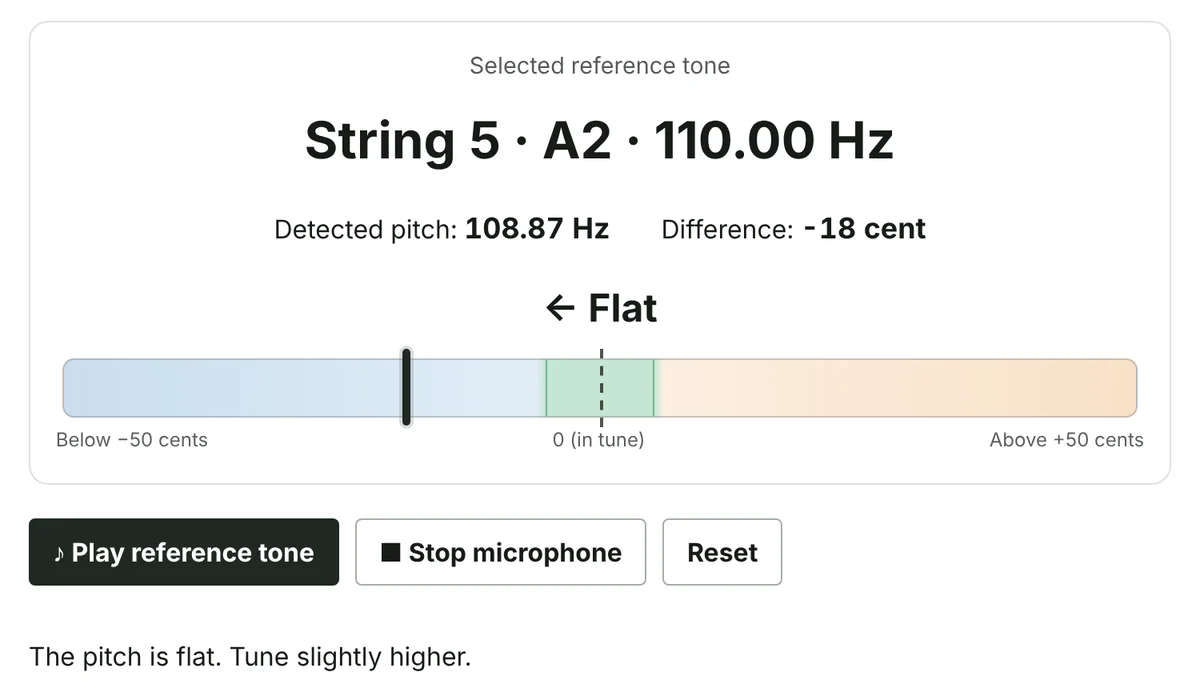
“Detected pitch” shows 108.87 Hz, “Difference” shows -18 cent, and the verdict is “← Flat”. The message below also says “The pitch is flat. Tune slightly higher.” The left side of the meter is flat and the right side is sharp; tighten the string until the needle enters the green zone in the center.
With a tone 2 cents sharp (110.13 Hz), the verdict changed to “✓ In tune”.
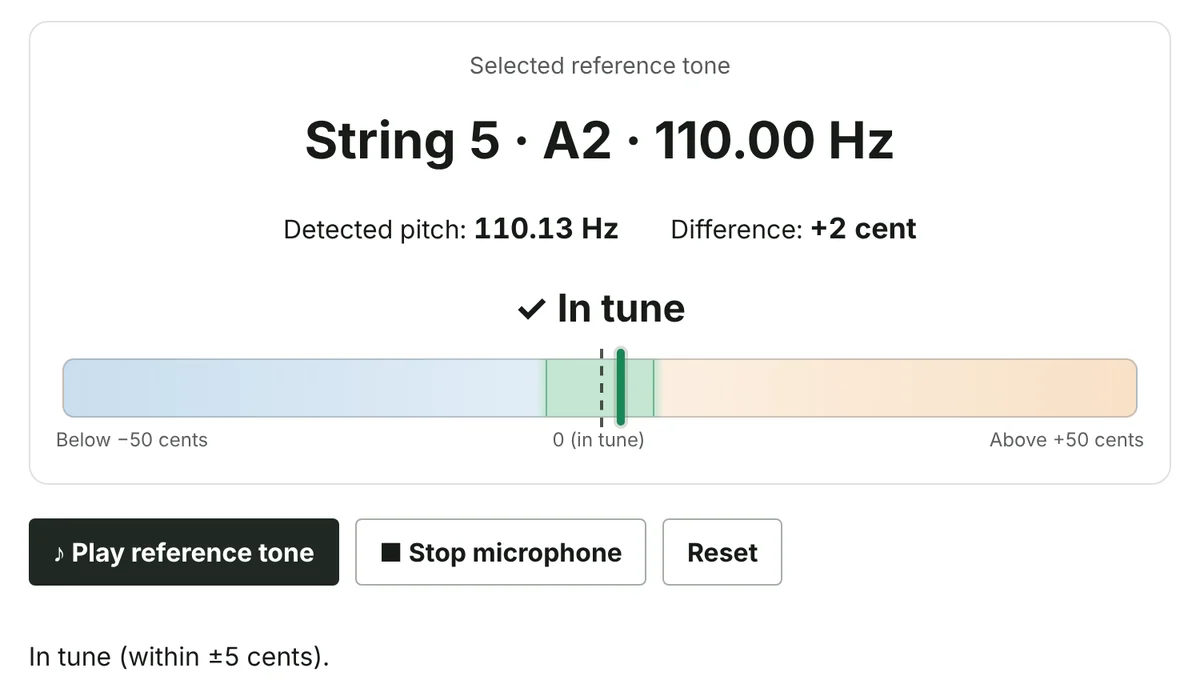
The tool treats anything within ±5 cents as “In tune”. Five cents is one twentieth of a semitone, a difference you can barely hear even when comparing tones side by side. There’s no need to chase the number as it flickers by 1 or 2 cents; once the needle settles in the green zone, move on to the next string.
If you overshoot while turning the peg, it’s easier to drop the string clearly flat and bring it back up than to lower it straight onto the pitch. The gears in the tuning machine have some play, and a string stopped while being lowered can slip back slightly under string tension as you play.
When all six strings are done, go through them once more from the 6th string. Tightening one string changes the force on the neck, and strings you tuned earlier may drift a little. Freshly installed strings stretch and go flat easily, so expect to recheck them several times.
Nothing appears if you play a different string from the one selected
With the 5th string A2 still selected, I played the 6th string E2 tone. The verdict stayed at “Waiting for microphone input”.
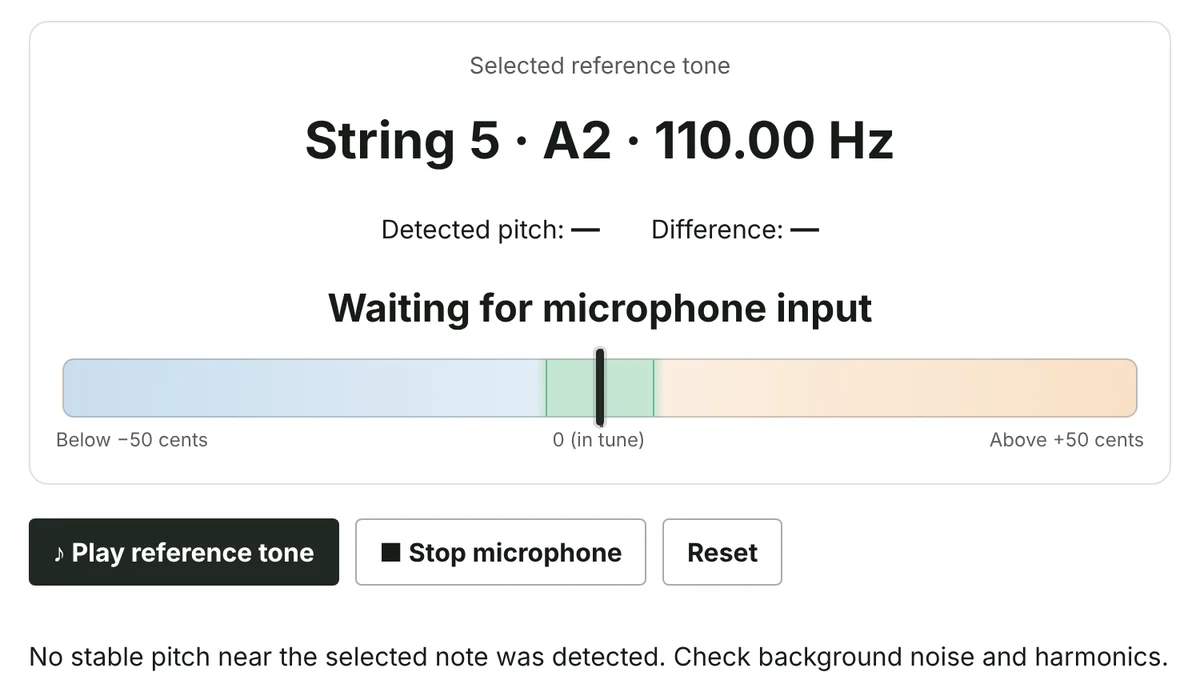
The message reads “No stable pitch near the selected note was detected. Check background noise and harmonics.” The tool doesn’t try to identify whatever note is sounding; it searches only within three semitones (±300 cents) above and below the selected string’s note. The 6th string E2 is five semitones (500 cents) below the 5th string A2, so it falls outside that range.
This design means the tool picks up only sounds close to the string you’re aiming for and is less likely to be thrown off by other strings ringing or by harmonics. The trade-off is that nothing appears if the string you selected and the string you played don’t match. If the display stays on “Waiting for microphone input”, first check that the selected string is the one you’re playing. A string that has gone so slack it is more than three semitones flat gives the same result; in that case, play the reference tone, bring the string roughly into range by ear, and then finish with the microphone.
With the 6th string selected, a tone 40 cents flat (80.52 Hz) showed -40 cent and “← Flat”. Even a low string like the 6th can be measured.
Switching to half-step down or Drop D
To change from standard tuning to another tuning, switch the tuning preset and then follow the same steps. The notes for each string in each preset are as follows.
| Tuning preset | 6th → 1st string |
|---|---|
| Standard (E A D G B E) | E2 A2 D3 G3 B3 E4 |
| Half-step down (E♭) | E♭2 A♭2 D♭3 G♭3 B♭3 E♭4 |
| Whole-step down (D) | D2 G2 C3 F3 A3 D4 |
| Drop D | D2 A2 D3 G3 B3 E4 |
| Drop C | C2 G2 C3 F3 A3 D4 |
| DADGAD | D2 A2 D3 G3 A3 D4 |
| Open G | D2 G2 D3 G3 B3 D4 |
| 7-string standard | B1 E2 A2 D3 G3 B3 E4 |
With a guitar still in standard tuning, I selected “Half-step down (E♭)” and played the 6th string E2 tone. First the message “A large pitch difference was detected. Checking for a stable signal.” appeared, and shortly afterward it changed to “Detected pitch: 100 cent sharp relative to the reference. The meter is capped at ±50 cents.” In other words, lower the 6th string by exactly one semitone.
In “Drop D”, only the 6th string is lowered a whole step, from E2 to D2 (73.42 Hz). Playing the same 6th string E2 tone showed +200 cent.
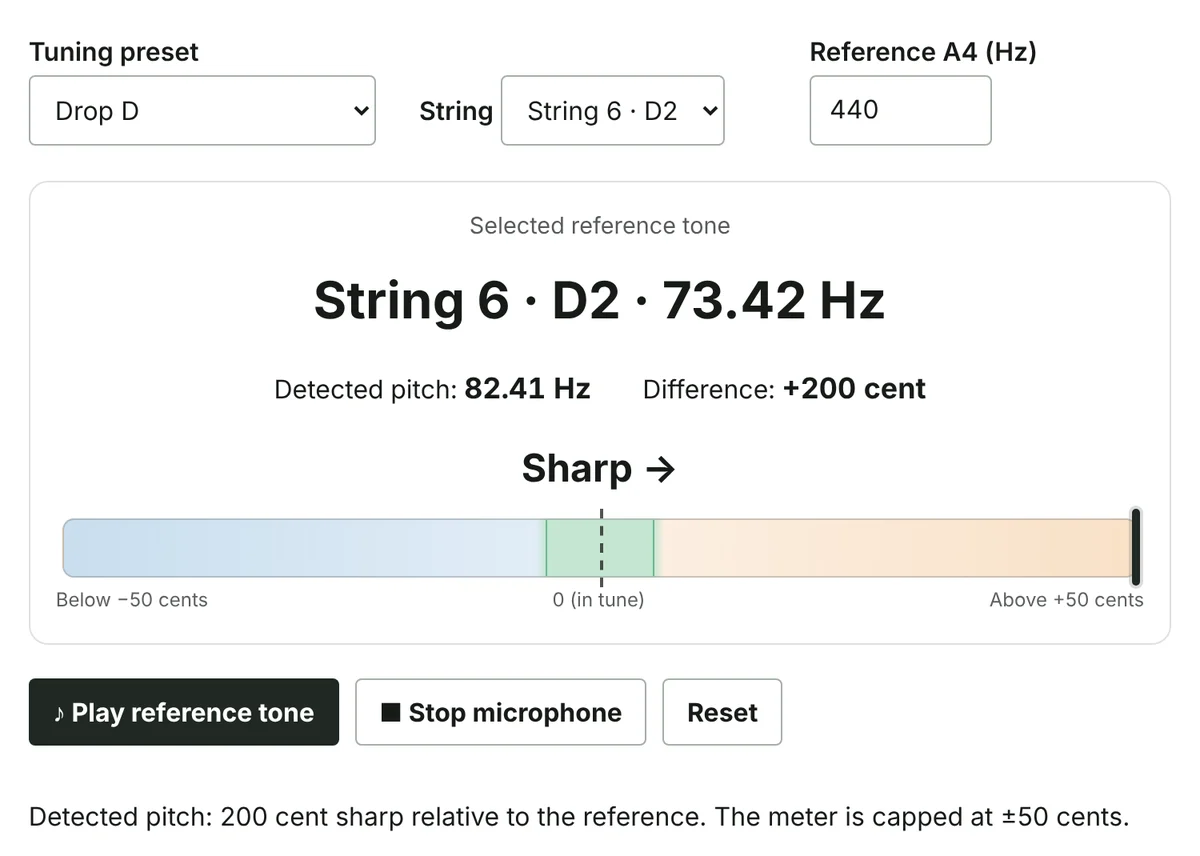
The meter stops at ±50 cents, so the needle sits at the right end whether you’re +200 or +60 cents off. When you’re far off, lower the string while watching the “Difference” number rather than the meter; once it’s under 50 cents and the needle starts moving, finish with the needle. When the difference exceeds 50 cents, the tool shows a result only after the same pitch continues for a while, to make sure it hasn’t mistakenly picked up noise. That is why there’s a short pause before anything appears.
In presets that change only some strings, like Drop D, the unchanged strings stay in tune from standard tuning. Select and tune only the strings that change. The “Drop D” and “DADGAD” links at the top of the tool page switch directly to those presets. If you bookmark the page opened with Drop D, you won’t have to select it again every time.
Lowering all the strings reduces the tension, which slightly changes the bow of the neck and moves the other strings too. For half-step or whole-step down, tune all six strings once and then go around again to let everything settle.
Setting reference A4 to something other than 440 Hz
The tool uses 440 Hz for the reference A4, but you can change “Reference A4 (Hz)” to any whole number from 390 to 480 Hz. Use it when your ensemble has agreed to tune to 442 Hz, or when an instrument that’s hard to retune, such as a piano, is off from 440 Hz.
With A4 at 442 Hz, the reference for the 5th string A2 becomes 110.50 Hz and the 6th string E2 becomes 82.78 Hz. Playing a 5th string tuned at 440 Hz (110.00 Hz) showed -8 cent and “← Flat”. The gap between 440 Hz and 442 Hz is about 8 cents, which is outside the ±5-cent “In tune” range. Before playing with others, match the reference used by the other instruments and retune.
To restore the defaults, press “Reset”. It returns to standard tuning, the 6th string, and A4 = 440 Hz, and stops the reference tone and the microphone.
When detection doesn’t work well
Microphone detection depends on the surrounding sound and the characteristics of the microphone. In a room with a loud TV or air conditioner, or with other strings resonating and ringing on, the note you’re aiming for is harder to pick up. Pluck one string at a time and lightly rest your palm on the strings you aren’t tuning to mute them. On a laptop, play the guitar close to the built-in microphone.
The tool ignores sounds below a certain level, so the reading disappears for a weakly plucked note or one that has faded after ringing for a while. If the reading cuts out, pluck again. Depending on strong harmonics or the characteristics of your device’s microphone, an off value may also appear. If the number jumps around a lot, pluck a few more times and see whether it settles on the same value.
If you switch screens or turn off your phone’s display, the tool stops the reference tone and the microphone. If you opened another app partway through tuning, press “Check with microphone” again.
Tuners for other string instruments
Tuners built the same way are also available for other string instruments. The Bass Tuner for 4- and 5-string bass, the 12-String Guitar Tuner that tunes each string of a course one at a time, and the Ukulele Tuner all work like the guitar version: select a string, then play it, and read the result the same way.