120 Annual Days Off in 2027 Is Just Weekends and Public Holidays. Counting a Company's Days Off with Summer and Year-End Closures on a Calendar
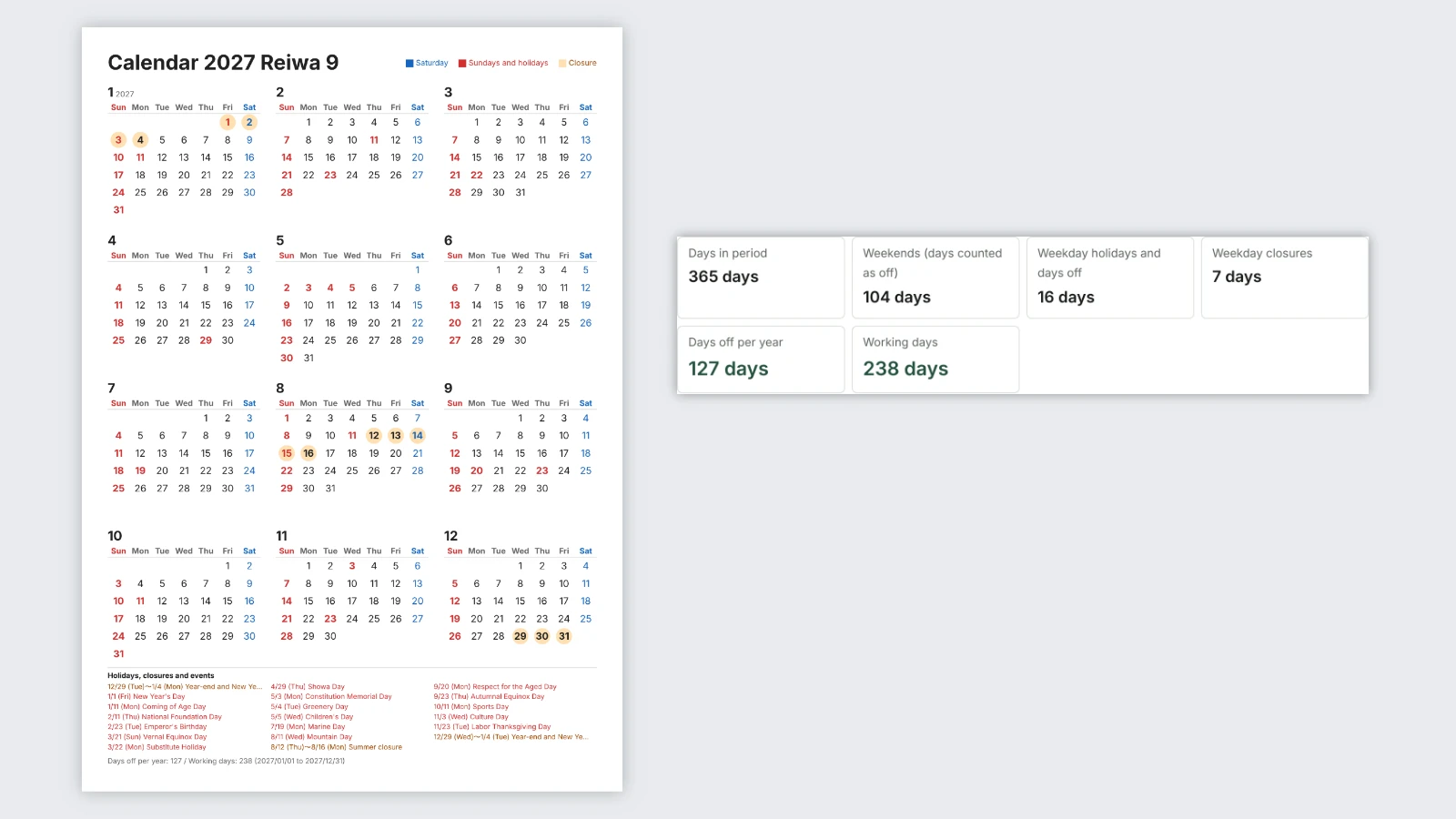
For anyone who wants to check the "120 annual days off" on a Japanese job listing, or count the days off in their own company calendar: in 2027, 104 weekend days plus 16 weekday public holidays make 120, and adding a summer closure and a year-end/New Year closure brings it to 127. This walkthrough uses the Calendar Maker tool, and also covers counting by fiscal year and counting for companies that work Saturdays.
Contents
When a Japanese job listing says “annual days off: 120” (年間休日120日), does that figure count only weekends and public holidays, or does it include the company’s summer and year-end closures too? The opposite question comes from the general-affairs person who is building their own company calendar: before deciding between a 3-day and a 5-day summer closure, they want to know how it changes the annual total.
This article uses 2027 as the example. We first check how many days weekends and public holidays alone give, then add a summer closure and a year-end/New Year closure to count a company’s annual days off. The counting is done with this site’s Calendar Maker, which can also save a year calendar with Japanese public holidays and substitute holidays as a PDF from the same screen.
In 2027, weekends and public holidays alone make exactly 120 days
First, work out the number with no extra closures at all. Once you have it, you can tell whether the figure on a job listing is “weekends and holidays only” or “including the company’s own extra days off.”
2027 has 365 days, and Saturdays and Sundays add up to 104 of them. Japan has 17 public holidays (祝日, the national holidays set by law) in 2027, but March 21 (Vernal Equinox Day) falls on a Sunday, so it is already counted among the weekend days. In its place, the next day, March 22, is a substitute holiday (振替休日, a day off given when a holiday lands on a Sunday), and that is a Monday that does not overlap a weekend. So of the 17 public holidays, 16 fall on weekdays.
- Saturdays and Sundays: 104 days
- Public holidays on weekdays (substitute holidays included): 16 days
- Total: 120 days
In 2027, a company with a full two-day weekend that also takes public holidays off therefore has exactly 120 annual days off. The figure shifts a little from year to year. Counted the same way, 2024 had 118 days, 2025 had 119, 2026 had 121 (September 22 becomes a “citizens’ holiday,” a day between two holidays that is also a day off), 2027 has 120, and 2028 has 120 (the 2028 equinox dates are calculated from estimates, since the National Astronomical Observatory of Japan has not yet published them). So the same pattern of days off can move by a day or so when the year changes, even if a job listing says “120 days.”
Adding summer and year-end closures in the tool and counting
Next we add the company’s own closures. As an example, take a summer closure from Thursday, August 12 to Monday, August 16, and a year-end and New Year closure from Wednesday, December 29 to Tuesday, January 4 of the following year. The screenshots use the English version of the tool; the other language versions have the same layout, and the label in your language is given in parentheses where it differs.
1. Enter the year and the closures
When you open the tool, the year is “2027,” the start month is “January,” and months per page is “12 months,” so the whole year fits on one sheet of paper.
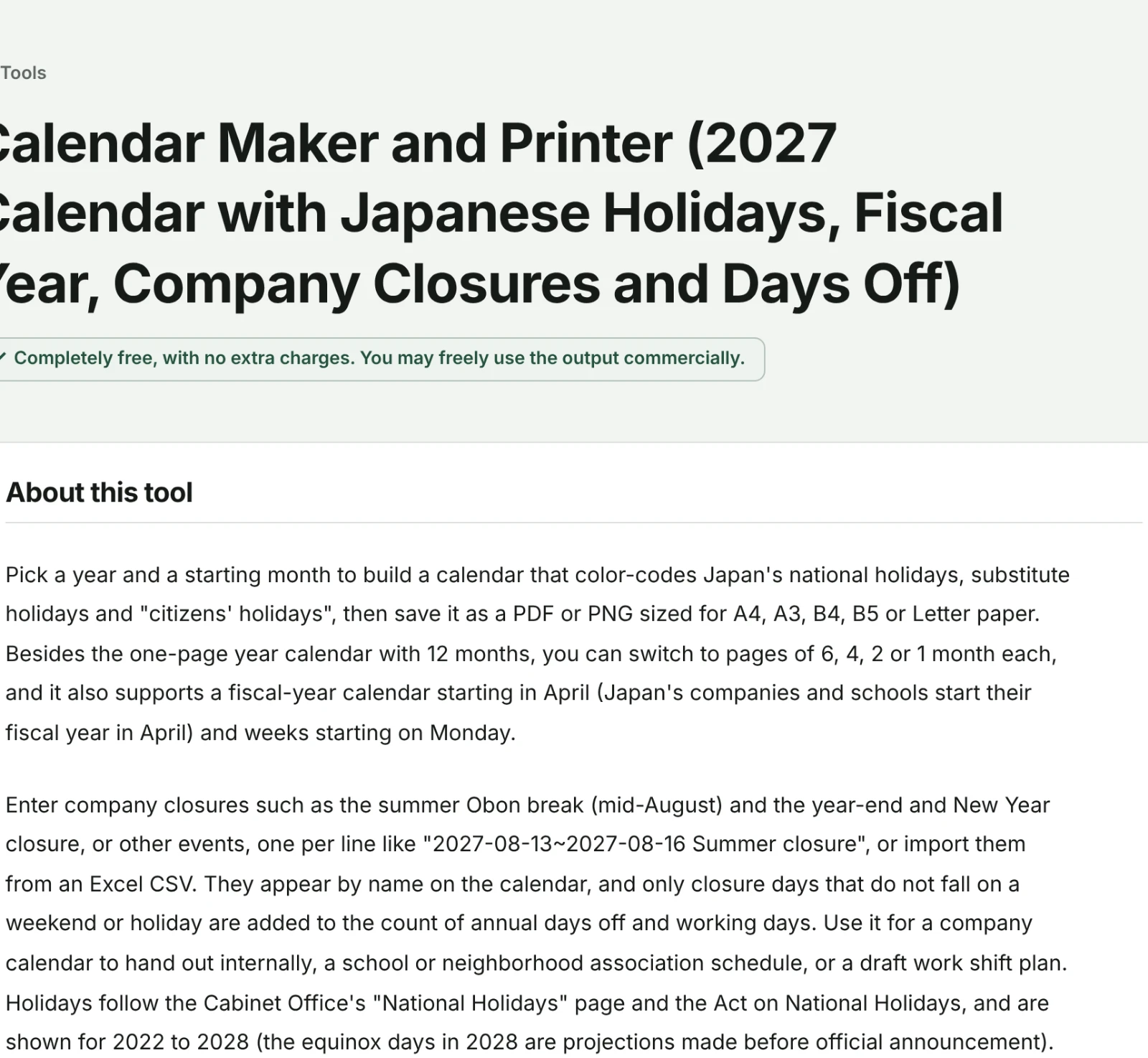
Open “Add company closures and events” and, in the “Closures” box, write one closure per line in the form “start date~end date name”. We entered these three lines:
2026-12-29~2027-01-04 Year-end and New Year closure
2027-08-12~2027-08-16 Summer closure
2027-12-29~2028-01-04 Year-end and New Year closure
The first line is there so that the days of last year’s year-end closure that fall in January 2027 are counted. A year-end closure spans two years, and only days inside the period being counted (January 1 to December 31, 2027) are included. The third line covers December 2027; the January 2028 days are outside the period and are not counted. The box starts out with only the second and third lines, so without the first line the January 2027 closure would be missed.
2. Check where the closures fall on the calendar
Once you enter them, the preview below updates immediately. Saturdays are blue, Sundays and public holidays are red, and closure days are marked with an orange circle.
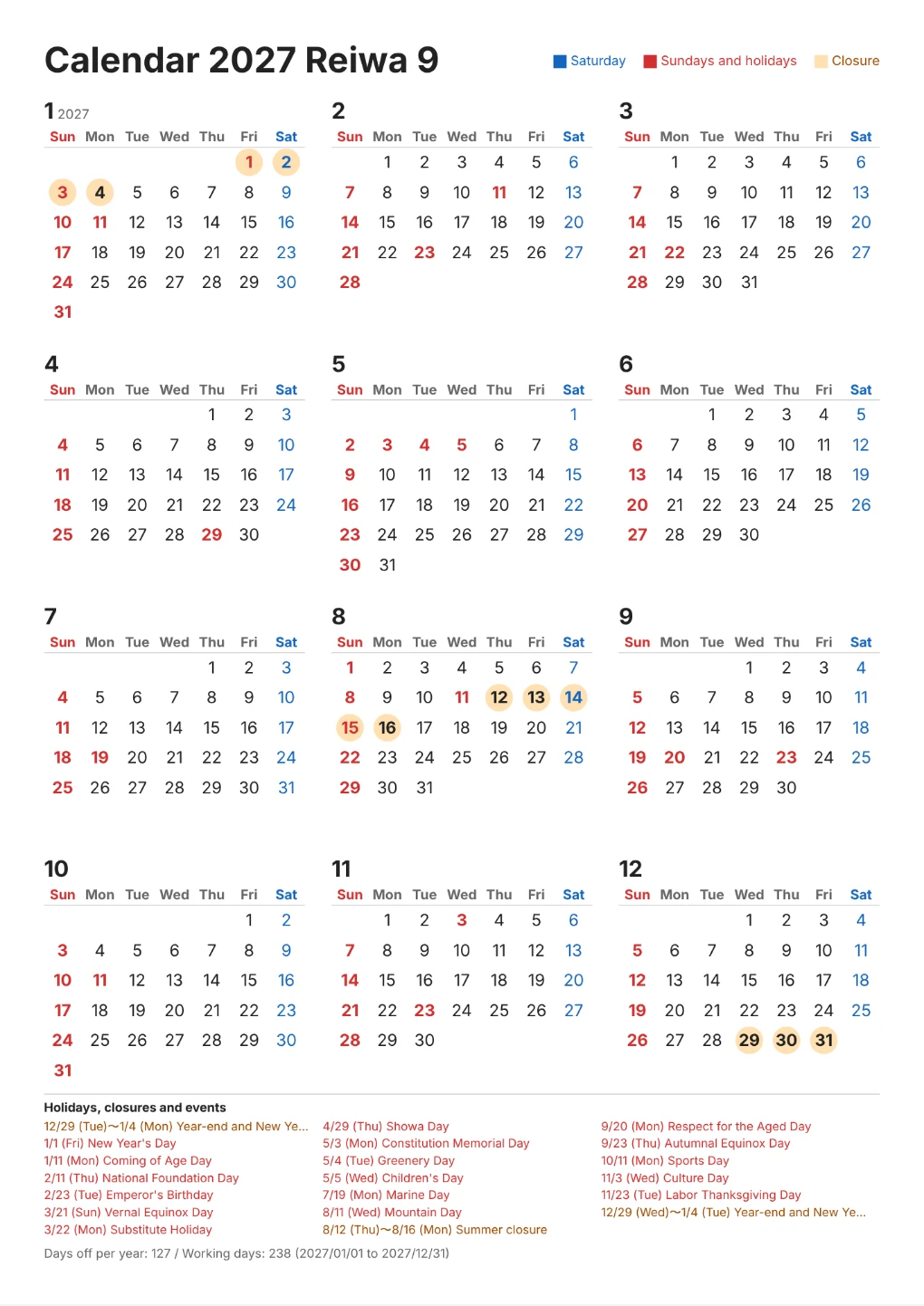
In August, the 12th (Thu) and 13th (Fri) are weekdays, the 14th (Sat) and 15th (Sun) are the weekend, and the 16th (Mon) is a weekday. So even a five-day closure creates only 3 new weekday days off. December 29 to 31 are Wednesday to Friday, so all three are new weekday days off. In January, the 1st is New Year’s Day on a Friday and the 2nd and 3rd are the weekend, which leaves only Monday, January 4 as a new weekday closure.
3. Read the annual days off and working days
The summary appears below the preview.
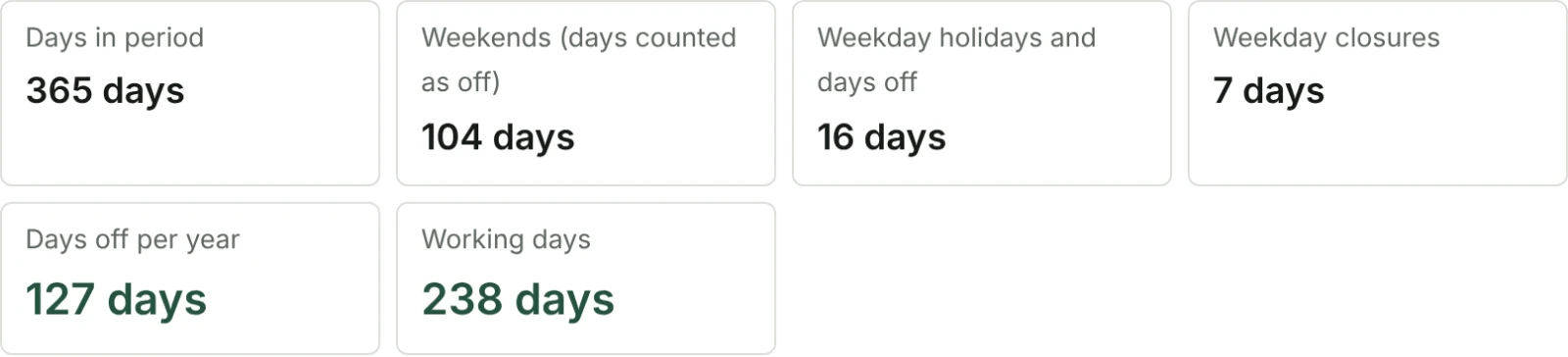
The breakdown is 104 weekend days, 16 weekday public holidays, and 7 weekday closure days, for a total of 127. Working days are 365 minus 127, or 238. The 7 closure days are 3 in August, 3 in December, and 1 in January.
You can also see it as the 120 days from weekends and holidays, plus 3 days of summer closure and 4 days of year-end closure (3 in December and 1 in January), which makes 127. The summer closure runs 5 days and the year-end closure runs 10 days counting last year’s part, but days that already fall on a weekend or a holiday are not counted twice, so the total grows by only 7.
The same days off give different totals depending on the period and on Saturday work
So far we have counted from January to December. In practice, many Japanese companies set their annual days off by fiscal year (年度), which runs from April to March of the following year. Setting the tool’s start month to “April (fiscal year)” and entering the same summer and year-end closures also gives 127 days for the fiscal year, but the breakdown differs: 15 weekday public holidays and 8 weekday closure days. In a fiscal year, the January to March 2027 holidays drop out of the period and the January to March 2028 holidays come in, but New Year’s Day 2028 is a Saturday that overlaps the weekend, so there is one fewer weekday public holiday. On the other hand, the closure days of January 3 and 4, 2028 are weekdays and are added, so closures go up by one. With no closures entered, the count is 120 for the calendar year and 119 for the fiscal year. When comparing “annual days off,” check which period the figure refers to.
Many companies also work on Saturdays. Open “Display and counting options” and uncheck “Count Saturdays as days off in the annual total” to count Saturdays as working days. For 2027 with no closures, that gives 52 Sundays plus 16 weekday public holidays, so 68 annual days off and 297 working days (no public holiday falls on a Saturday in 2027, so the holiday count does not change). If only some Saturdays are off, as at a company that takes every other Saturday, enter the Saturdays that are off as closures and they will be counted.
Does it stay above 105 days, and how it affects the overtime rate
When you read a job listing or a company’s work rules (就業規則, the rules every employer must set out for employees) and wonder whether the annual days off are too few, here is a rough guide worked out. Article 32 of Japan’s Labor Standards Act (労働基準法) sets the upper limit on weekly working hours at 40. For a company with 8-hour days, the maximum number of working days in a year (365 days) is 365 ÷ 7 × 40 ÷ 8 = about 260.7 days. Days off must therefore be at least 365 minus that, about 104.3 days, so rounding up gives a guide of 105 days. In 2027, weekends alone come to 104 days, so a company that does not give public holidays off has to add at least one more day off, such as a summer closure, or its scheduled working days would exceed the limit.
Annual days off also bear on the hourly rate used for overtime pay. The average monthly scheduled working hours are calculated as “(365 days − annual days off) × scheduled hours per day ÷ 12,” so for the same monthly salary, a company with more annual days off has a higher hourly rate. For a worked example comparing 105 and 125 annual days off, see What Is One Hour of Overtime Worth in Japan?.
Handing out the counted result as a company calendar
If you are making your own company’s calendar, the tool’s “Save PDF” button turns the year calendar, with public holidays and closures color-coded, into a PDF in A4 or another size that you can hand out. If you choose one month per page, you also get margins for writing in plans. When you only want the number of days or business days between two dates, the Day Calculator works (how to use it is in Count business days over New Year with the Day Calculator).
The public holidays follow the Cabinet Office’s list of “National Holidays” (国民の祝日) and the National Astronomical Observatory of Japan’s annual almanac announcement (暦要項). The 2028 Vernal and Autumnal Equinox Days are estimates, because the almanac announcement is not published until February 2027.
Frequently asked questions
How many annual days off do you get in 2027 from weekends and public holidays alone?
- In 2027 there are 104 Saturdays and Sundays combined, plus 16 public holidays that fall on weekdays (substitute holidays included). Only March 21, Vernal Equinox Day, lands on a Sunday, so of the 17 public holidays, 16 add to the count.