What Is One Hour of Overtime Worth in Japan? Working Out the Hourly Rate From Salary and Annual Days Off, and Checking Payslip Overtime and Fixed Overtime Pay
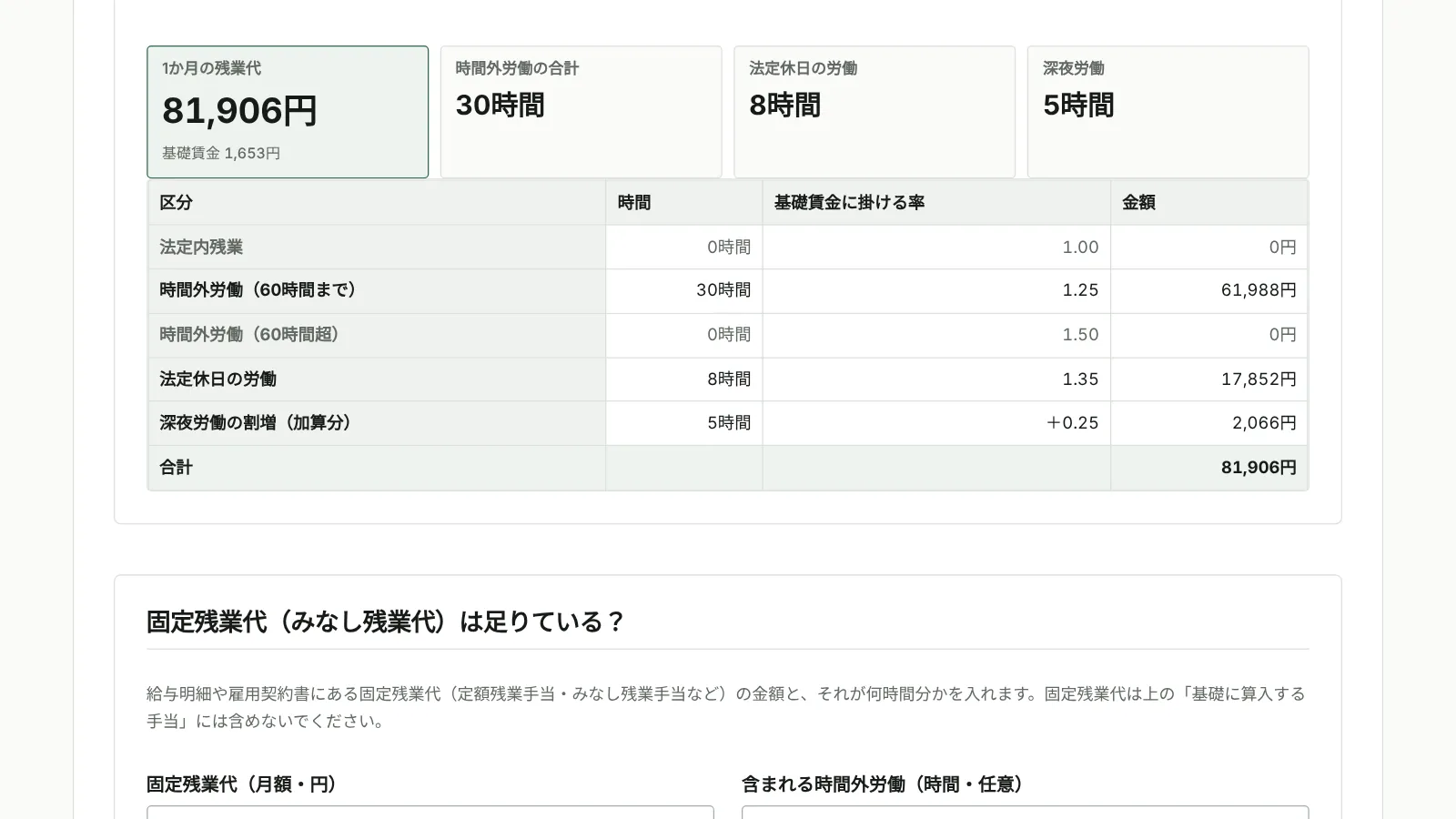
With a ¥250,000 base salary, ¥20,000 in allowances, 120 annual days off and 8-hour days, one hour of overtime in Japan is worth ¥1,653, and 30 hours of overtime, 8 hours on the statutory day off and 5 late-night hours come to ¥81,906. The same salary gives ¥1,558 with 105 days off and ¥1,688 with 125. At 70 hours, the 10 hours beyond 60 are paid at 1.5 times, for ¥148,770. A ¥40,000 fixed overtime allowance for 20 hours falls short of the ¥41,325 legal minimum. We entered the numbers into the overtime pay calculator to check a payslip step by step.
Contents
A Japanese payslip (kyūyo meisaisho) usually shows the overtime allowance as a single amount, without saying how many hours it covers or what hourly rate was used. You can see the hours you worked in your attendance records, but without the hourly rate there is no way to check whether the amount is right.
Japan’s Labor Standards Act (Article 37) sets overtime pay as “hourly base wage × hours × premium rate”. The multiplication is not the hard part. What trips people up is which hours the monthly salary is divided by to get the hourly rate, which allowances count, and which category late-night and day-off hours belong to. The Japan Overtime Pay Calculator takes a monthly, daily or hourly wage and the month’s overtime hours and shows the pay for each category with its formula. Below, we enter real numbers to check how the hourly rate is worked out, what changes beyond 60 hours a month, how to total hours from a time card, and whether a fixed overtime allowance (minashi zangyōdai) is enough.
The hourly rate is “monthly salary ÷ average scheduled hours per month”
For a monthly salary, the hourly rate for overtime (the hourly base wage) is the salary divided by the month’s scheduled working hours. Because the number of scheduled workdays differs from month to month, dividing directly would change the rate every month. Instead, the law uses the “average scheduled hours per month”: the year’s scheduled hours divided by 12 (Article 19 of the Enforcement Regulations of the Labor Standards Act).
- Average scheduled hours per month = (365 days − annual days off) × scheduled hours per day ÷ 12
- Hourly base wage = (base salary + allowances included in the base) ÷ average scheduled hours per month
When you open the tool, the first section, “Hourly base wage”, already holds an example: a base salary of ¥250,000, ¥20,000 of allowances included in the base, 8 scheduled hours a day and 120 annual days off.
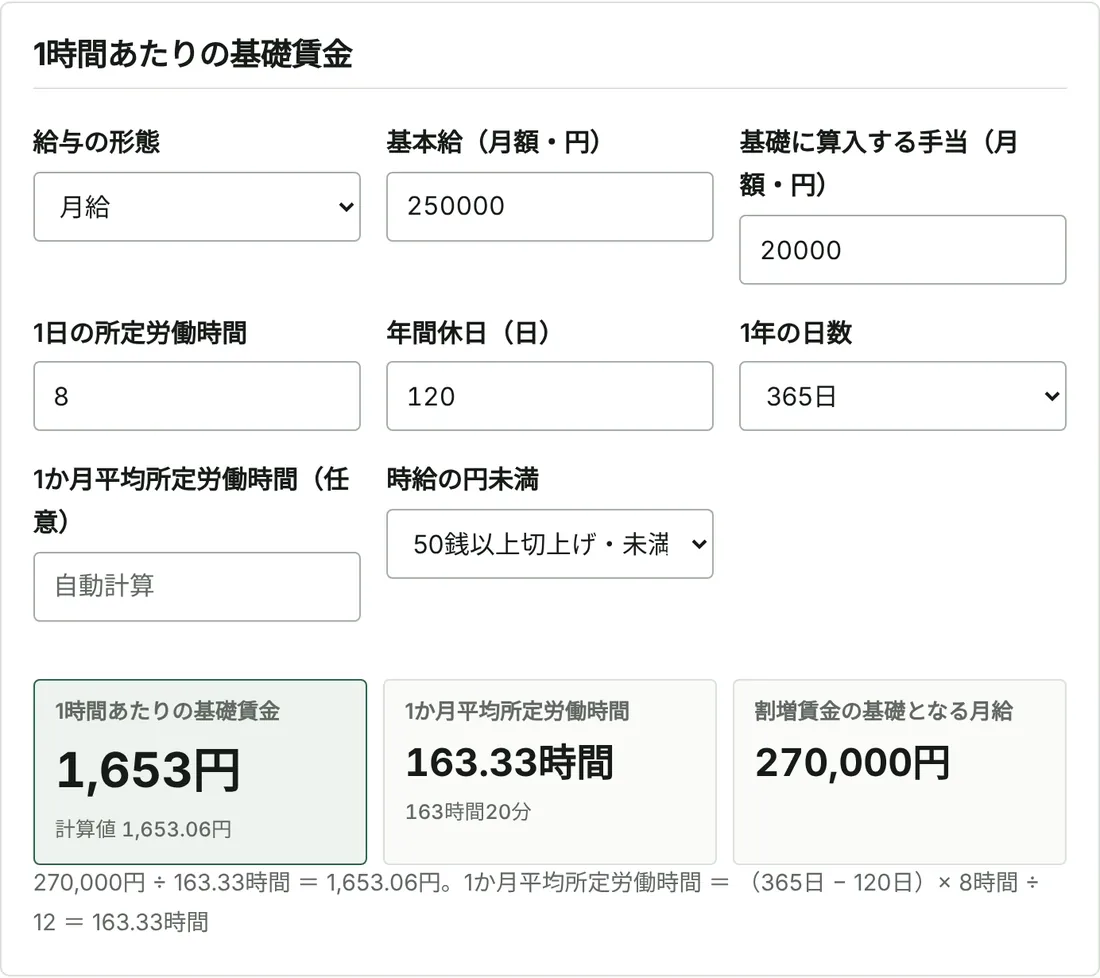
(365 − 120) × 8 ÷ 12 ≈ 163.33 hours, and 270,000 ÷ 163.33 ≈ ¥1,653.06. The fraction of a yen is rounded at half a yen, giving ¥1,653. This rounding is allowed by a notice from the Ministry of Health, Labour and Welfare (Kihatsu No. 150 of March 14, 1988).
Annual days off and scheduled hours per day are stated in your work rules (shūgyō kisoku), the company calendar, or the written notice of working conditions (rōdō jōken tsūchisho) you receive when hired. If your payslip or work rules state the “average scheduled hours per month” directly, enter it in “Average scheduled hours per month (optional)”, and it takes priority over the calculation from days off. For a fiscal year that includes February 29, set “Days in the year” to 366.
Different annual days off, different hourly rate for the same salary
Because the average scheduled hours depend on annual days off, the same monthly salary gives a higher hourly rate at a company with more days off. We kept the salary at ¥270,000 and 8 hours a day, changed only the annual days off, and compared the pay for 30 hours of overtime.
| Annual days off | Average scheduled hours per month | Hourly base wage | Pay for 30 h of overtime |
|---|---|---|---|
| 105 days | 173.33 h | ¥1,558 | ¥58,425 |
| 120 days | 163.33 h | ¥1,653 | ¥61,988 |
| 125 days | 160 h | ¥1,688 | ¥63,300 |
Between 105 and 125 days off, the hourly rate differs by ¥130, which is ¥4,875 over 30 hours. It is easy to miss when comparing job offers by monthly salary alone, and the gap grows with the amount of overtime. (In Japan, around 120 annual days off is typical for a company closed on weekends and national holidays.)
Allowances that count toward the base and those that do not
The amount in “Allowances included in the base” also follows rules. Only the following may be excluded from the base for premium wages: family allowance, commuting allowance, allowance for living apart from family, children’s education allowance, housing allowance, wages paid on a one-off basis, and wages paid at intervals of more than one month, such as the twice-yearly bonuses common in Japan (Article 37(5) of the Labor Standards Act and Article 21 of its Enforcement Regulations). Position, qualification and perfect-attendance allowances are included.
Whether an allowance can be excluded depends on what it actually is, not on its name. A “family allowance” paid at the same amount to everyone regardless of dependants, or a “housing allowance” paid at a flat rate regardless of rent, cannot be excluded and is part of the base. Go through the allowances on your payslip one by one and enter the total of those that count. Fixed overtime pay is payment for overtime, so it does not go here.
Applying each premium rate and adding them up
Once the hourly rate is set, enter the month’s hours by category in the next section, “Overtime hours and overtime pay for the month”. The example has 30 hours of overtime, 8 hours on the statutory day off and 5 late-night hours, and the result is ¥81,906, as shown in the image at the top.
| Category | Hours | Multiplier on base wage | Amount |
|---|---|---|---|
| Overtime (up to 60 h) | 30 h | 1.25 | ¥61,988 |
| Work on the statutory day off | 8 h | 1.35 | ¥17,852 |
| Late-night premium (added) | 5 h | +0.25 | ¥2,066 |
| Total | ¥81,906 |
There are three common mistakes in sorting hours into categories.
The first is that overtime means hours beyond 8 a day or 40 a week, not “hours after the company’s finishing time”. If your company’s scheduled day is 7 hours 30 minutes and you work 8 hours, the 30 minutes is “overtime within the legal limit”, for which the law only requires × 1.0. If your work rules say × 1.25 is paid, open “Change the premium rates” and set the pay for overtime within the legal limit to 125%.
The second is days off. The 35% premium applies only to hours worked on the statutory day off, one day a week (or four days in four weeks). In a company closed on Saturdays and Sundays, hours worked on Saturday count as ordinary overtime (25%) if the week exceeds 40 hours. Check your work rules for which day is the statutory day off.
The third is late night. Every hour worked between 10 p.m. and 5 a.m. goes in the late-night field, whether or not it is overtime. The tool adds late-night hours as a separate “+0.25” line, so together with the overtime line’s × 1.25, overtime worked late at night comes to × 1.50. Late-night work on the statutory day off is 1.35 + 0.25 = × 1.60.
Hours can be entered as 20, 20.5, 20:30 or 20h30m. Each category’s amount is rounded at half a yen, as the notice allows. Some companies round every fraction up in the employee’s favour, so your payslip may differ by a few yen.
Beyond 60 hours a month, the extra hours are paid at 1.5 times
When overtime exceeds 60 hours in a month, the premium for the hours beyond 60 rises to at least 50%. This has applied to large companies since April 2010 and to small and medium-sized companies since April 1, 2023. We set overtime to 70 hours and the statutory day off and late-night hours to 0.
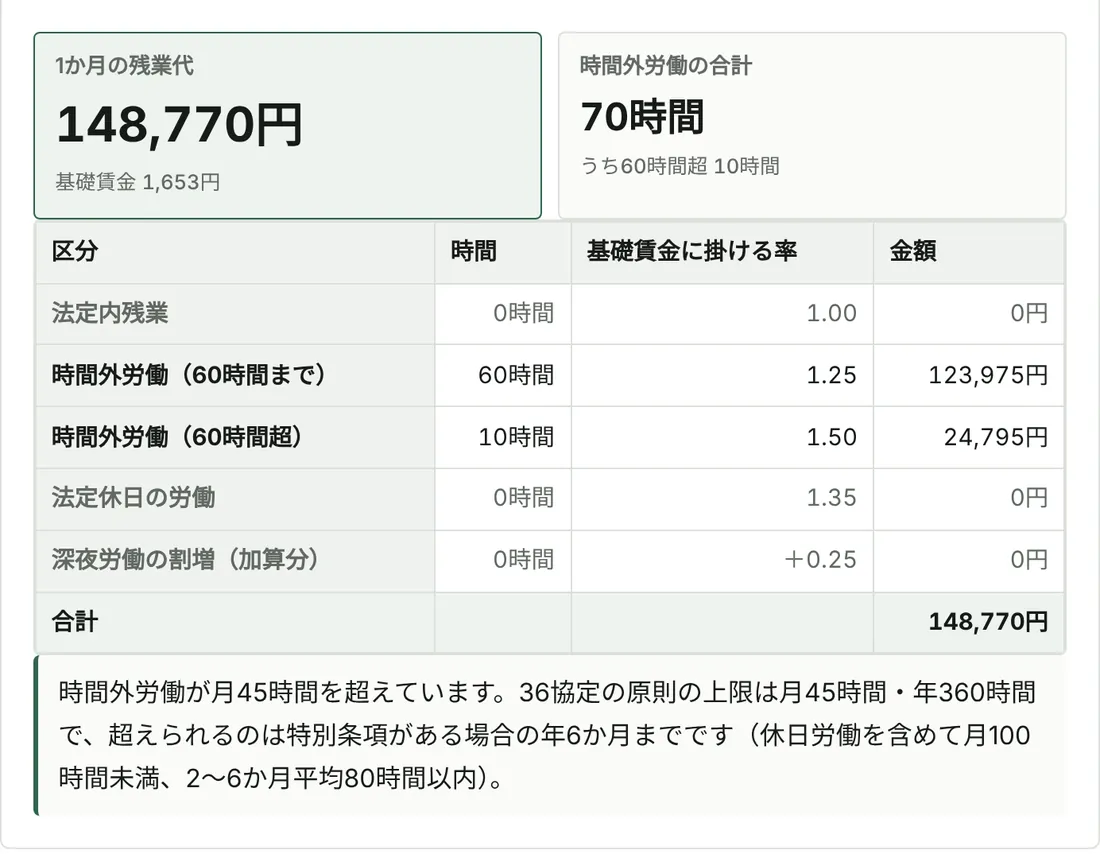
¥123,975 for the first 60 hours and ¥24,795 for the 10 hours beyond make ¥148,770. If you untick “Use the over-60-hour rate for overtime beyond 60 hours a month” and pay all 70 hours at × 1.25, the total is ¥144,638, which is ¥4,132 less. If a payslip for a month over 60 hours looks as though the overtime was calculated as “hours × rate × 1.25”, this is the part to check.
Hours worked on the statutory day off do not count toward the 60 hours. Hours worked on other company days off, such as Saturdays, do count as overtime.
Beyond 45 hours, a note about the 36 Agreement cap also appears below the result. A “36 Agreement” (saburoku kyōtei, named after Article 36 of the Labor Standards Act) is the labour-management agreement an employer must file before it can ask for any overtime at all. Under it, overtime is capped at 45 hours a month and 360 hours a year in principle, and these limits can be exceeded only under a special clause. This is a separate question from how much overtime pay is owed, but the tool shows the note as a prompt to look at the hours themselves.
Totalling the hours by category from time-card records
If you don’t know the month’s totals of overtime, day-off and late-night hours, use “Total the hours from daily records” at the bottom of the page. Enter the start, end and break of each day you worked overtime, and the type of day, and the table splits each day into categories and adds them up. Three days are filled in as an example.
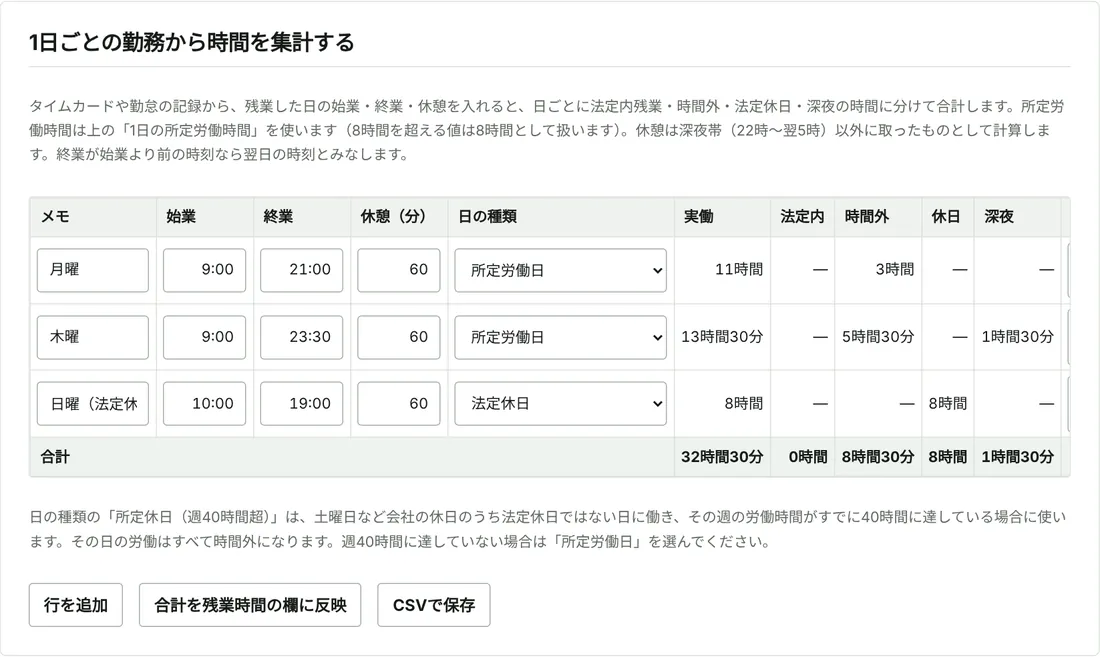
On Thursday, 9:00 to 23:30 with a one-hour break is 13 hours 30 minutes of work. The 5 hours 30 minutes beyond 8 hours are overtime, and the 1 hour 30 minutes after 22:00 also count as late night. Setting Sunday to “Statutory day off” puts all 8 hours in the day-off column and none in overtime.
Pressing “Copy totals to the overtime fields” fills in 8 h 30 min of overtime, 8 h on the statutory day off and 1 h 30 min of late night, and the overtime pay becomes ¥36,035. For a shift past midnight, enter an end time earlier than the start (for example 2:00 for 2 a.m.), and it is read as the next day. Breaks are assumed to fall outside the late-night period, so on a day when you took a break late at night, the late-night hours will come out longer than they really were.
If you set “Scheduled working hours per day” to 7 hours 30 minutes (7:30), the 30 minutes between 7:30 and 8 hours on Monday and on Thursday, 1 hour in all, move to the “Within limit” column. The average scheduled hours per month become 153.13 hours, so the hourly rate rises to ¥1,763, and the overtime pay for the same three days becomes ¥40,196.
For a company day off that is not the statutory day off, such as a Saturday, choose “Scheduled day off (over 40 h/week)” if your hours that week have already reached 40. All work on that day then counts as overtime. If the week has not reached 40 hours, choose “Scheduled workday”. “Save as CSV” exports the table as a CSV file that opens in Excel, and “Add row” adds more days.
Is the fixed overtime allowance (minashi zangyōdai) enough?
Many Japanese employers pay a fixed overtime allowance, stated in the job posting or contract as something like “fixed overtime pay ¥45,000 (for 20 hours)”. In any month where the actual overtime pay exceeds that amount, the employer must pay the difference. The Ministry of Health, Labour and Welfare asks employers that use fixed overtime pay to state three things in job postings: the base salary excluding the fixed overtime pay, how the fixed amount is calculated (the number of hours and the amount), and that overtime beyond those hours is paid extra.
Check it in “Is the fixed overtime allowance enough?”. We set the section above to 30 hours of overtime and 0 for the statutory day off and late night, and entered a fixed allowance of ¥45,000 covering 20 hours of overtime.
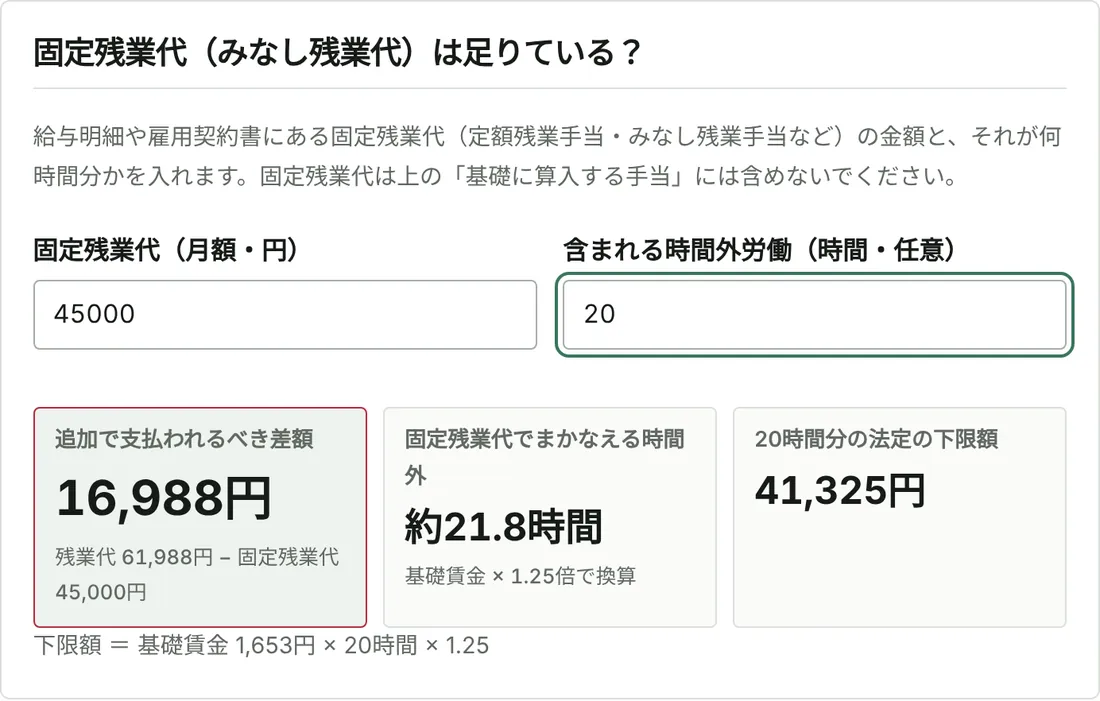
The overtime pay for 30 hours is ¥61,988, so ¥16,988 more is owed. ¥45,000 covers about 21.8 hours, converting at ¥1,653 × 1.25.
Entering the hours covered also shows the legal minimum for that many hours. For 20 hours of overtime, 1,653 × 20 × 1.25 = ¥41,325, and ¥45,000 is above it. Change the fixed allowance to ¥40,000 and the display changes.
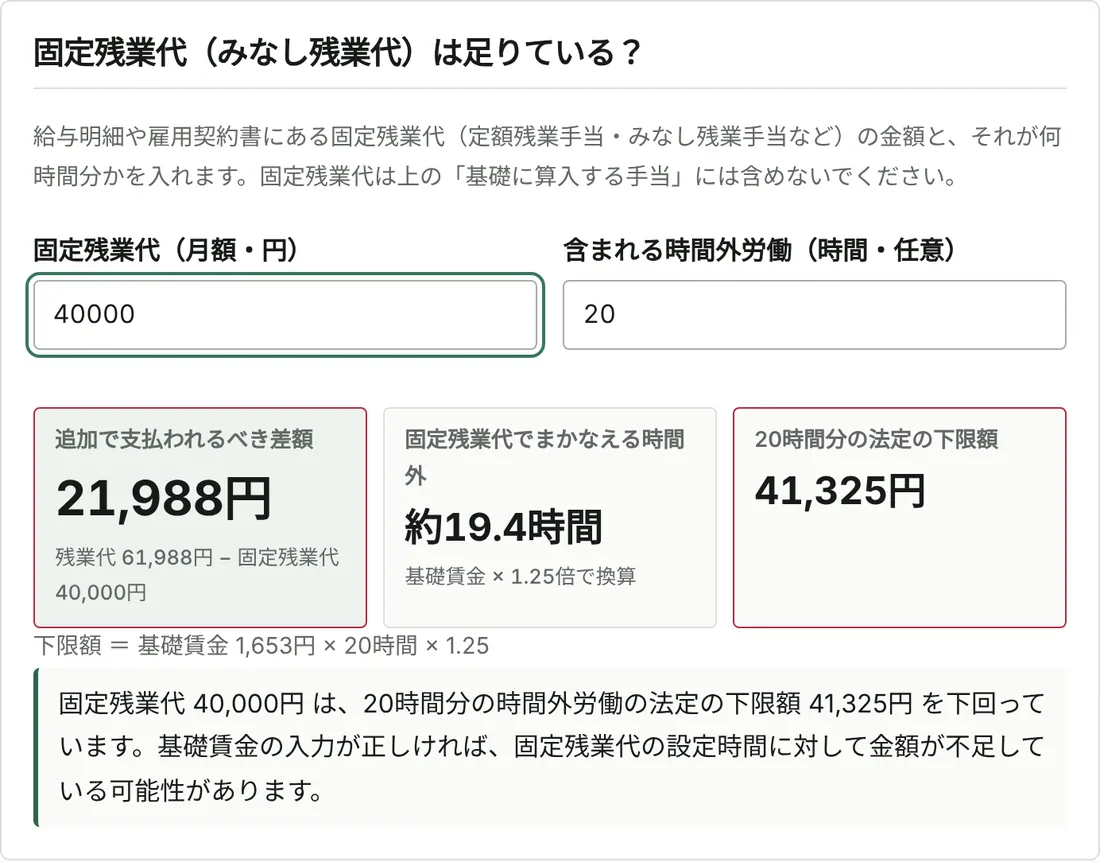
¥40,000 covers about 19.4 hours, so as payment for “20 hours” it is ¥1,325 short. This note stays even in a month with so little overtime that nothing extra is owed: with 15 hours of overtime, the difference is ¥0 (within the fixed allowance, ¥9,006 to spare), but the warning that the amount is below the minimum remains. Beyond the monthly difference, this lets you check whether the fixed allowance itself matches your hourly rate.
The example above set day-off and late-night hours to 0, but the tool compares the fixed allowance with the total overtime pay calculated above, including overtime within the legal limit, day-off and late-night work. If your company’s rules say the fixed allowance covers only overtime, compare with day-off and late-night hours at 0, as here, and check on your payslip that day-off and late-night work are paid separately.
Cases the tool cannot calculate
Managers and supervisors (Article 41 of the Labor Standards Act) are exempt from overtime and day-off premiums, but the late-night premium still applies. In that case, set overtime and the statutory day off to 0 and enter only the late-night hours. Note that in Japan an employee with the title of “manager” (kanrishoku) is not automatically exempt; the exemption depends on actual authority, working arrangements and pay.
Variable working hours, flextime, discretionary work and deemed working hours for work outside the workplace count overtime differently. The daily table uses 8 hours a day as its threshold, so it cannot be used under these systems. If you know the overtime hours your company calculated, you can still enter them in the section above to check the amount. The tool also does not handle agreements that give substitute leave instead of the over-60-hour premium, or premiums on commission pay.
The results are an estimate based on what you enter. If they differ a lot from your payslip, first check your work rules for annual days off, scheduled hours, which day is the statutory day off and how allowances are treated, and compare with your attendance records. To discuss unpaid overtime, you can consult your local Labour Standards Inspection Office (rōdō kijun kantokusho) or a General Labour Consultation Corner. The Ministry of Health, Labour and Welfare also offers consultation for foreign workers by phone and in person in English and other languages; see its Consultation for foreign workers page.
Keeping and sharing the result
Your inputs are saved in the page URL after #, so a bookmark reopens the same conditions. “Copy all results” copies the base wage, the breakdown and the fixed allowance comparison as text, and “Reset to example” returns to the first example. All calculations run in your browser, and the pay and hours you enter are not sent anywhere.
The screenshots in this article were taken in the English version of the tool.
Related tools and articles
The Percentage Calculator shows what percentage of your salary the overtime pay is, or how much it rose from last month. The difference between “%” and “percentage points” in month-on-month changes is explained in “Is 20% Off Plus Another 10% Off Really 30% Off?”. The Day Calculator counts the days to the payroll cut-off or the business days excluding holidays (see “Count business days over New Year with the Day Calculator”).
Test environment and references
- Japan Overtime Pay Calculator (English and Japanese versions), Chromium via Playwright. The base salary of ¥250,000, ¥20,000 of allowances, 120 annual days off and 8 hours a day, with 30 hours of overtime, 8 hours on the statutory day off and 5 late-night hours, and the three days in the daily table, are the default values. We entered 105 and 125 annual days off, 70 hours of overtime, fixed allowances of ¥45,000 and ¥40,000 for 20 hours, 15 hours of overtime and 7:30 scheduled hours a day as written in the text and checked the results.
- Labor Standards Act (e-Gov Laws and Regulations, in Japanese)
- Ministry of Health, Labour and Welfare, “The premium rate for overtime beyond 60 hours a month is rising” (leaflet for small and medium-sized companies, in Japanese)
- Ministry of Health, Labour and Welfare, prefectural labour bureaus and Hello Work, “If you use fixed overtime pay, state all of items 1 to 3 in job postings” (in Japanese)
- Ministry of Health, Labour and Welfare, “Consultation for foreign workers”