Ono or Ohno? How Japanese names are romanized on passports: long vowels, ん and っ in Hepburn
Japanese passports spell names in the Ministry of Foreign Affairs' Hepburn system: 大野 (Ōno) is ONO, 佐藤 (Satō) is SATO, 純平 is JUMPEI, 八丁 is HATCHO and 妹尾 is SENOO. Using a Hepburn romanization converter, this guide checks the long-vowel rules, readings such as Inoue and Matsuura that only look like long vowels, non-Hepburn spellings like OHNO and SATOH, and converting a whole name list.
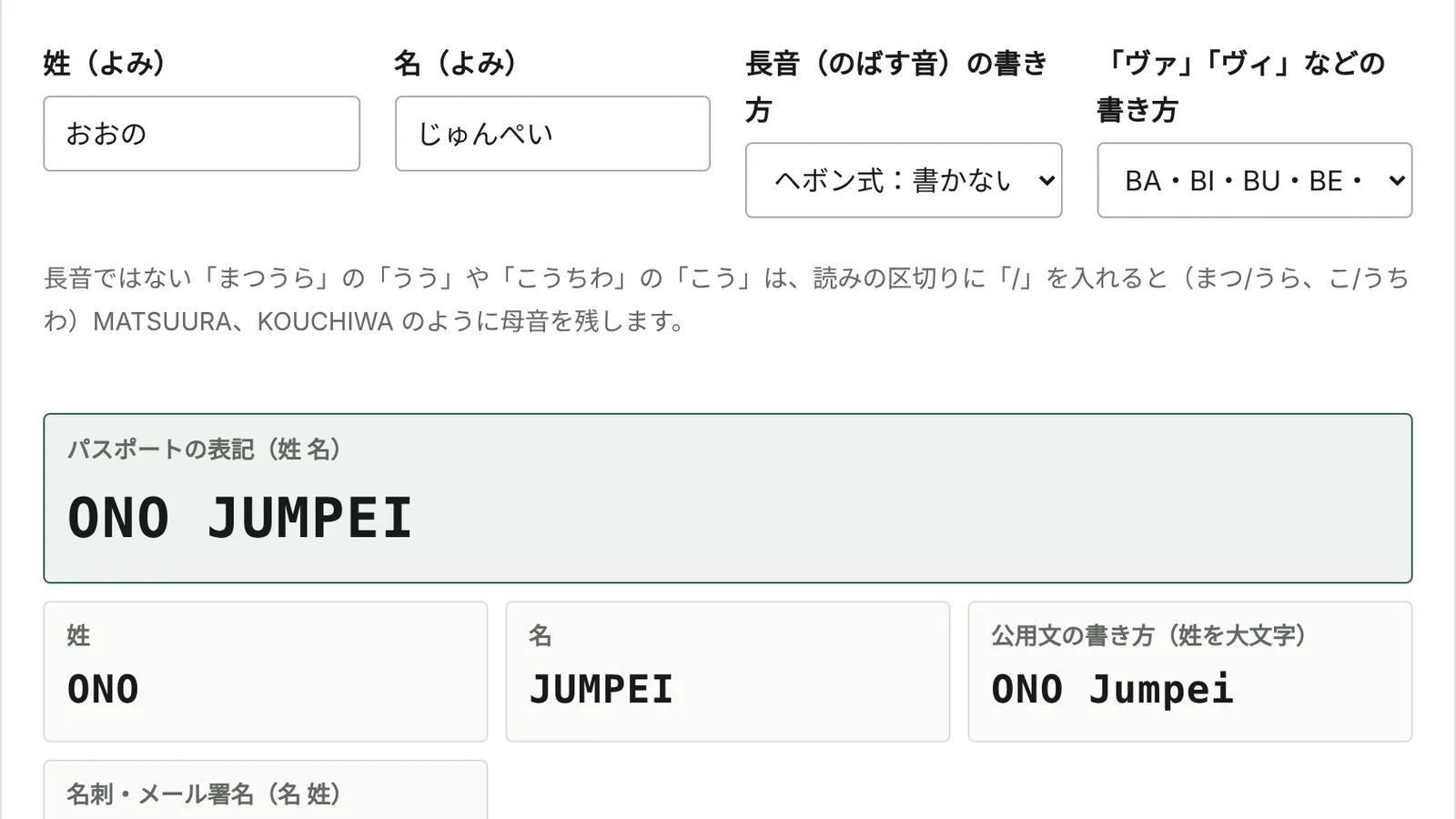
Japanese passport applications have a field for the holder’s name in Latin letters. Japanese children learn romanization at school, yet many people still hesitate when they have to write their own name: is 大野 written OONO or OHNO, is the ん in 純平 an N or an M, and how do you write the small っ in 服部? The spellings people see on colleagues’ business cards and email addresses are all over the place, which only adds to the confusion.
The same question comes up outside Japan. If you are booking flights for a Japanese colleague, filling in a visa form for a Japanese spouse, or checking a list of exchange students’ names, the name you type must match the passport exactly, and a Japanese name can be romanized in several plausible ways.
Some background on Japanese names
A few facts about Japanese make the rest of this guide easier to follow.
- Names are written in kanji (Chinese characters), but a kanji name does not tell you how it is read. The reading is written separately in kana, the two Japanese syllabaries: hiragana (おおの) and katakana (オオノ) represent the same sounds. Japanese forms ask for the reading in kana next to the kanji, and the passport spelling is based on that reading as recorded in the family register (koseki), not on the kanji.
- Japanese distinguishes short and long vowels. おの (o-no) and おおの (ō-no) are different names, and in kana a long vowel is usually written by adding an extra お or う (さとう for Satō).
- The family name comes first in Japanese.
- Romanization has more than one system. Schools teach Kunrei-shiki (し = SI, ち = TI), while passports use Hepburn (SHI, CHI), and the Hepburn table for passports has rules of its own, such as not writing long vowels at all. Macrons such as Ō, common in textbooks, are not used on passports.
Under Japan’s Passport Act regulations, names on passports are, as a rule, written according to the Ministry of Foreign Affairs’ Hepburn romanization table. The Hepburn Romanization Converter turns the kana reading of a name into the spelling in that table and shows, kana by kana, which rule was applied. Below, I entered names that are easy to get wrong and checked what the tool produced and where a human still has to decide.
Enter the reading and the passport spelling appears
When you open the tool, “Family name (reading in kana)” contains さいとう and “Given name (reading in kana)” contains しんぺい, and “Passport spelling (family name, given name)” shows SAITO SHIMPEI. You can type the reading in hiragana or katakana, and the result updates without pressing a button. Kanji are not accepted because their reading is not fixed; if you enter them, the tool asks you to type the reading in hiragana or katakana instead. If you do not know the reading of a name, ask the person or look at their passport rather than guessing.
I changed the family name to おおの and the given name to じゅんぺい.
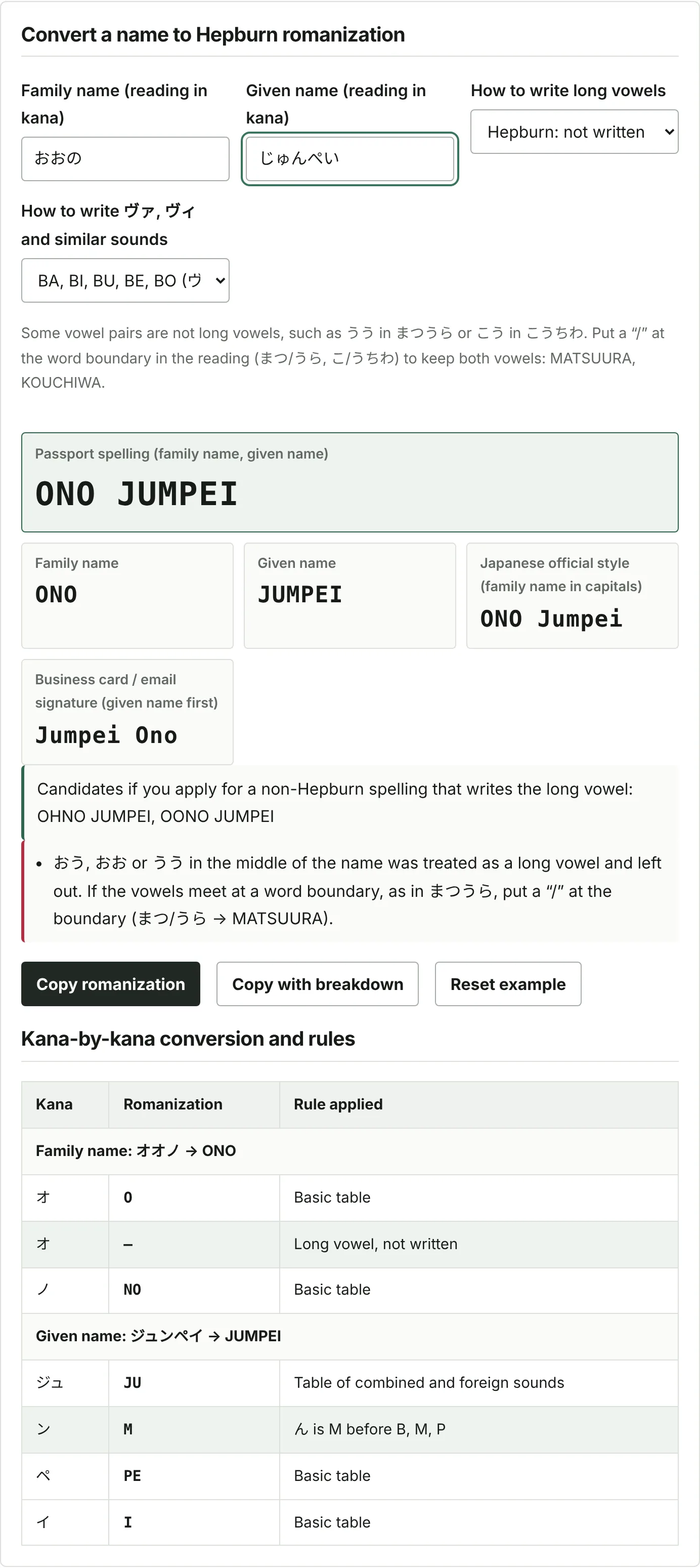
The passport spelling is ONO JUMPEI. In the “Kana-by-kana conversion and rules” table, the second オ of オオノ is marked “Long vowel, not written”, and the ン of ジュンペイ is marked “ん is M before B, M, P”. The two places where people usually hesitate are decided by two separate rules.
Besides the passport spelling, the result area shows ONO Jumpei under “Japanese official style (family name in capitals)” and Jumpei Ono under “Business card / email signature (given name first)”. A passport has separate fields for the family name and the given name, so on the application you simply copy the letters from the “Family name” and “Given name” boxes. “Copy romanization” copies the passport spelling, and “Copy with breakdown” copies the table as text as well.
Four spellings that often go wrong on passports
Putting together the Ministry of Foreign Affairs table and the explanations from the passport centers of Kanagawa and Saitama prefectures, these are the rules that cause the most trouble with names. Every example below gave the same spelling in the tool.
| Sound | Rule | Examples |
|---|---|---|
| Long vowels (おお, おう, うう) | Write a single O or U instead of doubling it | 大野 ONO, 佐藤 SATO, 洋子 YOKO, 優子 YUKO |
| お at the end of a name | Written even when it lengthens the vowel | 妹尾 SENOO, 高遠 TAKATOO, 横尾 YOKOO |
| Syllabic nasal ん | Written N, but M before B, M or P | 難波 NAMBA, 本間 HOMMA, 純平 JUMPEI, 信也 SHINYA |
| Small っ (doubled consonant) | Double the next consonant; only before CH is it written T | 服部 HATTORI, 吉川 KIKKAWA, 八丁 HATCHO |
Long vowels are the most confusing. 大野 (Ōno) and 小野 (Ono) are both ONO, and 加藤 (Katō) and 加戸 (Kato) are both KATO. The passport spelling cannot tell them apart, but that is the standard. A final う is not written either, so 伊藤 (Itō) is ITO. A final お, however, is written, so 妹尾 (せのお, Senō) is SENOO. Dropping a final う but keeping a final お is not symmetrical, which is why spelling by ear goes wrong.
When ん is followed by a vowel or Y, it is still written N with no apostrophe: しんいち is SHINICHI and しんや is SHINYA. The SHIN’ICHI form found in dictionaries is not used on passports.
えい and いい are not treated as long vowels. しんぺい stays SHIMPEI, けいこ stays KEIKO and にいな stays NIINA. Do not shorten せい or れい to SE or RE.
Readings such as Inoue and Matsuura that only look like long vowels
The hard cases are names whose kana look like a long vowel when they are not. The Kanagawa Prefecture Passport Center gives 松浦 (まつうら) as MATSUURA and 小団扇 (こうちわ) as KOUCHIWA. The name is まつ + うら, or こ + うちわ, so the うう and こう are not drawn-out sounds.
From the reading alone, the tool cannot tell the difference either. Here is what happens with いのうえ as the family name and ゆうき as the given name.
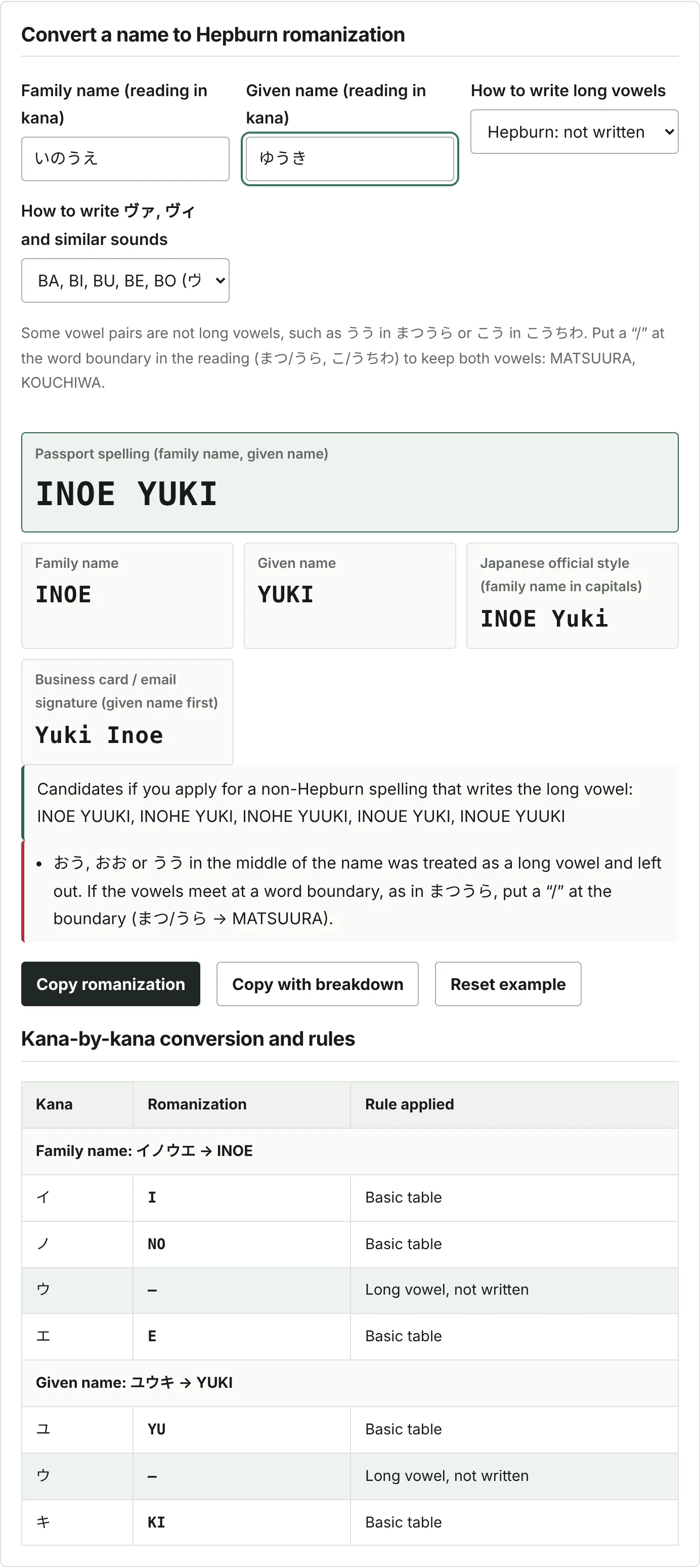
The result is INOE YUKI. The tool treated the う after の as a long vowel and dropped it, but 井上 is い・の・うえ (i-no-ue), and this う is not a lengthened sound. That is why the tool shows a message whenever it drops a long vowel in the middle of a name, asking you to put a “/” at the boundary.
Rewriting the reading as いの/うえ stops the long-vowel check at the “/”, and the result becomes INOUE. In the same way, まつ/うら gives MATSUURA and こ/うちわ gives KOUCHIWA. The given name ゆうき can stay YUKI: the ゆう in 優希 is a long vowel, so dropping it is correct.
The message appears whenever a long vowel is dropped in the middle of a name, even when dropping it is right. You will also see it for おおの and ようこ (but not for さとう, where the dropped う is at the end). When it appears, the practical test is whether that う or お is actually drawn out when the name is said aloud. Inoue is a very common family name, so if you are romanizing a list of Japanese names, look out for it. For a name you are unsure about, check with a passport center before applying.
When you want OHNO or SATOH (non-Hepburn)
Because Hepburn does not write long vowels, 大野 becomes ONO, the same as 小野. For people who want to avoid that, or who have always used OHNO, a Japanese passport can show a non-Hepburn spelling that marks the long vowel, on request. The Kanagawa Prefecture Passport Center’s examples are OONO or OHNO for 大野, SATOU or SATOH for 佐藤, and YUUKO for 優子. This is why you meet Japanese people named Ohno, Satoh or Itoh: they are the same names as Ono, Sato and Ito.
Switching “How to write long vowels” in the tool to “Non-Hepburn: use OH (SATOH, OHNO)” converts with that spelling.
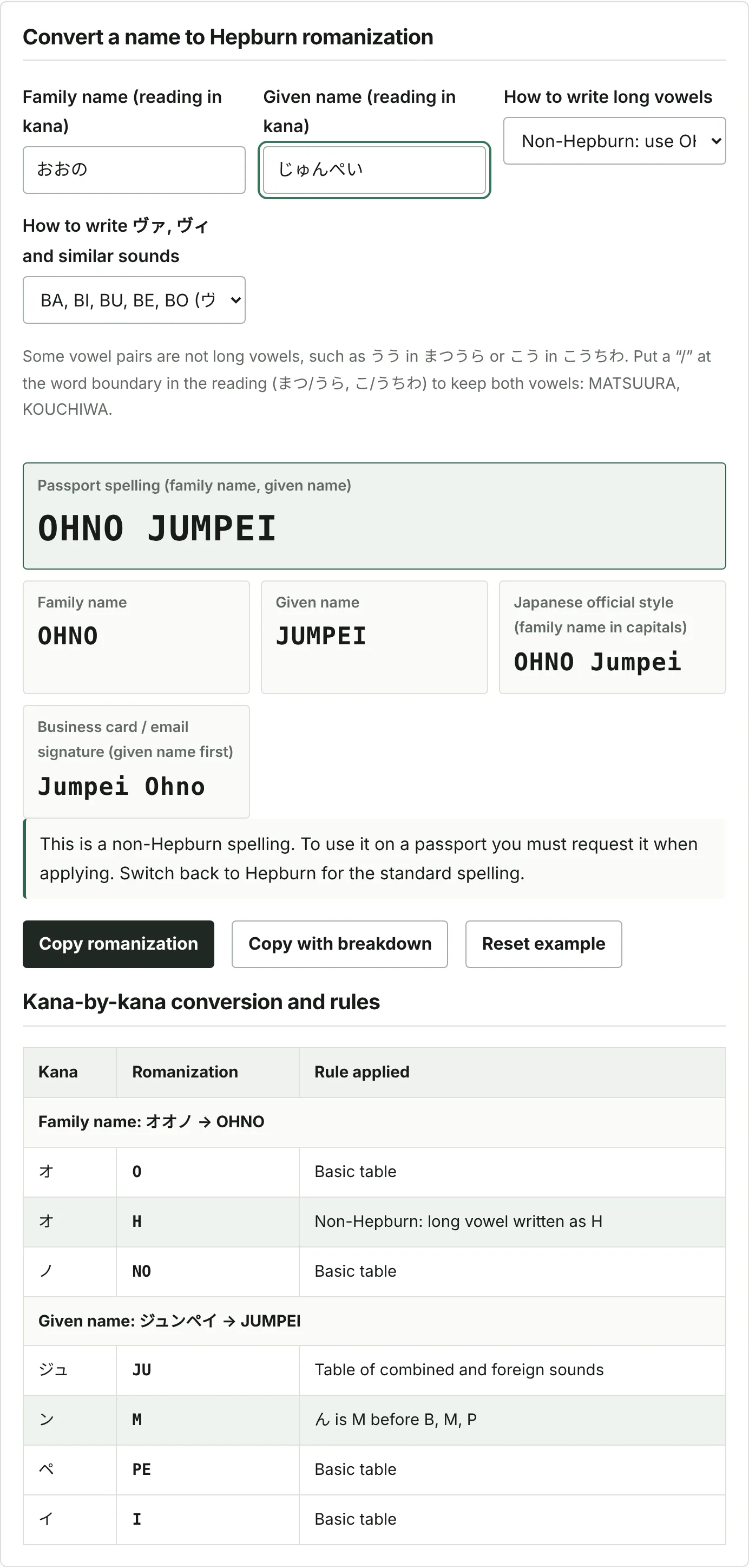
The passport spelling becomes OHNO JUMPEI, and in the table the second オ changes to “Non-Hepburn: long vowel written as H”. The other rules stay the same, so じゅんぺい is still JUMPEI. Choosing “Non-Hepburn: as in kana (SATOU, OONO, YUUKO)” writes the same vowels as the kana. Even in Hepburn mode, the tool lists “Candidates if you apply for a non-Hepburn spelling that writes the long vowel” under the result, so you can compare the possible spellings first.
Two things are worth knowing before choosing a non-Hepburn spelling.
First, it is hard to change later. The Kanagawa Prefecture Passport Center states that the romanized name in a passport, once issued, generally cannot be changed. Changes to the way a long vowel is written, or to make the family name match other family members, may be allowed as exceptions depending on when the previous passport was issued, but they require consulting a passport center.
Second, family members’ spellings may differ. The same page recommends that the whole family use the same spelling, because different spellings of the family name within a family travelling abroad can cause problems at immigration. Check the family’s passports before deciding, so that a parent does not end up as OHNO and a child as ONO.
For a first passport, a non-Hepburn spelling for a long vowel can be requested without documents proving that the spelling has been used (Kanagawa Prefecture Passport Center). Non-Hepburn spellings that change something other than a long vowel, such as using a foreign name (JOHN, KIM and so on) after an international marriage, require documents such as records from a foreign public authority or a birth certificate.
Names with シェ, ティ, ファ or ヴ
Sounds used in foreign-style names have fixed spellings in the reference column of the Ministry of Foreign Affairs table. Many differ from English spelling.
| Kana | Passport spelling |
|---|---|
| シェ, チェ, ジェ | SHIE, CHIE, JIE |
| ティ, ディ, デュ | TEI, DEI, DEYU |
| ファ, フィ, フェ, フォ | FUA, FUI, FUE, FUO |
| ヴァ, ヴィ, ヴ, ヴェ, ヴォ | BA, BI, BU, BE, BO, or BUA, BUI, BU, BUE, BUO |
For example, ティナ (Tina) becomes TEINA, and ヴィヴィアン (Vivian) becomes BIBIAN (or BUIBUIAN). The ministry’s table states that VA, VI, VU, VE and VO cannot be used. In the tool, “How to write ヴァ, ヴィ and similar sounds” switches between the BA and BUA series. If you enter a combination that is not in the table, such as トゥ or イェ, the tool converts the small kana as a separate sound and shows a message asking you to check with a passport center. A child with a foreign parent who wants the name spelled as in the original language (JOHN rather than the Hepburn JON) needs the non-Hepburn application described above.
Converting the readings in a name list
Japanese schools take students on trips abroad, and companies and universities send groups on overseas programs, so someone often has to prepare a romanized list for everyone. In “Convert the readings in a name list” at the bottom of the page, paste one person per line and only the hiragana and katakana are converted. Kanji, digits, commas and tabs are left as they are, so you can paste two columns from Excel, such as “Name” and “Reading”.
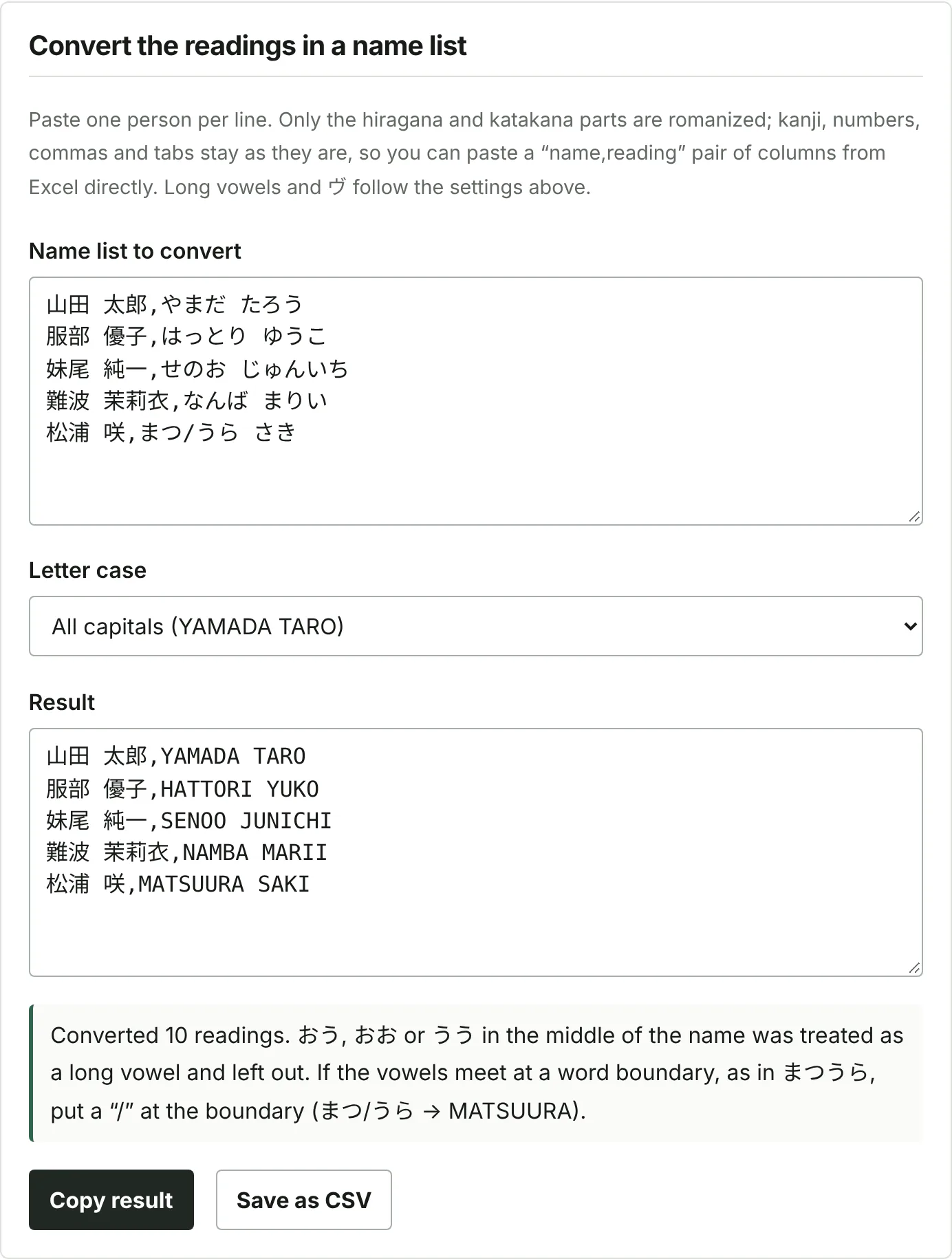
The five default names become YAMADA TARO, HATTORI YUKO, SENOO JUNICHI, NAMBA MARII and MATSUURA SAKI. The final う of たろう is dropped, ゆう in ゆうこ becomes YU, and まつ/うら keeps MATSUURA because the boundary is marked. Some lines have a long vowel dropped in the middle of a name, so the same message as in the single-name section appears. In a list, too, review the names with dropped long vowels when the message appears and add a “/” where needed.
“Letter case” also offers “First letter only (Yamada Taro)”. “Save as CSV” saves hepburn-romaji.csv with the original line and the result in two columns, which opens directly in Excel. The long-vowel and ヴ settings from the single-name section are used for the list as well.
Treat a list produced in one go as a draft. Anyone who already holds a passport with a non-Hepburn spelling should use that spelling. Airline tickets and visa or travel authorization applications usually require the name exactly as it appears in the passport, so checking the list against each person’s passport early saves rework later.
Name order changes in official documents and on business cards
The tool also has “Japanese official style (family name in capitals)” and “Business card / email signature (given name first)”. In 2019 the Japanese government agreed that, when Japanese names are written in Latin letters in official documents, the family name should as a rule come first, and that the family name may be written in all capitals to distinguish it from the given name. YAMADA Taro is that form. For business cards or email signatures aimed at readers who expect the given name first, use the Taro Yamada field.
The spelling itself is the same in every field as in the passport. If your passport says ONO, using Ono on business cards too avoids mismatches with airline tickets and paperwork abroad. If you are writing to a Japanese colleague, the passport spelling is the safest choice for anything official, even if their email address uses OHNO.
Related tools and articles
If a web form asks for half-width (ASCII) letters and you typed full-width Latin letters on a Japanese keyboard, the Full-width / Half-width Converter converts just the letters and digits. If a pasted name causes an input error, the Invisible Character Checker shows whether a zero-width space or other invisible character got mixed in.
To schedule meetings and calls with Japan, see the article on the Japan–US time difference and meeting times across three locations.
All processing in the tool happens in your browser, and the names you enter are not sent anywhere.
References and test environment
- Ministry of Foreign Affairs of Japan, “Hepburn romanization table” (Japanese)
- Kanagawa Prefecture, “Hepburn romanization” and “Spellings other than Hepburn (non-Hepburn romanization)” (Japanese)
- Saitama Prefecture Passport Center, “Romanized names, maiden names and other names” (Japanese)
- Tested with: Hepburn Romanization Converter (English version), Chromium via Playwright. The cover image shows the Japanese version of the tool. Every example in the text was entered into the tool and the result checked.