Shorten the Term or Lower the Payment? How Much Interest a Mortgage Prepayment Saves, Tested with 1 Million, Different Timings and a Rate Rise
Borrow ¥30 million at 1.5% for 35 years and prepay ¥1 million after five years: shortening the term cuts interest by ¥552,332 and ends the loan 1 year 4 months early, while lowering the payment cuts the monthly payment by ¥3,452 and interest by ¥242,366. See why the gap appears in the amortization schedule, how timing changes it, what happens when a variable rate rises from 0.5% to 1.5%, and what Japan's 10-year rule for the mortgage tax credit means, using a loan repayment calculator that works in any currency.
Many people repaying a mortgage think about paying off part of it early when they come into some money. In Japan, the bank’s online form for this usually asks you to choose between two types: “shorten the term” (期間短縮型) and “lower the payment” (返済額軽減型). The usual advice is that shortening the term saves more interest, but it is rarely shown how big the difference is or why it arises.
Below, I take a ¥30 million loan at 1.5% a year over 35 years with level monthly payments, and use the Loan Repayment Calculator to compare the same ¥1 million extra payment made each way. I also try different timings and a variable rate that rises partway through.
The figures are in Japanese yen, as in the original Japanese article; ¥30 million is roughly the size of a typical Japanese home loan. The calculator has no currency of its own, so the same steps and the same relationships between the numbers apply to dollars, euros or any other currency. Rates in the examples are low by international standards because Japanese mortgage rates have long been low; with higher rates, every effect described here becomes larger.
The two types of extra payment
An extra payment (prepayment, or overpayment) is a payment of part of the principal ahead of schedule, on top of the regular monthly payments. All of it goes toward the principal, and the future interest that principal would have incurred no longer arises. The difference between the two types lies in how the repayment plan is rebuilt once the principal has gone down.
- Shorten the term The monthly payment stays the same and the loan is paid off sooner.
- Lower the payment The end date stays the same and the monthly payment goes down.
Either way, the balance right after the extra payment is the same. What differs is how much of each later monthly payment goes toward the principal.
Japanese lenders usually let you choose either type when you prepay. Elsewhere the default can differ. In the US, for example, extra principal payments normally shorten the loan while the payment stays the same, and lowering the payment usually requires a separate “recast” that the lender may or may not offer. Check what your own lender does.
First, the payment without any extra payment
In the calculator, enter 30000000 as the “Loan amount”, 1.5 as the “Interest rate (% per year)” and 35 as the “Term (years)”, and leave the “Repayment method” on level payments (same payment every month).
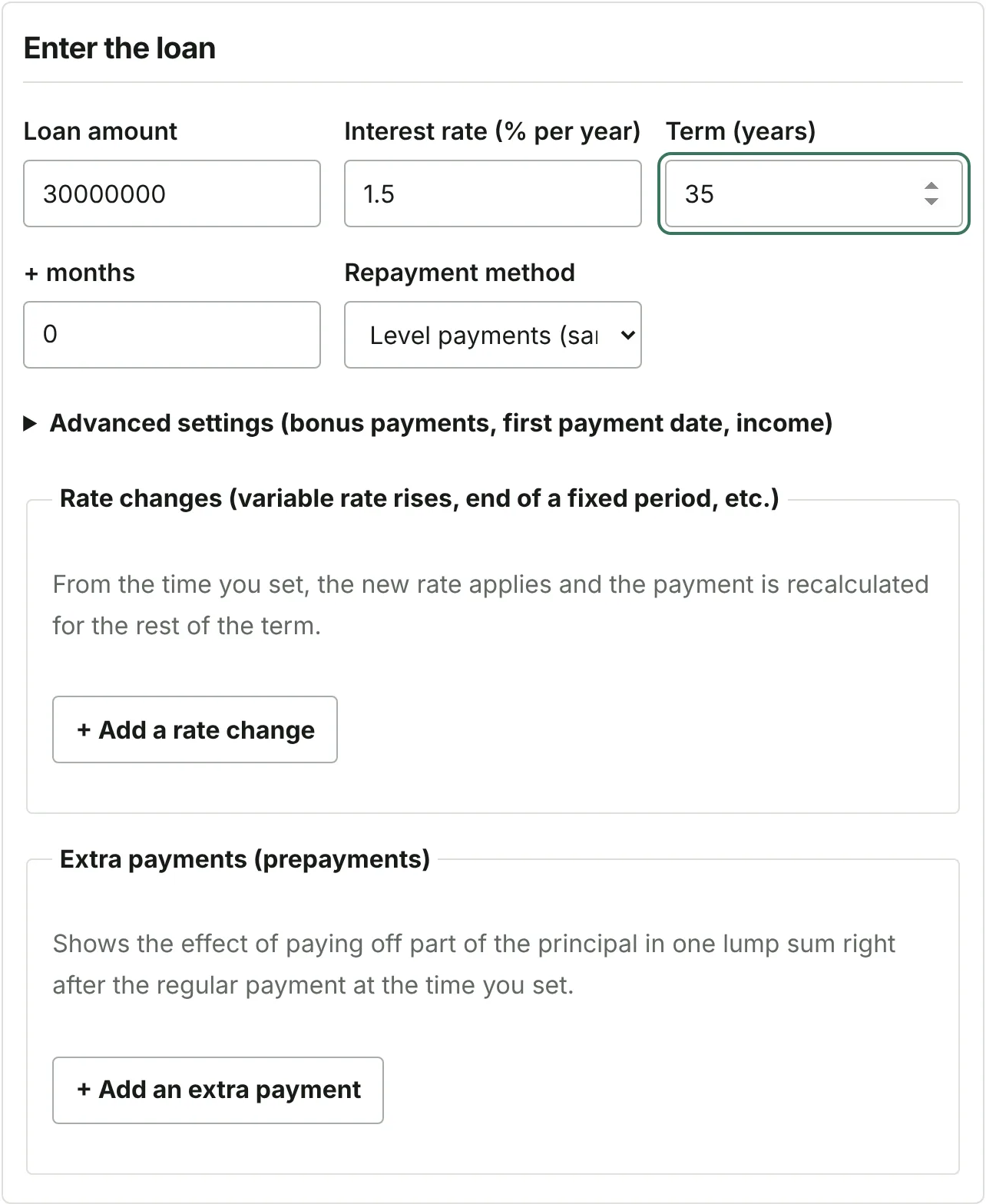
The results show a monthly payment of 91,856, a total repaid of 38,578,882 and total interest of 8,578,882. Over 35 years you pay almost 30% of the amount borrowed in interest. The monthly payment is Excel’s =PMT(1.5%/12, 420, -30000000), which returns 91,855.33, rounded up to the next whole yen. The calculator works out each month’s interest as “balance × annual rate ÷ 12”.
After five years (60 payments) on these terms, the balance is 26,615,387. This is where the ¥1 million extra payment goes in.
Paying an extra 1 million after five years
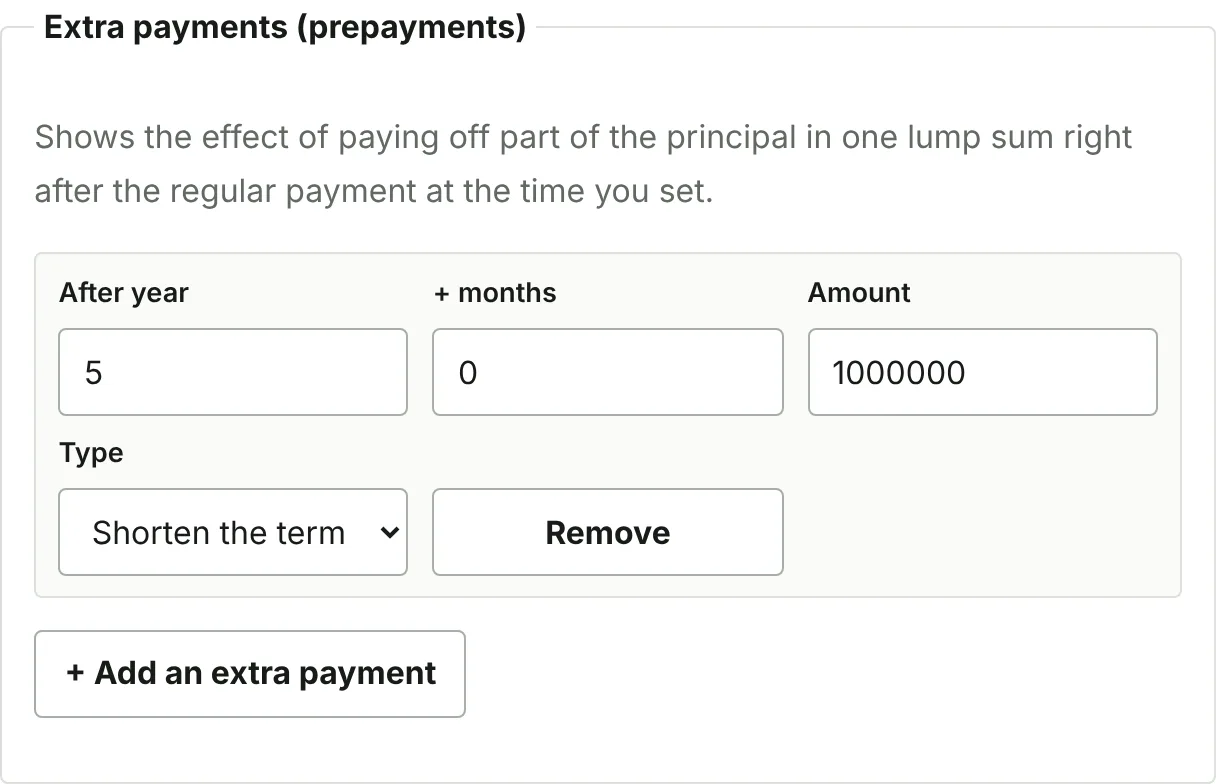
Click “+ Add an extra payment” and a new row appears. Enter 5 in “After year”, 0 in “+ months” and 1000000 in “Amount”, then choose “Shorten the term” or “Lower the payment” under “Type”. Five years and zero months means the extra payment is made right after the 60th regular payment.
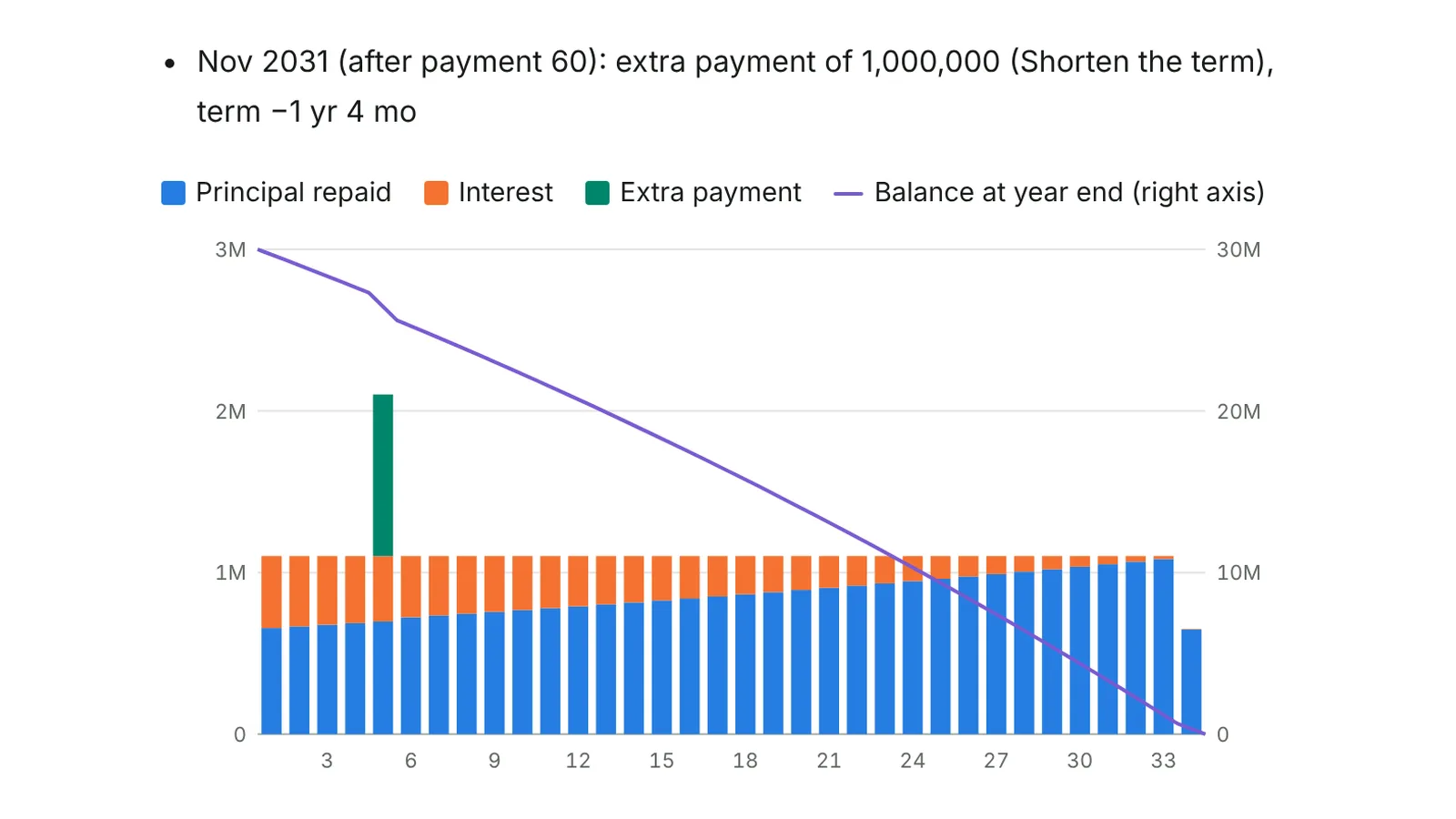
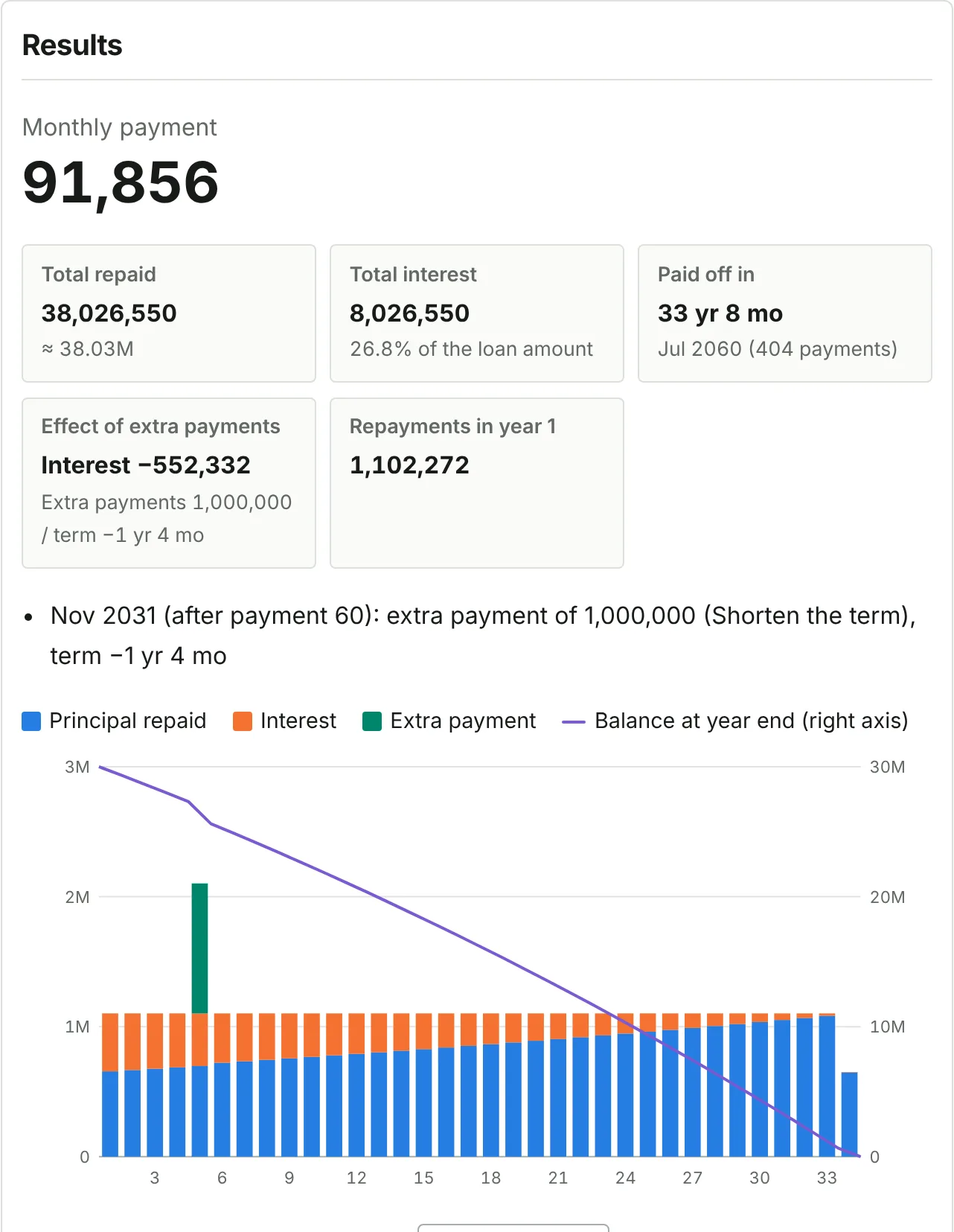
With “Shorten the term”, an “Effect of extra payments” box appears in the results, showing that interest fell by 552,332 and the term by 1 year 4 months. The number of payments goes from 420 to 404, while the monthly payment stays at 91,856.
Switch the type to “Lower the payment” and the loan still runs for 35 years, but the monthly payment from the 61st payment on falls to 88,404. Interest goes down by 242,366.
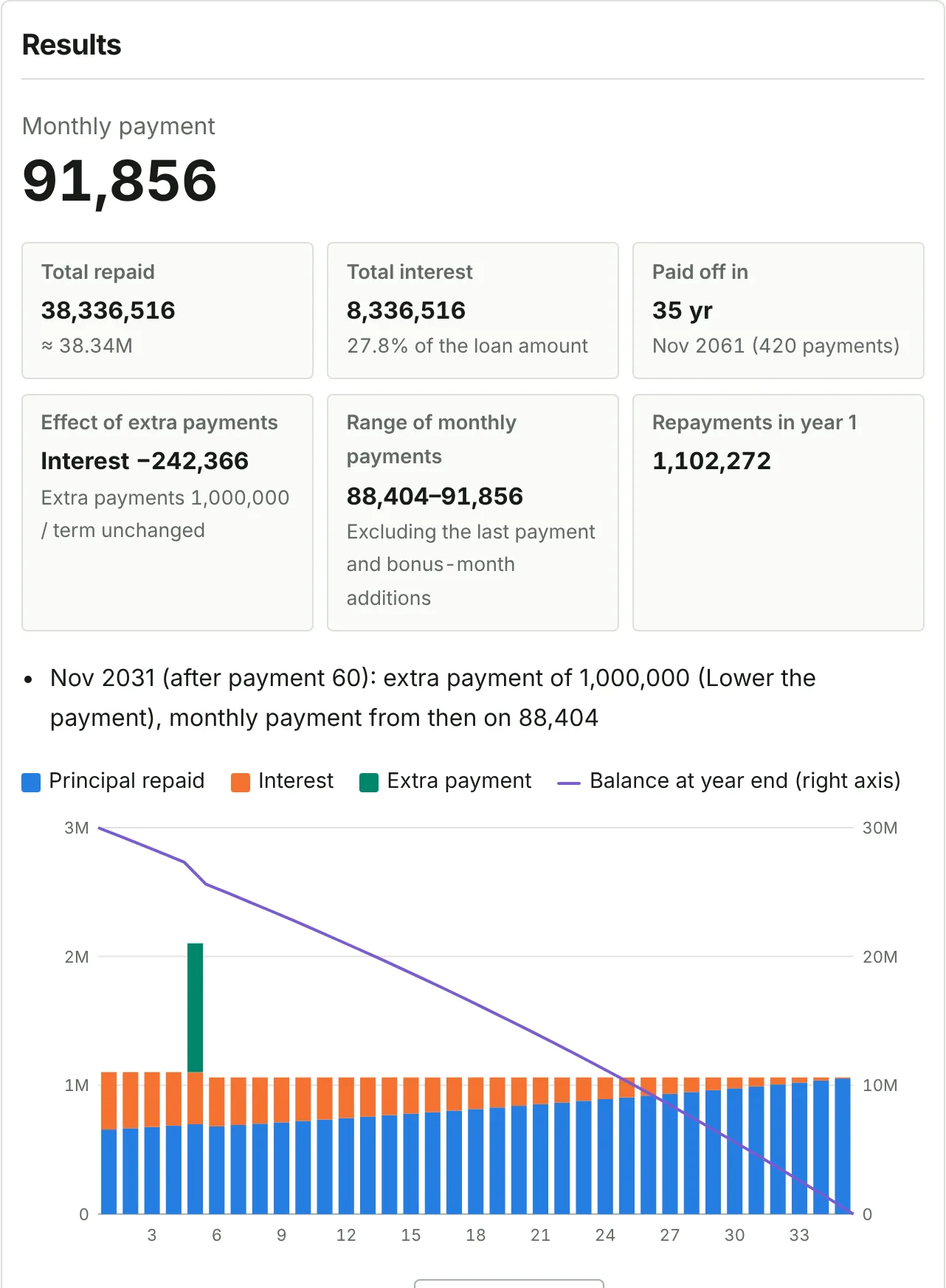
| Type | Monthly payment from payment 61 | Paid off in | Total interest | Interest saved |
|---|---|---|---|---|
| No extra payment | ¥91,856 | 35 years (420 payments) | ¥8,578,882 | — |
| Shorten the term | ¥91,856 | 33 years 8 months (404) | ¥8,026,550 | ¥552,332 |
| Lower the payment | ¥88,404 | 35 years (420) | ¥8,336,516 | ¥242,366 |
With the same ¥1 million, shortening the term saved ¥309,966 more interest.
Where the difference comes from
Show the schedule by month and look at payment 61, the month after the extra payment, and the reason becomes clear. The balance is the same under both types, so the interest that month is the same, ¥32,019. What differs is how much of the rest of the payment goes to the principal.
| Payment 61 | Payment | Interest | Principal |
|---|---|---|---|
| Shorten the term | ¥91,856 | ¥32,019 | ¥59,837 |
| Lower the payment | ¥88,404 | ¥32,019 | ¥56,385 |
When you shorten the term, the ¥3,452 by which the payment was not lowered is added straight to the principal repaid. The principal falls faster, so the next month’s interest is lower, and even more of the payment goes to the principal. This difference builds up every month, so the gap between the balances widens over time.
| Time from start | No extra payment | Shorten the term | Lower the payment |
|---|---|---|---|
| 10 years | ¥22,967,338 | ¥21,889,505 | ¥22,104,449 |
| 20 years | ¥14,797,322 | ¥13,545,169 | ¥14,241,493 |
| 30 years | ¥5,306,004 | ¥3,851,340 | ¥5,106,904 |
Put another way, lowering the payment hands part of the ¥1 million back to you in the form of smaller monthly payments: ¥3,452 a month for the 360 payments from 61 to 420, about ¥1.24 million in total that you do not have to pay. Shortening the term keeps putting that money toward the loan, which is why it saves more interest. Which is better depends not only on the total interest, but also on how much it is worth to you to spend less each month.
Changing the timing of the extra payment
Next I compared paying the same ¥1 million after 5, 10, 15 and 20 years. The loan is still ¥30 million at 1.5% over 35 years; only “After year” changes.
| Timing of the extra payment | Interest saved (shorten) | Term cut | Interest saved (lower payment) | Monthly payment after lowering |
|---|---|---|---|---|
| After 5 years (after payment 60) | ¥552,332 | 1 yr 4 mo | ¥242,366 | ¥88,404 |
| After 10 years (after payment 120) | ¥441,319 | 1 yr 3 mo | ¥199,781 | ¥87,856 |
| After 15 years (after payment 180) | ¥338,176 | 1 yr 2 mo | ¥158,050 | ¥87,029 |
| After 20 years (after payment 240) | ¥242,345 | 1 yr 1 mo | ¥117,283 | ¥85,646 |
With both types, the earlier you prepay, the more interest you save, because the principal stays lower for longer and more months go by without interest on it. With “Lower the payment”, the later you prepay, the more the monthly payment drops: fewer payments are left, so each one gets a bigger share of the ¥1 million.
When a variable rate rises
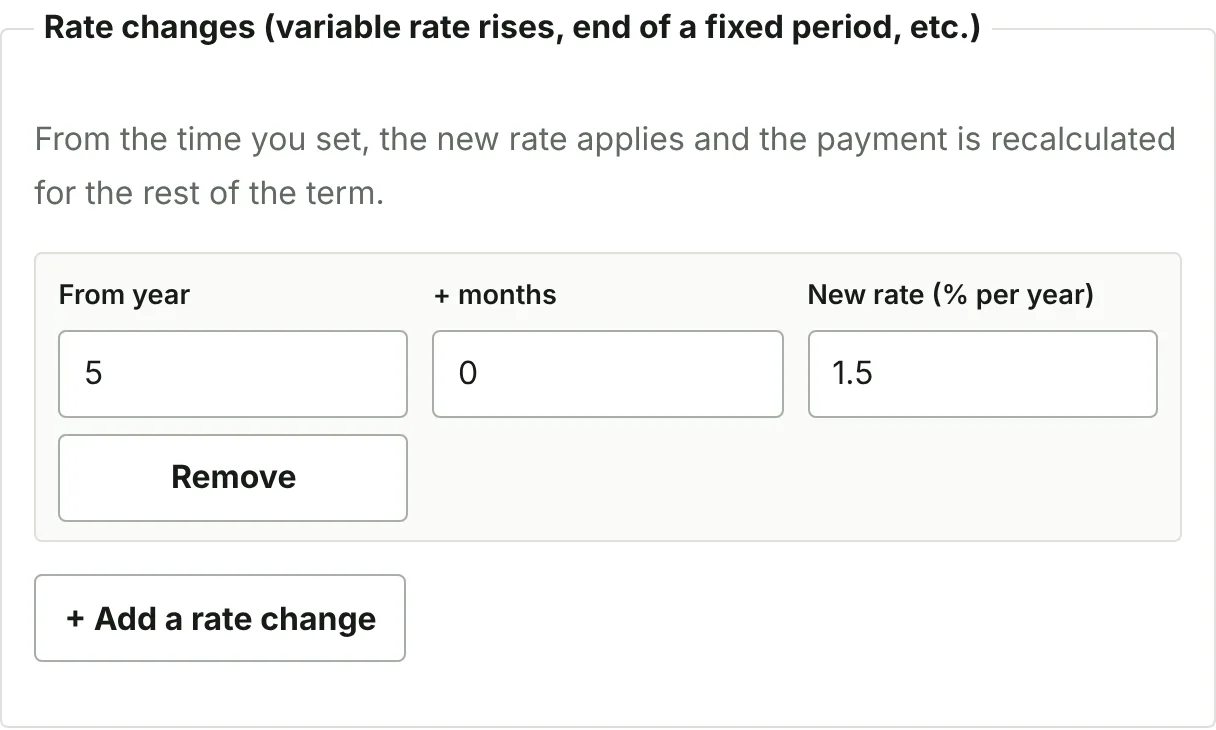
With a variable-rate loan, the effect of an extra payment also depends on how the rate moves. Variable-rate mortgages are the most common kind in Japan. Here, take ¥30 million at 0.5% over 35 years, with the rate rising to 1.5% after five years. Click “+ Add a rate change” and enter 5 in “From year”, 0 in “+ months” and 1.5 in “New rate (% per year)”.
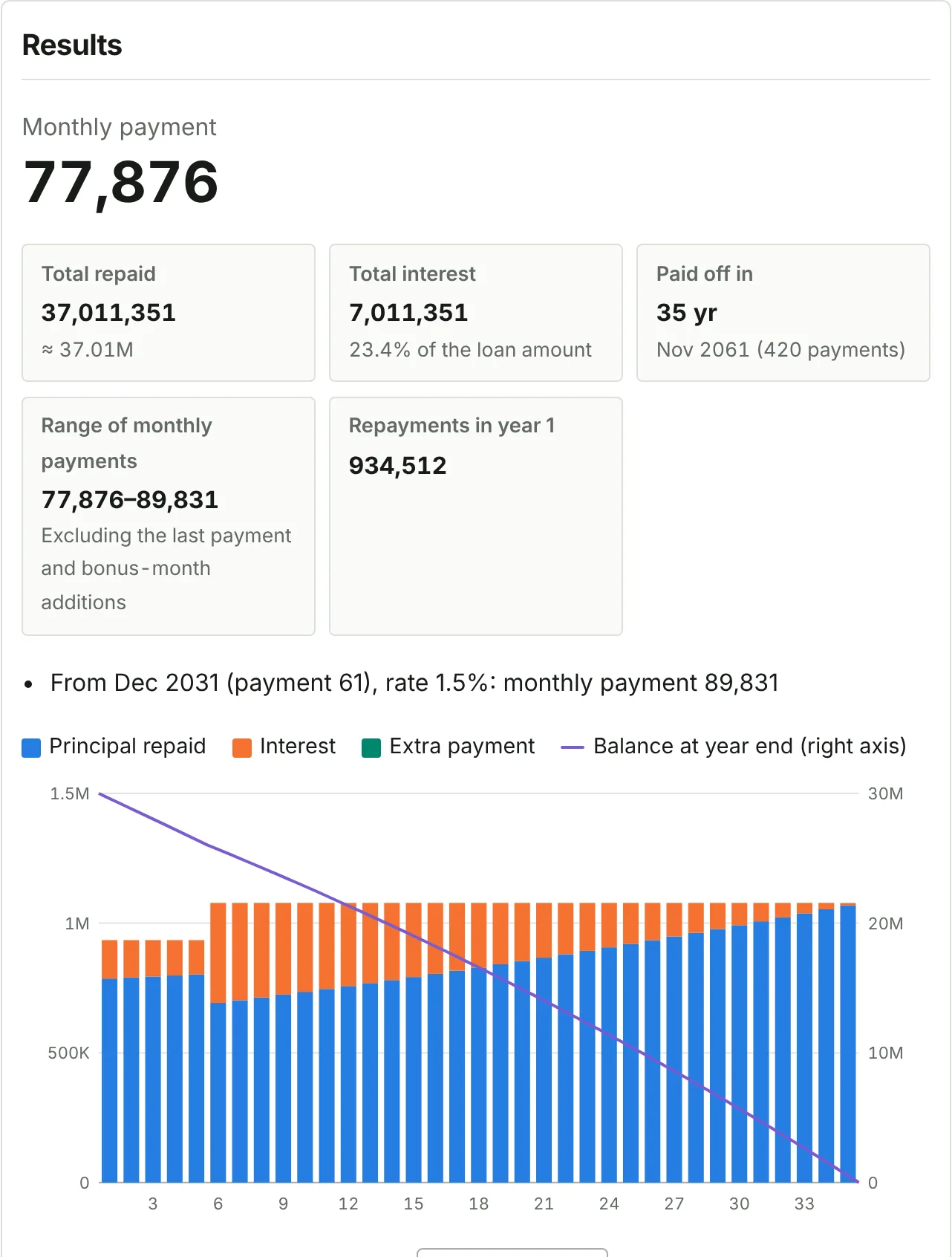
The monthly payment starts at 77,876 and rises to 89,831 from payment 61, an increase of 11,955 a month. Total interest, 2,707,511 if the rate stayed at 0.5%, becomes 7,011,351 under these conditions.
Add a ¥1 million extra payment just before the rate rises (after five years), and you get the following.
| Extra 1 million after 5 years | Monthly payment from payment 61 | Paid off in | Total interest | Interest saved |
|---|---|---|---|---|
| None | ¥89,831 | 35 years | ¥7,011,351 | — |
| Shorten the term | ¥89,150 | 33 years 10 months | ¥6,517,898 | ¥493,453 |
| Lower the payment | ¥86,380 | 35 years | ¥6,768,898 | ¥242,453 |
With “Lower the payment”, the payment after the rate rise is 86,380 instead of 89,831, so the jump is smaller. With “Shorten the term”, the payment also comes down a little, to 89,150. This is because, in the month the rate changes, the calculator recalculates the payment from the balance at that point and the remaining term (the shortened term, in that case).
Many Japanese variable-rate mortgages, however, have a “five-year rule”, under which the monthly payment is only reviewed every five years, and a “125% rule”, under which a reviewed payment may not exceed 1.25 times the previous one. Loans in other countries can have their own payment or rate caps. The calculator applies none of these and recalculates the payment in the month the rate changes. With such rules, less of each payment goes to the principal while the payment is frozen, so the payments change differently from this example. Check the rules of your own loan in the contract or the lender’s schedule.
Things to check before you rely on the numbers
Japan’s mortgage tax credit and its 10-year condition
This section applies to borrowers in Japan. Japan’s mortgage tax credit (住宅ローン控除, officially the special credit for housing loans) reduces income tax by a percentage of the year-end loan balance, and it is only available for loans with a repayment period of 10 years or more. According to the National Tax Agency’s Q&A “Repayment period after an early repayment” (in Japanese), if a “shorten the term” prepayment shortens the repayment period, you can keep the credit as long as the period from the first repayment month under the original contract to the last month of the shortened period is still 10 years or more. If it falls below 10 years, you lose the credit from that year on. Paying ¥1 million off a 35-year loan is no problem, but if you pay a large amount with “shorten the term” when little time remains, check this period first.
Because the credit is based on the balance at the end of each year, a lower balance after an extra payment also means a smaller credit. Other countries treat mortgage interest differently for tax purposes (some allow it to be deducted, many do not), so look up your own country’s rules.
What the results leave out
The calculator does not include prepayment fees, refunds of guarantee fees, or the group credit life insurance that Japanese mortgages usually carry. Each month’s interest is “balance × annual rate ÷ 12”, rounded down to the whole yen, so results can differ by a few to a few thousand yen from lenders that charge interest daily. If you compare with your own schedule, first check that the result without an extra payment matches; that makes it easier to see where any difference comes from.
Remember, too, that money you prepay does not come back. If you put money you need for emergencies, or for education costs coming up soon, into the loan, you may end up having to borrow again. People choose “Lower the payment” when reducing what goes out each month matters more to them than saving interest.
Keeping the conditions you calculated
With your conditions entered, click “Copy URL with these conditions” to copy a URL that contains the loan amount, rate, rate changes and extra payments. Open that URL when discussing it with your family, or when reviewing the same conditions a year later, and the same results appear. “Save as CSV” saves the schedule shown in a format Excel can open.
If you want to compare prepaying with keeping the money and investing it, the Compound Interest Calculator can work out what the same amount would grow to. How to use it, and how taxes and fund fees affect the result, are explained in “How Much Does ¥30,000 a Month Grow to in 20 Years?”.