Heider’s balance theory and the P–O–X triangle
Use plus and minus signs to map how you and a friend feel about baseball and see which change would balance the triangle.
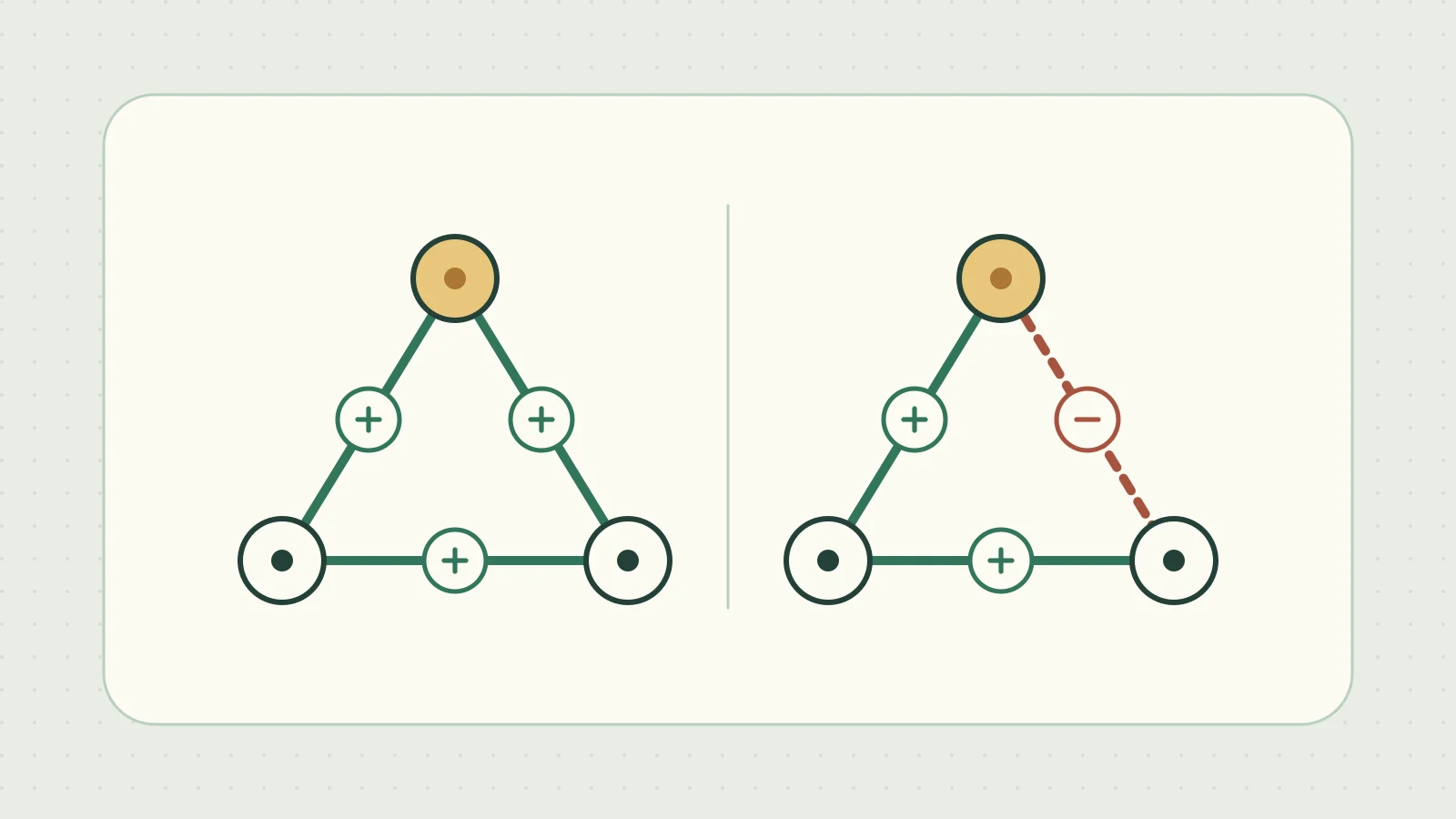
A close friend is happily talking about baseball, a sport you have never particularly enjoyed. You like your friend, so you would like to understand their enthusiasm. But if someone asked whether you like baseball yourself, your answer for now would be no.
Fritz Heider’s balance theory treats this situation as a combination of three relationships. Let P stand for you, O for the other person, and X for the topic or object. Signs represent liking or evaluation. Heider’s paper also discusses relationships that make two things seem like a unit, such as a person and an event they caused. Heider’s original paper (1946)
Assigning signs to the sides of P–O–X
- P → O is how you feel about the other person.
- P → X is how you evaluate the object.
- O → X is how you think the other person evaluates the object.
Use “+” for liking or approval and “−” for dislike or disapproval. In a simple triangle with one sign per side, a positive product is balanced and a negative product is unbalanced. For example, when you like someone and you both enjoy the same topic, all three signs are positive. A triangle with two negative sides also counts as balanced under this rule. Cartwright and Harary’s paper on structural balance (1956)
| P → O | P → X | O → X | Result |
|---|---|---|---|
| + | + | + | Balanced |
| + | − | − | Balanced |
| − | + | − | Balanced |
| − | − | + | Balanced |
| + | + | − | Unbalanced |
| + | − | + | Unbalanced (baseball example) |
| − | + | + | Unbalanced |
| − | − | − | Unbalanced |
When you and a friend disagree about baseball
In the opening example, your feelings toward your friend are positive, your feelings toward baseball are negative, and your friend’s feelings toward baseball are positive. The product of the three signs is negative, so the triangle is unbalanced.
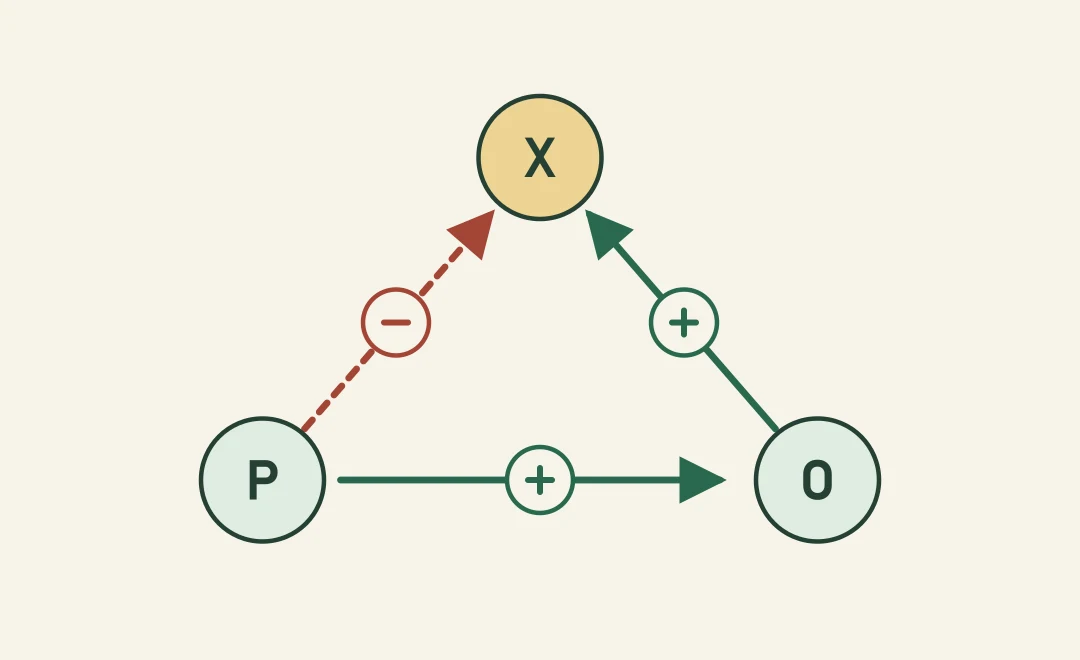
If just one side changes, there are three routes to balance.
- You start enjoying baseball after watching games together. P → X becomes positive.
- As you listen, you discover that your friend actually dislikes baseball itself. Your perception of O → X becomes negative.
- Your conversation about baseball changes how you feel about your friend. P → O becomes negative.
People can stay friends despite differing tastes. You can leave a sign undecided when you know little about a person or have limited interest in a topic. If an interaction feels off, writing down your feelings about the person and about their interests on separate sides can help you notice where you made an assumption.
Redrawing the triangle from the other person’s perspective
Suppose two people meet and discover that they both like baseball. Even if you let the other person be P and yourself be O, both sides pointing toward baseball are positive. Leave the other person’s feelings about you undecided until later interactions give you some clues.