From one employee's GitHub account to customer data: closing the development-platform back door exposed by the 1Password breach
In November 2026, 1Password disclosed that attackers compromised one employee's GitHub account, got into its CI/CD and backend, and took customer names and email addresses. Using GitGuardian's secrets-leak statistics and IPA's Top 10 Information Security Threats as reference points, this article analyzes why repository write access becomes a key to production and what both SaaS customers and development organizations should review.
Contents
Summary
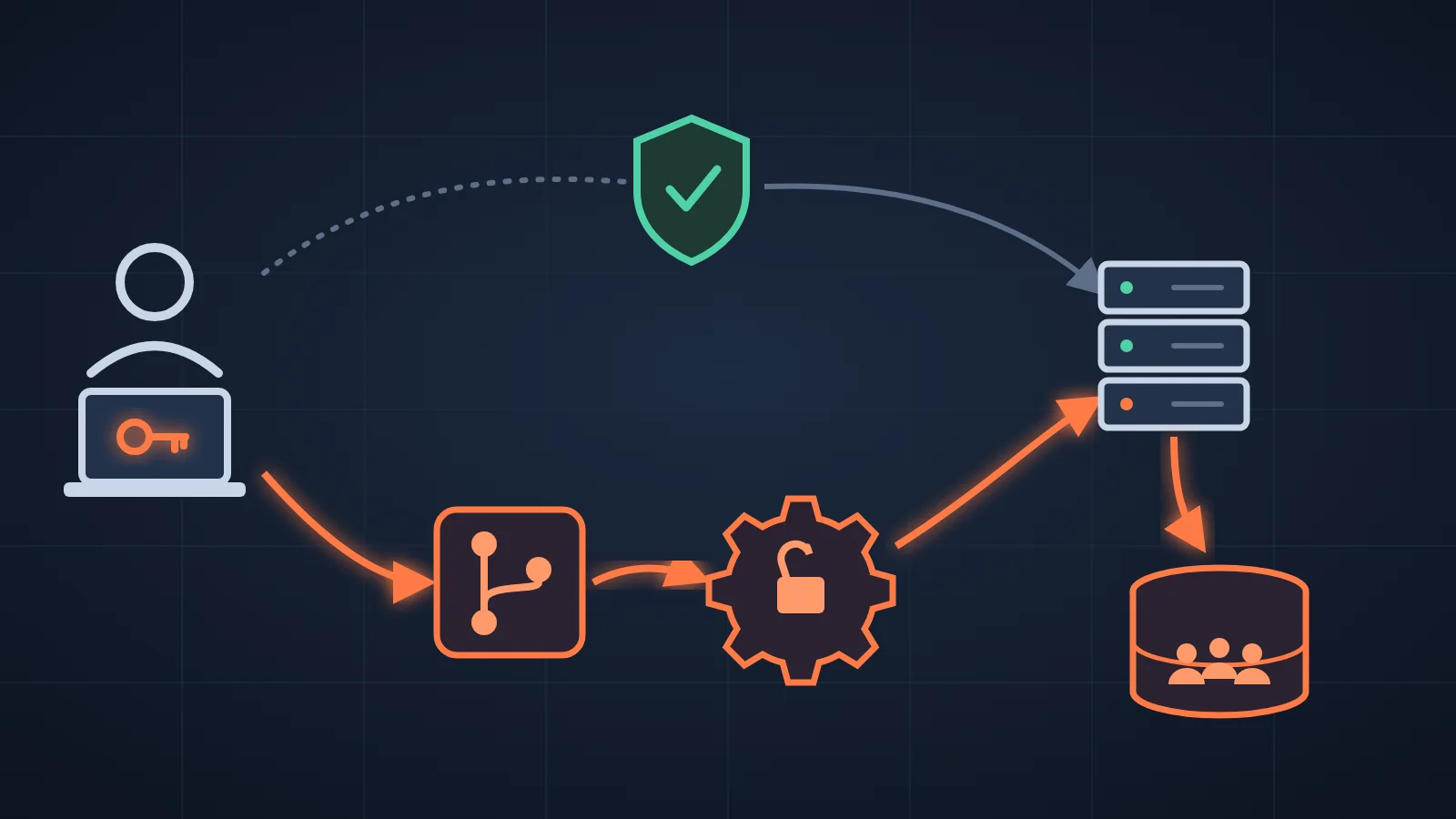
In November 2026, the password manager 1Password disclosed that one employee’s work GitHub account had been taken over and used to get into its CI/CD and backend. Vault contents were safe, but some customers’ names, email addresses, account identifiers and other data were taken. What stands out is that the entry point was not a production server but a developer’s account. People who can write to a repository can often reach secrets and the production environment through workflows. It is time to check, both in your own organization and at your vendors, whether the development platform is protected as seriously as production.
What happened: the way in was a single employee’s GitHub account
First, let us sort out what is known and what is not. The following is based on reports published on 26 November by The Hacker News, Help Net Security and The Register, and on 1Password’s statement as quoted by them.
On 19 November, 1Password began investigating signs that an attacker had accessed an employee’s work GitHub account. The attacker cloned source code from private repositories, also got into the CI/CD system, and pushed unauthorized code to backend services. That code downloaded customers’ account management data. The items listed as taken are:
- Names and email addresses used with 1Password
- Account and user identifiers, creation times and last sign-in times
- Public keys and SRP (Secure Remote Password) authentication parameters
- Tokens contained in invitation, provisioning and account recovery emails (for some users)
On the other hand, 1Password says vault contents, passwords, Secret Keys and recovery keys were not accessible to the attacker. 1Password disabled the compromised account, revoked the stolen tokens, rotated its CI/CD secrets and restored the affected backend to a clean version. Invitation and recovery codes were lengthened from six digits to ten alphanumeric characters. Users have not been asked to take any action on their accounts.
How the account was taken over, how long detection took, how many people were affected and why a GitHub account could reach customer data have not been disclosed. Even so, the incident showed that the distance from “one employee’s development account” to “customer data” is shorter than one might think. The next section looks at the mechanisms that make that distance so short.
If you can write to the repository, you can reach production
Details of 1Password’s intrusion path have not been published, so what follows is an explanation based on typical GitHub and CI/CD setups. It does not claim that this path was actually used in this incident.
With systems such as GitHub Actions, the workflow definition files live inside the repository. To run tests, build images and deploy to the cloud, workflows are given cloud credentials, container registry tokens, signing keys and the like as “secrets”. Secrets cannot be read from the UI, but they can be used inside workflows. As a result, in many setups anyone who can create a branch and modify a workflow can run jobs that use those secrets.
This is the weak spot. Even if logging in to production servers requires multi-factor authentication and an approval flow, writing to the same production environment is possible through a different door: “pushing to the repository”. And dozens of developers walk through that door every day.
This door had been used before 1Password. In March 2025, the widely used GitHub Action tj-actions/changed-files was tampered with, leaving workflows that used it writing secrets into their build logs (CVE-2025-30066). The worm “Shai-Hulud”, which spread through npm, also collected credentials from developer machines and CI and used them to spread to further packages. For attackers, the development platform is a place less well guarded than production where the keys to production are kept.
The defensive techniques already exist.
- Do not keep long-lived keys: With GitHub Actions’ OIDC integration, you can issue a short-lived token for each run without storing cloud credentials. If you restrict issuance by repository, branch and environment, a branch someone created on their own cannot obtain production permissions.
- Confine production secrets to environments: Keep secrets for production deployment in protected environments rather than at repository level, and specify approvers and the branches allowed to deploy.
- Put workflow changes under review: Require code owner review for changes to workflow definitions, and pin third-party Actions to commit hashes rather than tags.
- Reduce the permissions of personal accounts: Cut down long-lived personal access tokens and move to tokens limited to specific repositories and permissions, and to phishing-resistant authentication such as passkeys.
None of this is new technology. The problem is that it has not been retrofitted to existing repositories.
Leaked secrets live long, and development platforms are targeted
How widespread are such holes, then? Since the internals of individual companies cannot be seen from outside, published leak statistics give a sense of scale.
According to “The State of Secrets Sprawl 2026”, published in March 2026 by GitGuardian, a provider of secret-detection tools, 28.65 million new hardcoded secrets were committed to public GitHub in 2025, up 34% from the previous year. Internal repositories are about six times more likely than public ones to contain secrets, the report says. Furthermore, when credentials confirmed as valid in 2022 were rechecked in January 2026, more than 64% were still valid. In other words, keys leaked once remain usable for years. In the company’s analysis of 6,943 machines affected by Shai-Hulud 2, 59% were CI/CD runners rather than individual workstations.
These are the vendor’s own figures, so the absolute values should be read with some latitude, but the direction is clear: secrets are scattered across development platforms and left unrevoked, and attackers are targeting CI.
The view in Japan points the same way. IPA (the Information-technology Promotion Agency, a Japanese government agency) publishes an annual “Top 10 Information Security Threats” list, and in the 2026 edition for organizations, “attacks targeting the supply chain and contractors” ranks second, behind ransomware attacks. A compromise of the development platform is not only a way into your own company but also a way to attack the customers who use your products.
What it means for customers: the criteria for choosing SaaS change
So far we have looked at the development side. What does this incident mean for those who use SaaS products, including 1Password?
First, the leaked names and email addresses, together with the fact that “this person uses 1Password”, are phishing material on their own. The Register also urges caution about emails posing as invitations or recovery messages. Companies that use 1Password Business across the organization would do well to tell employees that “invitations and recovery messages claiming to be from 1Password only come via your administrator”.
Second, vendor assessment. Traditional security questionnaires have focused on how the production environment is managed, but given a path like this one, you cannot gauge a vendor’s real strength unless you also ask about “how developer accounts are authenticated”, “how CI/CD secrets are managed”, “how workflow changes are reviewed” and “whether build artifacts are signed”.
The Register points out that this incident resembles the first stage of the 2022 LastPass breach. At LastPass, a second attack that used information stolen from the development environment as a foothold went on to take backups of encrypted vaults. When a development environment is compromised, you need to see through whether it has become a foothold for the next attack.
On the other hand, 1Password’s design, which encrypts vaults with keys held only by users, kept the contents unreadable even though the servers were breached. Building a structure in which an intrusion does not become a fatal wound overlaps with the idea of zero trust.
What to check in your own organization
What, then, should organizations that develop and operate their own software check? Rather than adding to checklists, it is quicker to see whether you can answer the following questions.
- Whose account would an attacker need to take over to reach production?: List the workflows with production deployment permissions and count the people who can modify them. Include accounts of outside contractors.
- Are long-lived keys left in CI?: Replace whatever cloud credentials, registry tokens and signing keys can be replaced with OIDC or short-lived tokens.
- How many minutes would it take to stop a leak?: Actually rehearse disabling a developer account and rotating all related secrets at once. This is also what 1Password did first.
- Are CI operations logged?: Correlate GitHub’s audit log with cloud-side logs so that you can trace afterwards which workflow run used which permissions.
In organizations that give AI agents permissions on repositories or CI, the agents’ accounts fall within the scope of these questions too. The need for per-agent identities and logs was also touched on in an article on measuring the effect of generative AI and shutting agents off (in Japanese). The same GitGuardian report also shows that commits assisted by Claude Code had a secret leak rate of 3.2%, higher than the 1.5% for public commits overall.
Where this view is weak
So far this article has stressed the dangers of development platforms, but some points call for a discount.
First, the intrusion path in this incident has not been disclosed. Whether it was phishing, malware on a machine or a leaked token changes which countermeasures work. The technical explanation in this article is based on typical setups and does not claim to describe 1Password’s internal configuration.
Next, the cost of countermeasures. Environment separation per workflow, moving to OIDC and mandatory change review slow development down. If a small team demands the same strictness for every repository, developers will look for workarounds. Being strict only about the workflows that reach production is probably the realistic approach.
Furthermore, the damage this time did not extend to vaults. Deciding to switch products on the strength of headlines alone is premature, and there is no guarantee that the alternative’s development platform is any more robust. What should be evaluated is the speed of containment and disclosure and the quality of the explanations that follow, but while the intrusion path and the number of affected people remain undisclosed, that evaluation can only be provisional.
The outlook for the next three years
The following is not confirmed fact but conjecture from the material above.
- Procurement and audits: SaaS security assessments will come to include, as standard, questions about how developer accounts are authenticated and how CI/CD secrets are managed. I also expect growing demand for mechanisms that show build provenance (ideas such as SLSA).
- Fewer long-lived keys: Authentication from CI to the cloud will move further from stored keys to short-lived tokens such as OIDC. Conversely, organizations that keep long-lived keys will become easier targets.
- Agent permissions: As more AI agents write code and open PRs, I think identity management on development platforms will move toward handling people and agents within the same framework.
The author’s view
What I find most thought-provoking about this incident is that even a company whose core business is password management, and which designs its vaults on a zero-knowledge basis, let its development platform reach customer data. However strong a product’s cryptographic design is, protecting the process that builds and distributes it remains a separate problem.
In many companies, production is managed by infrastructure or security teams, while GitHub and CI are treated as the development team’s tools. From an attacker’s point of view, however, write access to a repository is simply one of the keys to production. Manage the development platform not as a “convenient tool” but as “part of production”, with the same level of authentication, permissions and logging. There is no need to wait for the intrusion path in this incident to come to light; I think it is enough to start by counting, in your own organization, “whose account would an attacker need to take over to reach production”.
References
- The Hacker News, “1Password Hacked, Customer Data and Source Code Stolen in GitHub Account Breach”, 26 November 2026
- Help Net Security, “1Password breached through hijacked employee GitHub account, customer names and emails stolen”, 26 November 2026
- The Register, “Hackers help themselves to 1Password’s source code and customer data”, 26 November 2026
- 1Password’s incident report on its official blog (cited by the three reports above): https://1password.com/blog/update-on-nov-2026-security-incident
- GitGuardian, “The State of Secrets Sprawl 2026”, 17 March 2026
- Information-technology Promotion Agency, Japan (IPA), “Top 10 Information Security Threats 2026” (in Japanese), 29 January 2026