Five-team round robin on one court: match order for two rounds without back-to-back games
Of the 3,628,800 orders for ten games, 240 avoid consecutive appearances. See why none can repeat unchanged, and use a two-round schedule with one or two games off between appearances.
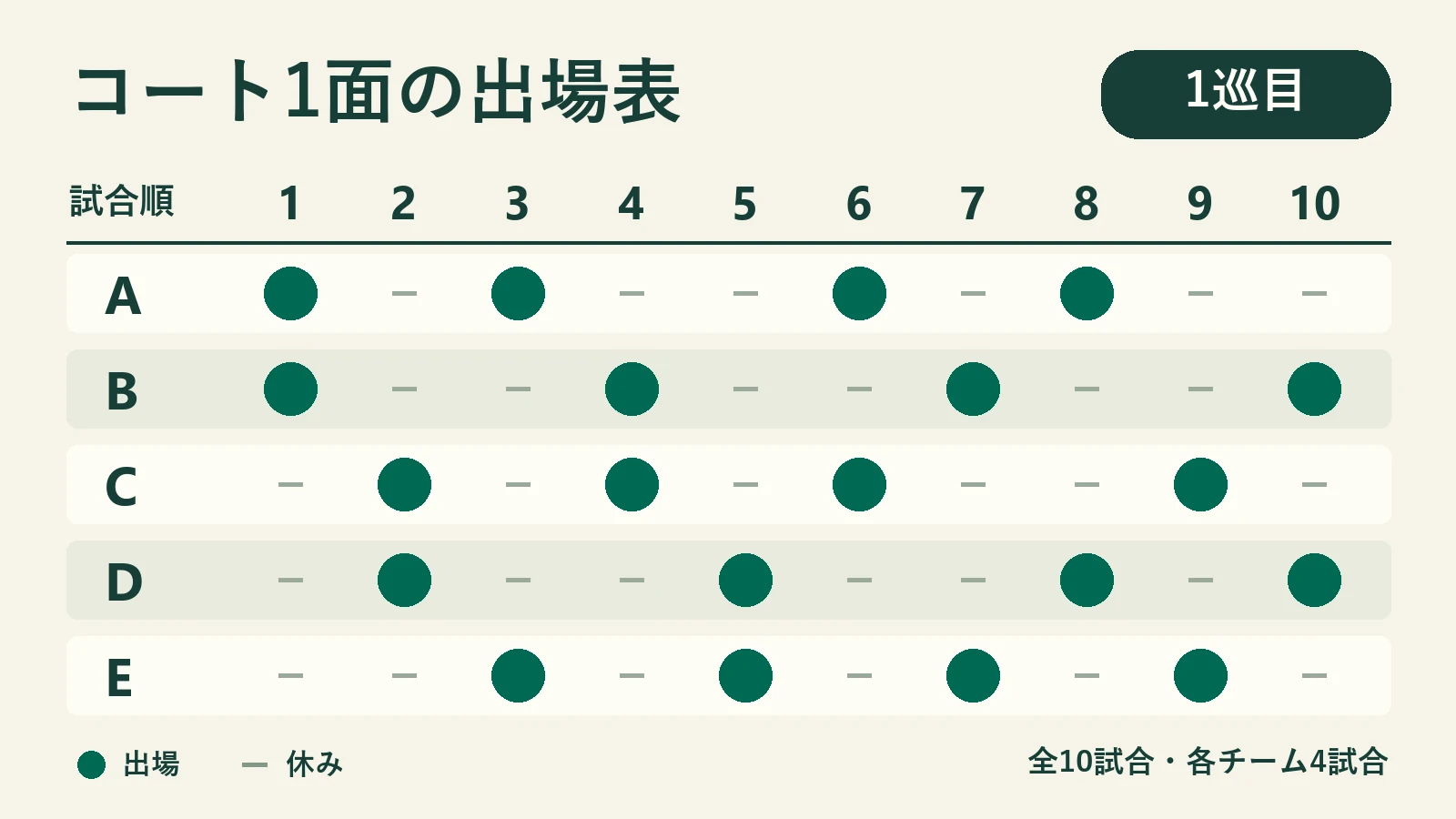
We booked one court for five teams. Call A vs C just after A vs B and A has to stay on court. We want everyone to get at least one game off before playing again.
The first ten games below give everyone a break. If we call for another round in the same order, though, B appears at the end and again at the top. Could a better ordering repeat as it stands?
A match order you can use
Assign A–E to the teams. Read round 1 from top to bottom, then move to the top of round 2 if playing twice. Use one court for one game at a time. Each team plays every other team once per round.
| Game in round | Round 1 | Round 2 |
|---|---|---|
| 1 | A–B | A–E |
| 2 | C–D | C–D |
| 3 | A–E | A–B |
| 4 | B–C | C–E |
| 5 | D–E | B–D |
| 6 | A–C | A–C |
| 7 | B–E | B–E |
| 8 | A–D | A–D |
| 9 | C–E | B–C |
| 10 | B–D | D–E |
Open the 20-game schedule as CSV. It lists games 1–20 in calling order. Replace A–E in the last two columns with your team names. The shared file has Japanese column headers.
In round 1, B plays in games 1, 4, 7 and 10, with two games off each time. E plays in 3, 5, 7 and 9, with one off. Rest here is counted in intervening games. Minutes of rest vary if game lengths vary.
For a different number of teams or playing areas, use the round-robin planner. Set game and changeover lengths, daily venue hours and the lunch break to estimate how many days the schedule takes.
Trying to repeat all 240 orders with no consecutive appearances
After A–B there are only three choices, pairing two teams from C, D and E. If you choose C–D, only A–E and B–E remain next because A–B is used. Making a valid choice now does not guarantee a good final game.
I used Python to test all 3,628,800 permutations of ten games, treating A–B and B–A as the same pairing and counting each order with its team labels. 240 shared no team at any of the nine consecutive steps. Zero also avoided overlap from game 10 back to game 1.
Repeating the same round always leaves exactly one team on court. Two teams in common would mean the first and last matches were identical, which cannot happen in one round robin.
Count all 3,628,800 orders yourself with Python
Tested with Python 3.12.14. Save as draw.py and run python draw.py in the same folder. The output reports 3,628,800 total orders, 240 with no consecutive appearances and 0 repeatable unchanged. No external packages are needed.
from itertools import combinations, pairwise, permutations
from math import factorial

teams = "ABCDE"
games = ["".join(pair) for pair in combinations(teams, 2)]
next_games = {g: {h for h in games if set(g).isdisjoint(h)} for g in games}
valid = repeatable = 0
for order in permutations(games):
    if all(b in next_games[a] for a, b in pairwise(order)):
        valid += 1
        if order[0] in next_games[order[-1]]:
            repeatable += 1

print(f"全順序 {factorial(len(games)):,} / 連戦なし {valid} / 同順で周回可能 {repeatable}")
Represent each game as a vertex and connect pairs with no team in common. The resulting ten-vertex Petersen graph has a path visiting each vertex once but no cycle that also returns to its start. A. E. Brouwer’s Petersen graph reference
Why round 2 swaps B and E
Round 1 ends with B–D. Swap the letters B and E throughout round 2 and it begins A–E, so both B and D rest. Each team still faces four opponents and avoids consecutive appearances within the round.
Swapping B and C would also prevent back-to-back games, but E would wait from game 9 to game 13, three games off. Swapping B and E lets E sit out game 10 and return for game 11. Across all 20 games, everyone waits one or two games between appearances.
Game 20 ends with D–E, so even a return to A–B introduces no consecutive appearance. Alternate these two columns as long as your court booking allows.